
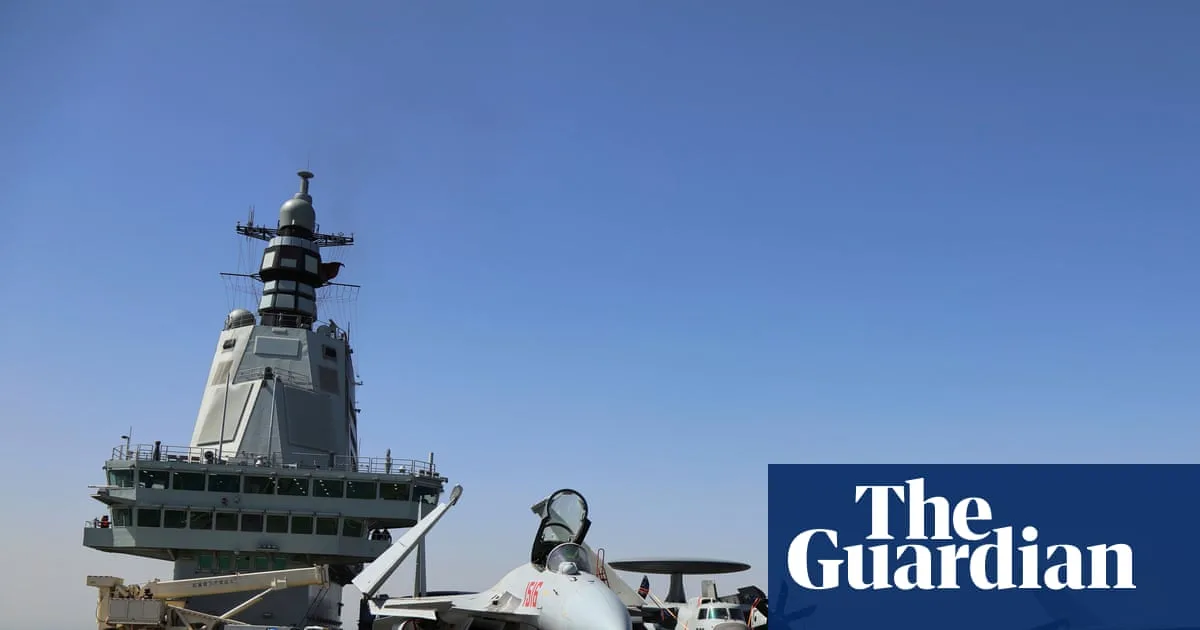
China's most advanced aircraft carrier, the Fujian, has formally entered service, marking a milestone in the country's naval expansion. The ceremony was overseen by President Xi Jinping, according to state media.
The Fujian is China's first domestically designed and built aircraft carrier and the third for its rapidly expanding navy, which already has the world's largest fleet by ship count. It features an electromagnetic launch system that reduces stress on aircraft and the ship, allows more precise control over speed, and can launch a wider range of aircraft than the steam systems used on most US carriers.
The vessel joins the Soviet-designed Liaoning and the Soviet-designed but Chinese-built Shandong, giving China the second-highest number of carriers globally, behind the United States with 11 and ahead of the UK, India and Italy, which each have two. The electromagnetic launch system enables the deployment of heavier aircraft, such as the KJ-600 early warning and control plane, and supports faster fighter jet sorties.
China's navy says it launched the J-35 stealth fighter and J-15T heavy fighter from the Fujian, providing 'full-deck operation capability'. However, US military analysts note the Fujian's configuration does not match newer US carriers as it does not appear to allow concurrent takeoffs and landings, though its electromagnetic launch system is found only on the latest US Navy Ford-class carriers.
Experts say the carrier is central to China's ambition to operate as a blue-water navy. Greg Poling of the Center for Strategic and International Studies noted that carriers are key to projecting power in the wider Indo-Pacific. Raymond Kuo of the Rand Corporation observed that while US carriers are more capable, they are increasingly vulnerable to anti-ship missiles, and lighter carriers can offer advantages. He added that China's third carrier severely complicates Taiwan's defensive plans, which have long relied on relocating aircraft to the east coast.




