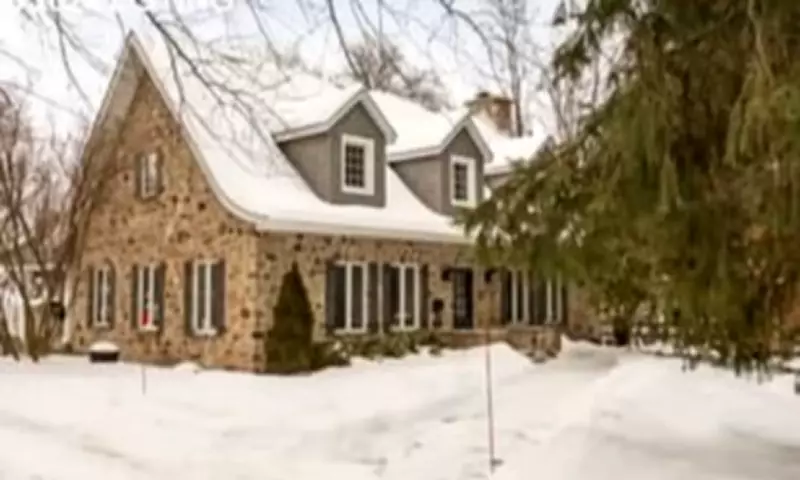
The owner of a picturesque stone cottage in Quebec has initiated legal proceedings against the former occupant, alleging that the violent death which occurred within the property was deliberately concealed. According to court documents obtained by CTV News, the previous proprietors of the $1.6 million Canadian home—equivalent to approximately $1.2 million US—were harbouring a grim secret.
Property's Dark History
Situated in the scenic town of Hudson, mere steps from the Ottawa River, the tranquil environment and charming facade of the residence mask a troubling past. Six years ago, Normand James, a 52-year-old man diagnosed with schizophrenia, perished after breaking into the house. The homeowner, a woman in her forties, fatally stabbed him ten times in an act of self-defence while her three children were present inside. Police questioned her on the day of the incident, but she was subsequently released without charges.
A coroner's investigation determined that James attempted to flee following the violent confrontation but collapsed outside the home near the front entrance. He was later pronounced dead at a hospital.

Purchase and Lawsuit
In April 2024, the property was acquired for just under $1.6 million CAD by its current owners, who claim they were unaware of the bloodshed that had taken place. The unnamed homeowners have filed a lawsuit against the previous occupants, seeking $425,000 in damages. They assert that the sellers failed to disclose James's death on the mandatory seller's declaration.
"If the plaintiffs had been informed of this violent death ... and the tragic circumstances of this widely publicized tragedy in a timely manner, they would not have purchased the property or paid the asked price," the lawsuit states.
Expert Opinions
Real estate broker Mark-Andre Martel, who is not involved in the case, noted that properties with a history of violent death or suicide typically see a price reduction of 10 to 15 percent. "Ultimately, when you have that type of disclosure it diminishes the pool of buyers for any given property. And if you have less buyers, well then the price will be lower as well," Martel explained to CTV News.
The new owners are aiming to recover 25 percent of the purchase price plus additional damages. They are also suing the sellers' listing agent for $25,000. The listing agent, whose name has not been disclosed, argued in her defence statement that the sellers did declare the death. "The seller's declaration … accurately described the incident … it would have been incorrect to indicate in that declaration that [the intruder's] death occurred on the property, as no evidence supports such a conclusion," she wrote.
In the declaration, the previous owners noted an "intrusion / altercation" but answered "no" to the question of whether a violent death or suicide had occurred inside the home, citing that James may have died outside or in the hospital.
Legal Grey Area
Real estate lawyer Maxime Laflamme, unaffiliated with the case, highlighted the ambiguity: "If I get in a car crash but I die in the hospital, did I die in the hospital or in a car crash? It's a little bit that the paradox of the event occurred in the home, but a consequence occurred outside of it." He suggested the case outcome hinges on whether the judge deems the sellers should have been more transparent or if the buyers bore responsibility for due diligence. "It's probably going to be this kind of tug-of-war between where the seller is entirely forthcoming. And did the buyers inquire enough?" he said.
The intruder had a prior history of mental illness and had previously been charged with attempted murder of a police officer. The woman who stabbed him was not charged in connection with his death.