
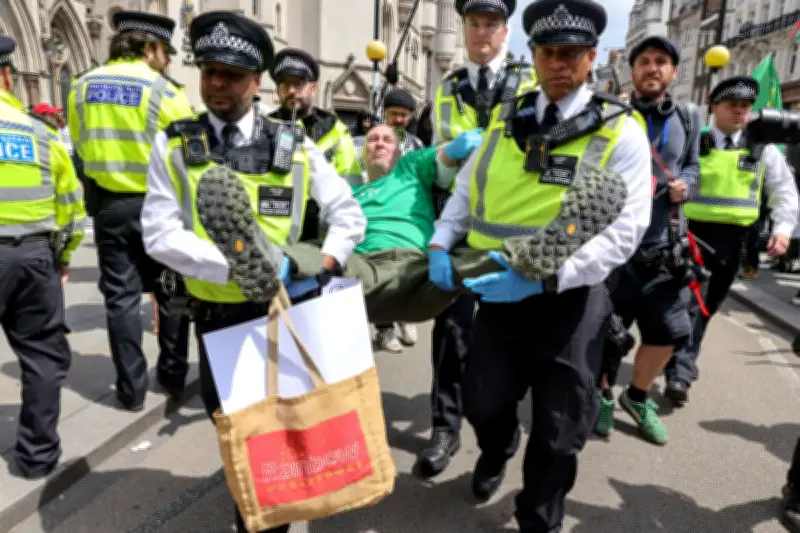
Letters to the editor respond to the court of appeal's decision to uphold the British government's ban on the Palestine Action movement, with readers raising concerns about government bias, legal flaws, and the erosion of protest rights.
Government Bias and the Ban
Tony Booth of Cambridge writes in response to George Monbiot's recent article, highlighting what he sees as government bias in attributing terrorism to disruptive action. Booth takes issue with the simplification of the decision to ban Palestine Action, noting that former Home Secretary Yvette Cooper's decision may have been influenced by factors beyond the spray-painting of warplanes. He points to the group's protest at Donald Trump's Turnberry golf course in March 2025, where they spray-painted "Gaza Is Not 4 Sale" and daubed a building with red paint. Trump later claimed that Prime Minister Starmer had informed him that the "terrorists" who attacked Turnberry had been caught, calling for them to be "treated harshly." Booth suggests Starmer's eagerness to please Trump may have influenced the decision, including promises to increase defence spending, defund Unrwa, and reduce international aid.
Booth further argues that the proscription order linked Palestine Action to two violent, racist groups—Maniacs Murder Cult and Russian Imperial Movement—with no known activity in the UK. He has asked 15 police officers if they have arrested anyone involved with Maniacs Murder Cult, and none had heard of it. He believes parliament might not have voted to ban Palestine Action without this dubious connection. Booth criticises the court of appeal judgment, which he says smoothed over these details and gave the decision a dubious rationality, making the UK a European outlier in suppressing protest.
Legal Flaws and Historical Ignorance
Louise Christian of London describes the court of appeal judgment as "seriously flawed," noting that it does not consider whether the manufacture of arms by Elbit Systems for use in genocide in Palestine could be unlawful, blandly describing all its activities as lawful. She points out that there is no reference to the UN commission of inquiry or the International Court of Justice's provisional finding that Israel committed genocide in Palestine. Christian argues that this wilful blindness to legal context is matched by a shocking ignorance of history, comparing Palestine Action's property-focused protest to that of the suffragettes and anti-apartheid protesters, who were arguably more violent yet are now celebrated. She expresses sadness and bewilderment that senior judges got things so wrong, and hopes the Supreme Court will better understand the threat to all protest that does not harm people, which many consider essential to democracy.
Impact on Protest Rights
One reader, who has been charged under section 13 of the Terrorism Act for holding a piece of paper supporting Palestine Action, emphasises two key points. First, the suffering of the Palestinian people in Gaza and the West Bank should remain the primary focus. Second, the restrictions on protest rights in the UK stem from the Terrorism Act 2000, which extends beyond international definitions of terrorism and puts fundamental freedoms of expression and association at risk. The reader argues that the treatment of Palestine Action activists and their supporters all stem from this act, and it must be amended to halt the slide into authoritarianism.
These letters collectively highlight concerns about the government's motives, the legal basis for the ban, and the broader implications for protest rights in the UK.




