
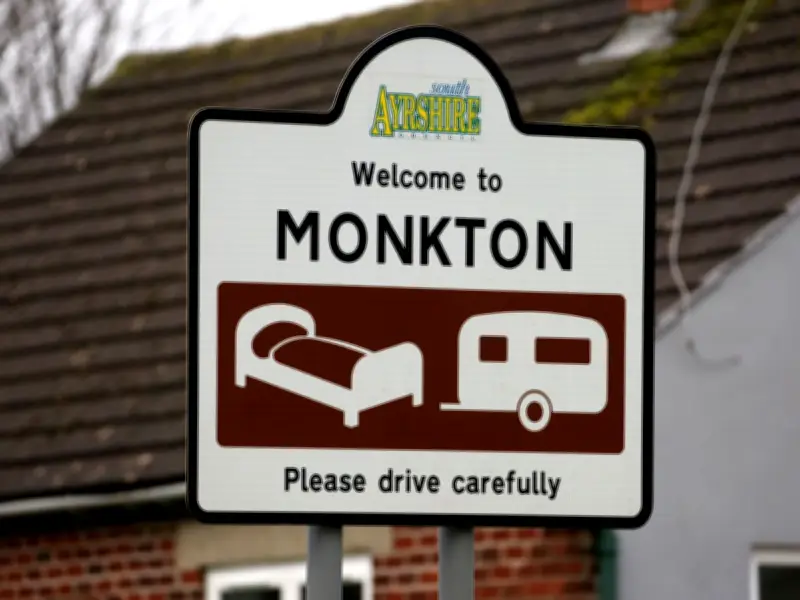
The reclassification of the Ayrshire village of Monkton to town status has been branded “a piece of nonsense” by a local resident, Harry Middleditch, who argues that the settlement lacks basic amenities expected of a town.
Population Growth Triggers Reclassification
Monkton’s village status was re-designated to ‘town’ following a population growth that took it above the 1,000-resident threshold. The announcement by Scotland’s Towns Partnership (STP) followed research involving the latest version of Understanding Scottish Places (USP), a platform offering insight into the social and economic dynamics of towns across Scotland.
STP, the national body for Scotland’s town centres, worked with the University of Stirling, supported by the Scottish Government, to expand the USP dataset. The data shows Monkton has “evolved significantly” from its historical roots in spinning and corn milling, with its proximity to Prestwick Airport shaping its modern identity around aircraft maintenance industries.
Resident Dismisses Reclassification
Harry Middleditch, a Monkton resident of 40 years, said: “Monkton hasn’t changed in 40 years that I’ve been here. We don’t have a doctors, we don’t have a dentist, we’ve not got a pub, we’ve got nothing! And it’s taken us seven years just to get a chemist and it’s only been open for a year and a bit. Monkton is a simple dormitory for other places like Glasgow. South Ayrshire Council have done nothing for us.”
He argued that if Monkton were truly a town, it would have standard amenities: “If we were a town, why do we not have the amenities of a town? We don’t even have a pub because the Brewers Fayre is shut. Apart from four shops we don’t have anything.”
Another Village Gains Town Status
Joining Monkton in reclassified town status is Lamlash, on the Isle of Arran. Lamlash serves as a summer ferry link to Argyll, is situated within a marine protected area, and has a population larger than Brodick, supporting both residents and visitors.
Kimberley Guthrie, STP’s Chief Officer, said: “The comparison tool is one of the most exciting elements of USP, allowing towns to immediately compare themselves with similar places. That means these places can learn from each other - potentially demonstrating the art of the possible when it comes to regeneration. USP supports organisations of all kinds to understand how places across Scotland are similar, emphasising shared characteristics and opportunities to build knowledge on their local context. The data often highlights unseen or unrecognised challenges and opportunities which can inform planning, management and policy decisions.”
Net Gain of 29 Towns Across Scotland
Across Scotland, there has been a net gain of 29 towns since the first USP compilation: 508 places with a population of more than 1,000, compared to 479 in 2014. The USP data uses the most recent census results as its foundation, pulling in facts from other sources to broaden analysis. Statistics are compared with those based on the 2011 census and other research from the previous version of the website.
Anne Findlay, a Research Fellow at the University of Stirling, led analysis of the data. She said: “The statistics show that towns are developing in new and interesting ways, but USP also helps people understand how towns relate to each other. That’s important.”
Resident Hits Back
Harry Middleditch responded to the news: “To call Monkton a town is a piece of nonsense and you can quote me on that. South Ayrshire Council has taken a village and destroyed the village. If they want to build houses here then what’s happening with the infrastructure? We need more shops and facilities for the people.”
South Ayrshire Council has been approached for a response. To view all data, visit www.usp.scot.




