
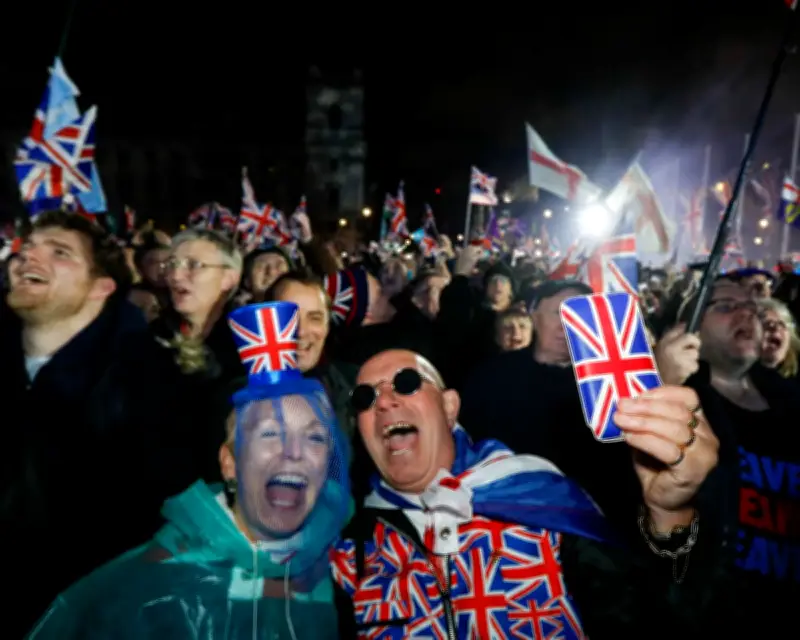
The Brexit Effect, 2016-2026, edited by Sir Anthony Seldon, is a massive collection of 43 essays by the great and the good, including seven lords, four baronesses, one dame, and three knights. Yet, the phrase 'English nationalism' appears only once in its 600 pages, in a passing reference to the Daily Mail's line during the 2016 referendum. Despite a fine essay by Aileen McHarg on Scotland, there is none on England, and no overview of the tensions within non-metropolitan England, where Brexit was won. For much of the political and intellectual establishment, Englishness remains the condition that dare not speak its name.
Avoiding the Elephant in the Room
This absence matters for understanding the past and the future. It evades the urgent question: why, when many Brexit voters now regard it as a failure, is Nigel Farage still a plausible contender for prime minister? Peter Kellner's incisive contribution shows that a third of Leave voters now say Brexit has failed, and a quarter of that group blame Farage 'very' much. Yet Farage still sets the agenda in English and Welsh politics. If a historian like Seldon does not try to understand the nationalist impulses behind Brexit, Farage's success becomes inexplicable. The collection has no specific essay on Farage, making it like Punch and Judy without Mr Punch.
Brexit's Objective Failure
That Brexit is a failure is hardly worth denying. The most recent independent study from Stanford University finds that by 2025, Brexit reduced UK GDP by 6% to 8% compared to what it would have been. Investment shrank by 12% to 18%, and employment and productivity fell by 3% to 4%. Intelligent Brexiters knew this might happen but saw economic pain as a price for political renewal. However, as jurist and historian Jonathan Sumption writes in his withering introduction, 'Britain's own ability to exercise 'control' over its own fate is inevitably more limited outside the EU.' The UK is still affected by EU decisions but has no say. On immigration, Madeleine Sumption notes that it rose to record levels after Brexit, which failed 'spectacularly to deliver on its clearest promise.'
Bad Deal on Both Sides
If voters traded growth for sovereignty, they got a bad deal. Brexit did not herald a liberated governing class. Pro-Brexit former Tory MP Conor Burns writes that cabinet secretary Simon Case was 'lightweight'—'that's why he was appointed.' Case himself spreads the blame: 'The vision of a nation released from the shackles of Brussels bureaucracy rapidly became a reality of muddled thinking, fruitless negotiations, Parliamentary quagmire and administrative confusion.' Former Ukip MP Douglas Carswell concludes glumly that 'Vote Leave might have gained us self-government. We have yet to govern ourselves well.' Six prime ministers since 2016, with a seventh on the way, make one wonder if post-Brexit Britain is governable at all.
Disappointment Built In
Disappointment was always part of the package. Brexit was doomed to become an instant lost cause. As Carswell puts it, 'we still have the European disease.' Gisela Stuart believes Britain is 'still overshadowed by the ghosts of fifty years of EU membership.' Paul Stephenson describes the triumph as 'bittersweet': 'We wrestled victory out of the jaws of defeat, but then promptly allowed it to be snatched back off us again.' Nowhere among Brexiters is there real reckoning with their failures. Burns refers to the Irish border as 'the problems the Irish had created,' ignoring that Northern Ireland voted to remain. Patrick Minford, who promised a golden age, writes that while 'in the short run Brexit is bound to cause disruption,' its point is to 'improve long-run performance.' But economists Paul Johnson and Robert Johnson argue that 'it seems unlikely that the long term hit to national income will be less than 4 per cent, and it might well be more.'
Remainers Also Miss the Point
There is no evidence that remainers face the identity crisis behind Brexit either. Susan Greenfield acknowledges that 'the all-important question of whether to leave or remain in the EU was somehow tied in with our identity,' but she thinks about identity only at a cognitive level. For concrete political and social terms, one must turn to the Future of England surveys by Ailsa Henderson and Richard Wyn Jones. The most recent finds that supporters of Farage rank 'being English' above 'being a parent' as a marker of identity. Those for whom Englishness is essential were not happy in 2016 and are no happier now. Henderson and Wyn Jones find them 'deeply conscious of what they clearly regard as a jarring contrast between past glories and a present brought-low; an England whose eponymous national group seems to feel besieged both from within and without; an England that has secured major changes (not least, Brexit) in order to assuage its concerns, yet remains deeply dissatisfied with the results.'
Conclusion
Brexit was a dishonest and self-harming response to the English question. But the great and the good seem loath even to hear it, let alone provide a better answer. The Brexit Effect, 2016-2026 is published by Cambridge University Press at £16.99.




