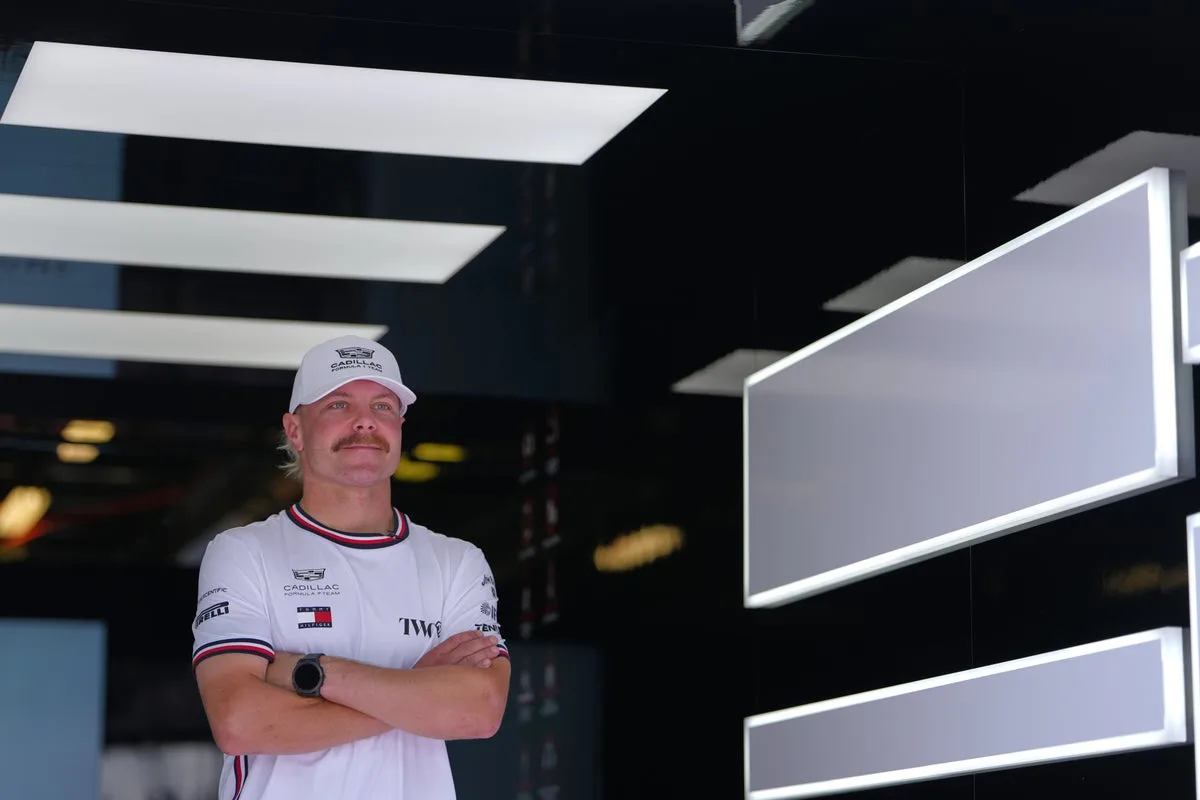
Valtteri Bottas Credits F1’s Improved Mental Health Support for Opening Up
Bottas: F1 Mental Health Support Helped Me Open Up

Formula 1 driver Valtteri Bottas believes that support for mental health struggles in motorsports has greatly improved during his career, giving him the courage to extensively detail his own personal battles.

A More Welcoming Environment

“The sport has changed a lot, the world has changed a lot,” Bottas said Thursday, a day after he discussed his struggles in an essay for The Players' Tribune. “There’s better ways for people to communicate and share their issues, or anything from the past. It’s definitely a more welcoming environment for everyone in F1, but I think also the whole world.”

Bottas was approached by the outlet late last year and began writing the essay titled “Born Crazy,” released ahead of the rookie Cadillac team’s North American debut at the Miami Grand Prix. Bottas, from Finland, and Sergio Perez of Mexico drive for the team, which considers itself the only true American team in the global series.

Wide Pickt banner — collaborative shopping lists app for Telegram, phone mockup with grocery list

Why He Opened Up

Bottas agreed to share his story to highlight the intense personal battles drivers face in the ultra-competitive racing world. “I think it’s important to highlight that we’re all humans and no one is perfect. Everyone has their struggles or their issues,” he said. “Hopefully somebody can learn from other people’s mistakes. Part of life is learning about your mistakes.”

Being a Wingman Broke Bottas

In the piece, Bottas revealed that during his time as a driver for Mercedes, he was pushed to the brink of depression and despised F1 when relegated to “wingman” for seven-time world champion Lewis Hamilton. He also disclosed an earlier two-year struggle with an eating disorder.

Bottas spent five seasons as Hamilton’s teammate following a 2017 promotion from Williams. “First season was good,” he told The Players’ Tribune. “I started the 2018 season thinking that I was the best driver on the grid, and that I was going to win the championship.” But he instead went winless and sacrificed track position often to help Hamilton win the title.

“Do you know how badly I wanted to just say no?” he said. “But I had to be a good teammate. I let him through, and of course he had an incredible season. He was the champion. I was ‘the wingman.’ To this day, I have complicated feelings about it. I don’t know how to answer when people ask me about it, because Lewis is an incredible driver and a friend. I have no bad blood with Mercedes ... but the whole situation almost made me walk away from the sport.”

The situation nearly broke him mentally. “The old me came back. The negative Valtteri. The obsessive Valtteri. I was reading too many comments on social media, and I started to become very self-loathing,” he wrote. “Thankfully, I had the tools from my experience in 2014 to understand what was happening, and I had plenty of support.”

Early Career Eating Disorder

The 2014 reference was to Bottas’ battle with an eating disorder that “completely consumed” him. “It was like a game to me. I’d wake up and weigh myself every morning, and when I’d see the number go down, I’d feel a deep satisfaction,” he said. “After two months of spiralling, my nerves were shot. I would wake up at 4 a.m. on my own, no alarm. I was like a drug addict, ‘I’ve never felt better!’ Ha. Completely delusional. The actual reason I was waking up so early was that my body was in starvation mode.”

He struggled to find joy and was “just so angry and negative about everything.” Bottas said his then-wife asked if he feared the risks of racing, but he’d become so detached that he told her “‘No. If I die, I die.’” “At that moment, I realized that I genuinely did not care what happened to me anymore,” he revealed. “Not long after that, I decided to get some help. I started seeing a psychologist, and I finally admitted out loud that I was unwell. It took me almost two years to feel like myself again.”

Pickt after-article banner — collaborative shopping lists app with family illustration

His descent into depression began again in 2018 when it became clear he would only ever be in Hamilton’s shadow. “I was definitely depressed and burnt out. I hated racing. During that winter break before the 2019 season, I did not think that I was going to come back,” he said. “That winter break, I made the decision that I was going to retire. Then I went for a walk one day in the forest. I walked in the deep snow for maybe three hours and I walked out of those woods with a completely different mindset.”

Help Is Out There

Bottas said Thursday he isn’t sure what reaction his essay has received, as it was released only the day prior and he has avoided social media. But he hopes the essay shows others there are resources available and the stigma surrounding mental health has changed. “The whole sport has evolved a lot. Everything is more professional,” Bottas said. “I also think when it comes to coaching, physical coaching, mental coaching, that level also has gone up. There is more support available. There’s better packages for drivers when it comes to mental coaches. I think people are less afraid of seeking for help, seeking for support, because these things are now talked about more.”