

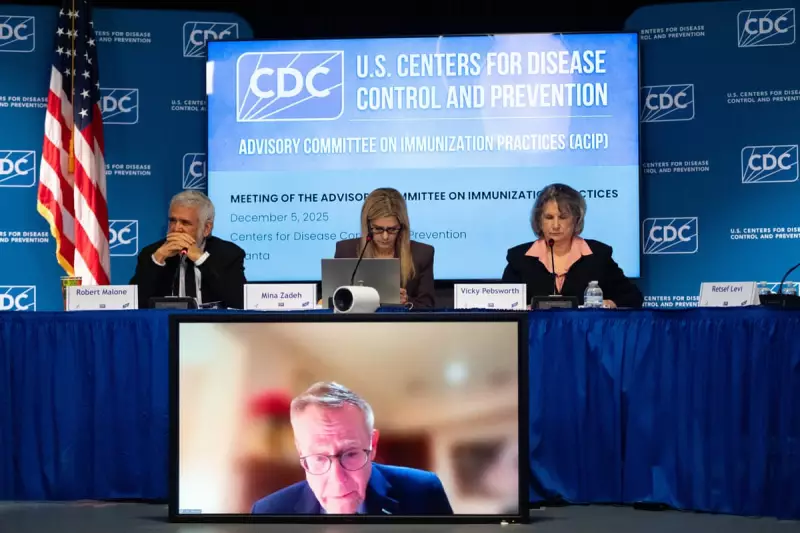
In a landmark decision that signals a significant shift in US vaccination policy, advisers to the Centers for Disease Control and Prevention (CDC) have voted to limit access to the hepatitis B vaccine for newborns. The vote, taken on Friday 5 December by the CDC's Advisory Committee on Immunization Practices (ACIP) in Atlanta, marks the first time the panel has moved to restrict a routine childhood immunisation that has been safely administered for decades.
A Major Reversal in Vaccine Policy
The expert panel recommended moving away from the long-standing practice of offering the hepatitis B shot to all infants at birth. Under the new guidance, parents who wish to vaccinate their newborn must first engage in a discussion with a doctor to determine if their baby qualifies for the immunisation. Furthermore, the advisers now suggest the vaccine should not be administered until an infant is at least two months old, unless it is given immediately after birth following the consultation.
This decision is part of a broader pattern under the current administration. Just a few months prior, the same committee voted to separate the combined measles, mumps, rubella (MMR) and chickenpox (varicella) vaccine, recommending they be given as two individual shots. The move to limit the hepatitis B vaccine, however, is unprecedented for a immunisation with such a long and proven track record.

Implications for Infant and Maternal Healthcare
The practical consequences of this policy change are expected to be substantial. Healthcare experts warn that making the vaccine optional rather than standard could lead to reduced access. Hospitals may choose not to stock sufficient doses if they anticipate lower demand from parents. Paediatricians, faced with the new guidance, may become hesitant to administer the shot before the two-month mark.
Perhaps most concerning is the potential for confusion among both parents and healthcare providers, which could result in infants missing this critical protection entirely. The shift places access under a framework known as "shared clinical decision-making," a term that lacks clear definition and has historically been applied only to a handful of vaccines that did not warrant a full, universal recommendation.
When this model was applied to Covid-19 vaccines, it led to widespread uncertainty among families and medical professionals. An additional complication is insurance coverage; while private insurance is likely to still pay for the shot, it remains unclear whether federal programmes will cover vaccinations given before two months of age if parents are unable to secure it at birth.
Why the Hepatitis B Vaccine Matters
The medical rationale for vaccinating newborns against hepatitis B is robust and well-established. The virus poses the greatest danger to children infected in their first year of life. An infant who contracts hepatitis B before age one has a staggering 90% chance of developing a chronic infection. This can lead to severe, lifelong health issues including cirrhosis, liver cancer, and premature death. In contrast, only about 5% of infected adults progress to chronic infection.
The success of the vaccination programme speaks for itself. Since its introduction for all newborns in 1990, recorded cases of the illness in children have plummeted by 99%, from approximately 20,000 annual cases to just around 20 today. The vaccine's safety profile is equally impressive, having been administered to over a billion people globally across three decades with no major safety concerns identified. Presenters at the recent CDC meeting offered no new data to challenge this safety record.
Despite the overwhelming evidence, some sceptics, including a few presenters and advisers at the meeting, expressed concerns about potential links to chronic conditions like allergies, eczema, or neurodevelopmental disorders such as autism. It is crucial to note that multiple large-scale scientific studies have found no evidence to support a connection between vaccines and these conditions.

The decision to target a vaccine with such a proven record of safety and efficacy sets a concerning precedent. It opens the door for other established immunisations to be questioned and risks sowing public doubt in the very tools that have protected population health for generations. The vote represents a fundamental challenge to decades of evidence-based medical recommendations.





