Gruesome Viking-Age Burial Pit Discovered on Cambridge Outskirts
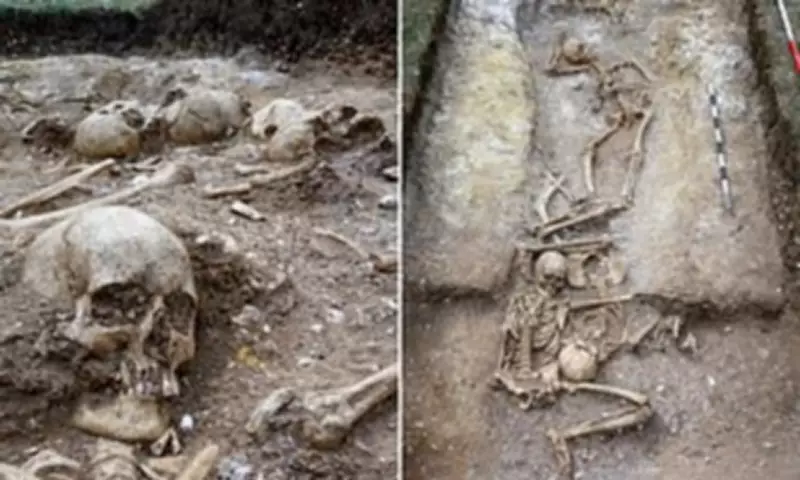
Archaeology students from Cambridge University have made a rare and chilling discovery during a training dig: a Viking-age burial pit containing the decapitated and mutilated remains of at least ten individuals. The find, located in Wandlebury County Park on the outskirts of Cambridge, dates from around the ninth century AD and is believed to be linked to violent conflicts between Viking and Saxon forces.
A Site of Ancient Violence and Surgical Mystery
The excavation revealed a grim tableau. Among the remains were four complete skeletons, some positioned in ways that suggest they were bound or tied. Disturbingly, a number of skulls were found without accompanying bodies, indicating possible decapitation. The dismembered state of the remains has led experts to propose the site may have been an execution ground or a mass grave following a battle.
One skeleton stood out remarkably: that of a man estimated to have been 6 feet 5 inches tall, a giant compared to the average male height of about 5 feet 6 inches at the time. Intriguingly, this individual's skull bore a 3-centimetre hole, hinting at an ancient surgical procedure, perhaps an early form of trepanation.

Frontier Zone of Clashing Cultures
Dr Oscar Aldred of the Cambridge Archaeological Unit, who led the excavation, explained the historical context. During the ninth century, this area of Cambridgeshire was a volatile frontier zone where Saxons and Vikings clashed over territory for decades before Viking conquest around 870 AD. The pit may relate directly to these conflicts, potentially holding the bodies of young men slain in battle or victims of corporal punishment.
"Those buried could have been recipients of corporal punishment, and that may be connected to Wandlebury as a sacred or well-known meeting place," Dr Aldred stated. He further speculated that some disarticulated body parts might have been displayed as trophies before being gathered for burial with other slaughtered individuals.
Student Archaeologists Confront the Past
The discovery was made between spring and summer last year by undergraduates participating in a training dig as part of Cambridge University's archaeology degree programme. The project was conducted in conjunction with the Cambridge Archaeological Unit and the local charity Cambridge Past, Present and Future, which owns the parkland.
For the students, encountering such human remains was a profound experience. Third-year student Olivia Courtney from Bath remarked, "I had never encountered human remains on a dig, and I was struck by how close yet distant these people felt. We were separated by only a few years in age, but over a thousand years in time."
Fellow undergraduate Grace Grandfield from York expressed her shock: "I would never have expected to find something like this on a student training dig. It was a shocking contrast to the peaceful site of Wandlebury."
Medical Theories and Future Investigations
The unusual height of the tallest skeleton has prompted medical theories. Dr Trish Biers of Cambridge University suggested, "The individual may have had a tumour that affected their pituitary gland and caused an excess of growth hormones."
Historic England, which is supporting the excavation, has commissioned a new geophysical survey of the surrounding area. Archaeologists hope this will reveal more about the site's context and any associated structures. The discovery will be featured in an upcoming episode of Digging For Britain on BBC Two.
This find adds to a series of significant archaeological discoveries in the UK, following recent news of a hall possibly belonging to England's last Anglo-Saxon king, Harold Godwinson, being unearthed in Yorkshire.