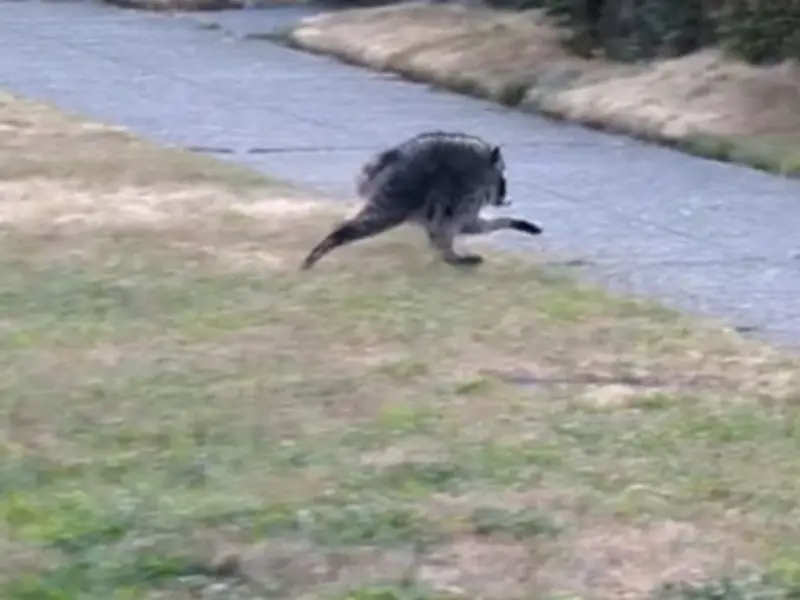
A bizarre 'mutant' raccoon nicknamed 'Jimothy' has become a viral sensation after footage of the stubby creature prowling through gardens in suburban Seattle, Washington, was posted on social media. The deformed animal, which has a short, awkward spine and no tail, was first spotted by Kiana Hall, 33, while she was on a late-night stroll with her partner.
Viral Video Captures Unusual Raccoon
Hall captured video of the raccoon and shared it on Instagram with the caption: 'For our 13th anniversary [her partner] and I were graced with the presence of Jimothy the raccoon with short spine syndrome. Praise Jimothy!! I got very confused at what I was seeing. I just have never seen any other animal like it.' The footage quickly went viral, drawing attention from around the world.
Expert Assessment: Jimothy Is Adapting Well
Despite the raccoon's stubby spine, medical expert Marcie Logsdon believes the animal is managing well. 'The fact that he's made it to this age tells me that he's managing and that he's adapting,' Logsdon said. 'I was surprised and honestly a little bit inspired that he's that resilient.' She advised homeowners in Jimothy's territory to leave the raccoon alone, as he is best 'left to his own devices.'
Social Media Reacts to Jimothy
Social media users have flooded the comments with positive messages. One user wrote, 'This is the most Seattle animal possible.' Another said, 'He needs to be protected at all costs.' A third added, 'ALL HAIL THE MIGHTY JIMOTHY.' However, some expressed concern, with one commenter noting, 'Someone I know said he’s likely alone because the other raccoons rejected him :( I hope this isn’t true because it makes me sad to think he might be all alone.'
Experts Urge Respect for Wildlife
Logsdon emphasized the importance of respecting wildlife, stating, 'Raccoons are amazing because they have done an amazing job at adapting to and sharing urban and suburban areas. But respectful sharing needs to remain just that.' The viral sensation has sparked conversations about urban wildlife and genetic abnormalities in animals.