
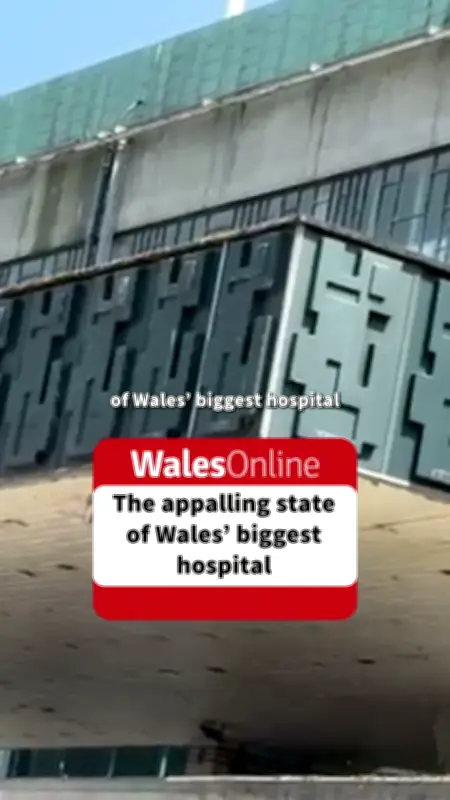
An army of pigeons perched atop Wales' largest hospital, the University Hospital of Wales in Cardiff, have become a symbol of the site's chronic decay. Dozens of birds survey patients and staff below, flitting in and out of gaping holes in the canopy over a staff entrance. Large panels are missing from the sides, while a plastic sheet hangs in a forlorn attempt to cover an absent chunk of the underside.
Online backlash over dilapidated structure
This week, pictures of the decaying canopy were shared online, sparking a backlash. “It's absolutely disgusting,” wrote the Reddit user who posted the images. “This part of the hospital needs tearing down, otherwise it's going to collapse at some point and cause serious injury or even (God forbid) death.”
One online comment stated: “It’s been like that for years now. My dad was hospitalised there last year and had to walk past that every day. Nothing instils a sense of doom and a sense of neglect like walking in here, up past the abandoned bike sheds past this drop-off point and passing all the smokers in wheelchairs huddling away from the leaky roof and puddles.”
Another expressed amazement that the structure was still there. “I worked there 10-plus years ago and that canopy has been falling apart for a long time before then,” they said. “The light fittings started falling out and they would patch up the holes, but every now and then the bits of wood came loose and you would see pigeon corpses hanging out of the holes. They'd be there for days until the skeleton eventually fell and a seagull or rat came and ate it.”
Health board blames delivery vehicle
Cardiff and Vale health board told us this part of the site – a drop-off point for samples – was damaged “after being struck by a delivery vehicle”, although it did not answer when asked when this happened. “There are plans to remove the remaining structure as funding becomes available,” it said, though neither the health board nor the Welsh Government could specify when this would be.
One comment complained about the “unbearable” stink from bird carcasses decomposing inside the canopy, adding: “It's a health and safety hazard and yet the [health] board are not doing a thing about it.”
Pigeon infestation in operating theatres
Above the drop-off point, pigeons loom like sentries atop the back of the operating theatre department. One source from the theatres told us: “They store medical equipment out here even though they shouldn't. The ceilings are constantly leaking here. A dead pigeon was rotting above a roof panel and stinking theatres out, and it was only discovered when maggots started dropping from a roof tile.”
The hospital as a whole, built in the 1960s, is now so dilapidated that its condition played a part in Wales recently losing a vital cancer diagnosis and research facility, the cyclotron. A source told us the health board had been worried about the possibility of being sued by a potential operator of the facility. “Imagine if the electricity went down or there was a leak in the roof,” they said. “The tenant could be litigious and say: 'We've lost five days.'”
Damning internal report and patient death
A damning internal report from last year slammed maintenance standards at the hospital's operating theatres, finding “significant delays in fixing leaks” as well as “several occasions when pigeons were found in trauma theatre or on the theatre corridor”. It also emerged last year that Gareth Idris Johnson, a 41-year-old dad, had lost his life after the hospital's maintenance problems led to him being moved to a different unit following an operation. A coroner warned of more deaths without urgent action.
In recent months we have reported on the hospital losing its water supply, regular sewage leaks, and an 80-year-old in his final hours wet from the dripping ceiling of a pigeon-infested tunnel. Almost 300 doctors have written to the health board that morale was at an “all-time low” due to a wide range of problems at the hospital, many of them to do with its deteriorating condition. The letter accused the health board of failing to act on the issue. Plans to build a replacement for the hospital – first announced by the health board in 2021 – soon stalled and there is now no definitive plan for a solution.
Government response and funding
A Welsh Government spokesman said the health board is “developing a plan for the future” of the University Hospital of Wales and University Hospital Llandough sites, adding: “Following this we will work with the health board about options and timelines.”
Geoff Walsh, director of facilities at the health board, said: “We continue to work closely with Welsh Government to develop a number of business cases that will support future investment and deliver longer-term improvements to the infrastructure across the University Hospital of Wales site.” He added: “The University Hospital of Wales is one of the largest and busiest hospitals in Wales and, like many NHS organisations across the UK, faces the challenge of maintaining an ageing estate while continuing to deliver safe, high-quality care. The canopy shown in the images has sustained damage after being struck by a delivery vehicle. The affected panels were removed to ensure the area was safe, and while we recognise its current appearance is not ideal, there are plans to remove the remaining structure as funding becomes available. [We] undertake a continuous programme of maintenance, repairs and essential improvement works across our sites, with investment prioritised according to risk to ensure available funding is directed where it will have the greatest impact on safety and patient care.”
The Welsh Government said it is investing more than £500m this year to modernise the NHS estate including “upgrading critical infrastructure, replacing essential equipment, enhancing digital systems to support new ways of working, and backing major regional diagnostic and surgical hubs”. Its spokesman said: “We recently announced an additional £145m investment in the NHS in Wales, including £20m towards essential maintenance across the estate.”
Last year the government escalated the health board to a 'level four' targeted intervention due to “serious concerns relating to governance, culture, quality and safety and operational pressures”, just short of special measures.




