
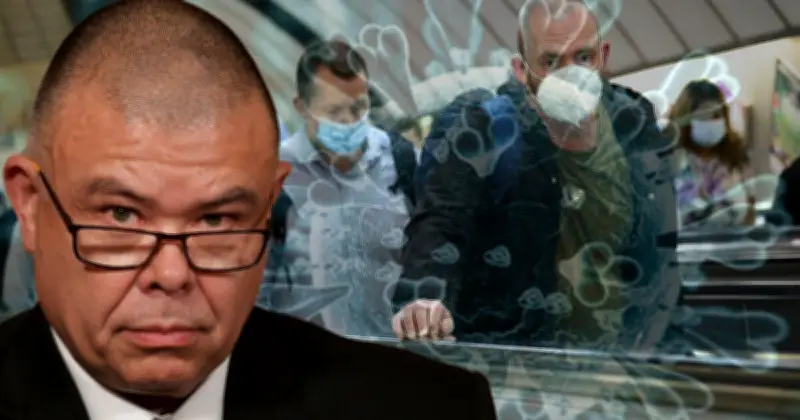
Professor Sir Jonathan Van-Tam, the former deputy chief medical officer for England, has issued a stark warning that the UK must significantly bolster its vaccine manufacturing capabilities to prepare for future pandemics, which he says are not a once-in-a-lifetime event but a recurring threat.
Pandemic risk remains high
A report from the Tony Blair Institute for Global Change (TBI) puts the cumulative probability of another pandemic in the next 25 years at between 47% and 57%, based on an annual risk of around 2.5-3.3%. Sir Jonathan, who was quoted in the report, agrees with this assessment. He told the Express: "I've been told by people that this is a once in a lifetime thing and I've said: 'Absolutely not'. I've had two pandemics in my professional lifetime, 2009 [swine flu] and 2020. I teach young scientists and doctors there will be at least two, probably more in their working lifespan."
Vaccine manufacturing as critical infrastructure
The TBI report warned that the UK was dangerously exposed to growing biological threats, including bioterrorism and climate-driven diseases. It argued that the geopolitical conditions which allowed for rapid access to Covid vaccines may not hold in the next crisis. The report called for vaccine manufacturing to be treated as critical infrastructure and a core pillar of the nation’s defences. Sir Jonathan agrees: "I'm not saying they should be level pegging. But I'm saying that they should be framed in the same way that we would frame energy security, food security and defence security. Vaccines are a health security matter and they deserve their place at the table."
Progress and setbacks
The Moderna Innovation and Technology Centre in Harwell, Oxfordshire, became fully operational last year and is the UK's first onshore facility for manufacturing messenger RNA vaccines. It could produce up to 250 million vaccine doses a year. However, the Vaccine Manufacturing and Innovation Centre — envisioned as the UK’s permanent, state-backed fortress against biological threats — was sold by the government to a private pharmaceutical company in 2022. The government has also faced criticism for funding cuts to global health initiatives including the Pandemic Fund and the Global Polio Eradication Initiative.
Sir Jonathan said: "If the same kind of pandemic occurred, we'll be much more confident about messenger RNA technology and we would have it onshored. So that bit's better. But there are also plenty of other bits that are worse and the public is in a different place compared to 2020. I think it's impossible to say that we are in a better place."
Need for diverse vaccine technologies
Messenger RNA technology is not a universal silver bullet. Future threats may be more suited to other types such as viral vectors, protein subunits, virus-like particles or technologies yet to be developed. Many jabs used in the UK are made overseas, and even if a vaccine is bottled in the UK, the process usually involves ingredients or components crossing borders. Sir Jonathan noted: "Some of the vaccines we use are made heavily in Europe. Some are made in North America. These places are not invulnerable to difficulties in the movement of goods, or costs, tariffs."
Football squad analogy
Sir Jonathan used a football squad analogy to explain the need for diverse vaccine manufacturing capabilities: "The longer the season runs, the more you appreciate the depth of your squad, because you start to pick up injuries, people aren't available, and things happen that you couldn't have predicted. Clubs that do well are often those that have the most resilience. They've got a nice big squad covering every position. That's how I see the different types of vaccine manufacturer, different modalities of vaccine type."
Political challenges and public sentiment
Sir Jonathan acknowledged that investing in pandemic preparedness is a difficult argument to make in peacetime: "In terms of political terms of office and political lifespans, it doesn't fit very well. There's always an immediate, pressing problem to spend money on, and the ones that might happen in the future feel a bit like they're on the never-never. It's a can that's too easily kicked down the road." He also noted that public sentiment has shifted due to events such as the parties at Downing Street during lockdowns, which left a bitter taste and could affect support for future measures.
The estimated cost of the UK government’s Covid measures was over £300 billion. The TBI report argued that vaccine access can determine how quickly a country reopens its economy, protects its healthcare system and preserves social stability.
Government response
A government spokesperson said: "Pandemic preparedness remains a top priority for this government, and research and innovation play a vital role in protecting the public from future health threats. Our recently published Pandemic Preparedness Strategy, supported by around £1 billion of investment in health protection, sets out ambitious plans to strengthen the UK's ability to develop, test and deploy vaccines, diagnostics and treatments at speed in response to emerging threats. This will help ensure the UK remains at the forefront of scientific innovation and is better prepared for future pandemics."




