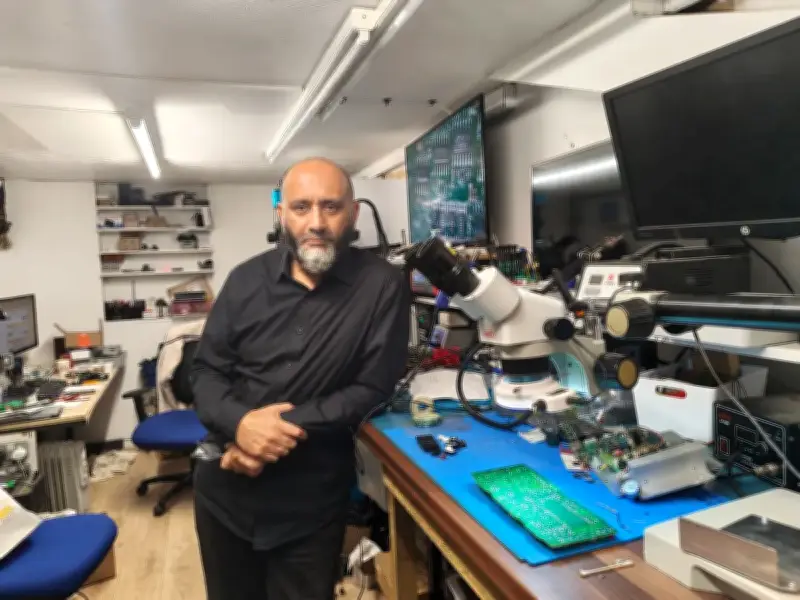
Nasser Hussain, a 58-year-old electronics engineer from Bolton, has spoken about how a series of health episodes turned his life upside down. Once busy, independent and hands-on, he now feels completely exhausted after just a few hours of work.
“I thought I’d get through it and just go back to normal,” he said. “But things are very different now. This is my new reality.”
Multiple mini strokes before major stroke
Nasser initially suffered multiple transient ischaemic attacks, often referred to as ‘mini strokes’. He said: “I had a number of episodes before it really hit. At first, I just felt tired. I didn’t realise anything serious had happened.”
During one episode, his sense of taste changed. “I went to a takeaway I know well and thought the food was terrible,” he said. “But it wasn’t the food that was the problem, it was me.”
Days later, the symptoms returned. “I felt this tingling down my face, arm, and leg. That’s when I knew something was wrong,” Nasser said.
Hospital experience and diagnosis
After multiple transient ischaemic attacks, Nasser sought help, but found his hospital experience confusing and distressing. “I was waiting all day, and no one really saw me,” he said. “At one point, I was told it wasn’t a stroke and sent home.”
It was only after further episodes and scans that doctors confirmed he had suffered an ischaemic stroke caused by a blood clot. By that point, his condition had worsened. “Everything is a blur,” he said. “Your brain just doesn’t process things the same way anymore.”
Living alone after discharge, Nasser struggled to cope. “December was the worst time,” he said. “I couldn’t cook, couldn’t clean, couldn’t even keep on top of basic things. I’d wake up, come downstairs, sit there all day and that was it. The house just slowly fell apart around me.”
Rebuilding life and helping others
As an electronics engineer, Nasser relied on precision and control, but after the stroke those abilities were gone. “I use one hand to place components and the other to solder,” he said. “I lost that ability overnight. I’d either grip things too hard or too soft, or they’d just disappear from my hand. It destroyed me mentally.”
He now works shorter days, focusing on less intricate tasks. “I can only manage about four hours,” Nasser said. “Anything more and I’m wiped out.” He has also learned to manage his energy carefully, batch cook meals, and make his home safer after several falls.
Nasser shared his story for World Stroke Day on Thursday, October 29, as part of the Stroke Association’s ‘Survival Is Not Enough’ campaign. He credits healthcare professionals and Stroke Association support services with helping him understand his experience, and now volunteers to support people in recovery spaces and shares his journey online.
“Talking to people who understand helps massively. You realise you’re not alone,” he said. “If someone needs me, I’ll be there. And if I can help even one person, that’s enough for me.”
Juliet Bouverie OBE, CEO of the Stroke Association, said: “A stroke is a devastating brain injury, leaving behind life-changing trauma. In an instant, a stroke can steal away the things that many of us take for granted, such as walking, talking, eating and living independently; the things that make you, you.”
In the UK, someone has a stroke every five minutes, with 1.4m people currently living with a brain injury caused by stroke. More than 85,000 people survive a stroke every year, and despite one in four strokes happening to people of working age, a third of Brits aged 18-34 and almost a quarter of 35-44 year olds believe they’re too young to have one.