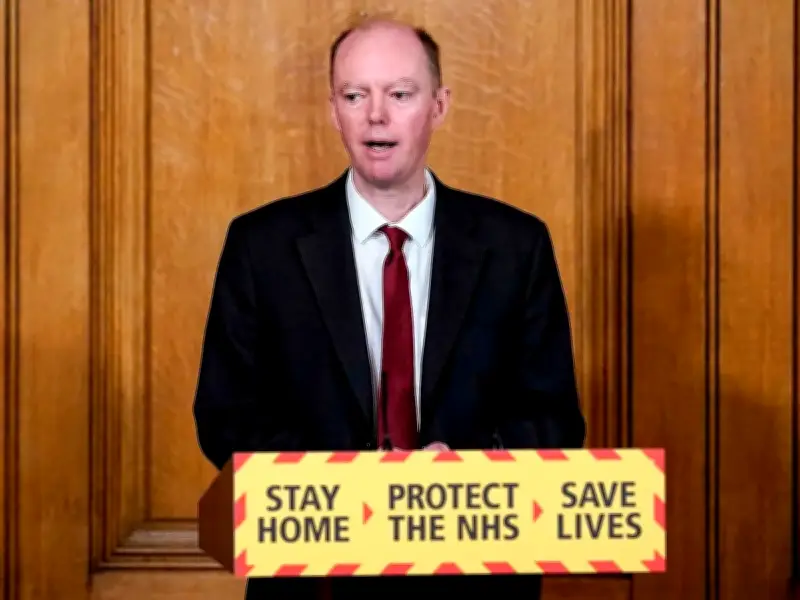
England's Chief Medical Officer Sir Chris Whitty has said the NHS does not have enough hospital beds and called for a reversal of decades of reducing them. His report highlights how aging populations in smaller towns and villages are struggling to access healthcare, with most of Britain's remaining beds situated in major city hospitals.
NHS hospital beds have been halved over the last three decades, falling in England from around 300,000 in 1987 to 140,000 in 2020. During the same period the UK population increased from 57 to 67 million, and research shows Britain has fewer beds for the size of its population than almost all comparable countries.
Decades of cuts go too far
For decades politicians and health leaders felt it was more efficient to care for more people outside of hospitals, but Sir Chris has said that cuts to bed numbers have gone too far.
Speaking at a media briefing in central London, Professor Whitty said: "If you look over a very long time period - and to be clear this is not aimed at any individual government [because] this has been true over decades - the number of beds available for people to be in has gone down in the NHS whilst the population of older people has gone up."
"That is just the mathematical reality. The NHS as a whole, in my view, should have more beds. That is a statement of the obvious, but it's going to take a long time to build up," he added.
Rural aging and centralisation
The intervention by Sir Chris comes as he published a report outlining how UK populations in smaller towns and villages are aging much more rapidly than the national average, placing more pressure on hospitals and GP services there.
There has also been a shift to centralise NHS services into larger hospitals usually based in major cities. A landmark report in 2023 found that Britain has almost half the hospital beds for its population when compared to other similar nations.
The Organisation for Economic Co-operation and Development (OECD), which is made up of 38 market-based democracies, found there were on average 4.3 hospital beds for every 1,000 people in the population. But in the UK it was 2.4 beds for every 1,000 people. Just Mexico, Costa Rica, Columbia, Chile and Sweden reported fewer beds.
Pandemic pressures and rural moves
The NHS went into the Covid-19 pandemic with a lack of hospital beds. The total average daily available NHS hospital bed stock in England fell by 8.3% between 2010/11 and 2019/20, dropping from 153,725 to 140,978.
Sir Chris was asked whether worse access to healthcare should deter people from moving out of cities to retire in the countryside. He said: "I think what people have to do is be quite clear eyed when they look into moving from an urban area to a rural area where they don't have links."
"They just need to think about the practicalities of it. That's not a reason not to [go]. These are very good places to live. There is a reason why people make that change and why that has been the tradition in the UK for a long time," he said.
Kerry Booth, chief executive of the Rural Services Network said: "We welcome the Chief Medical Officer's recognition of the health challenges facing people in small towns and rural areas. Everyone should have the opportunity to live a healthy life, wherever they live."