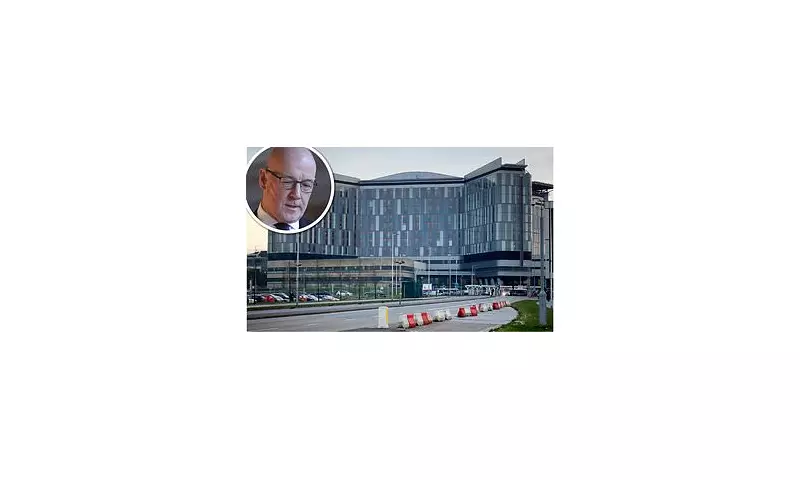
First Minister John Swinney has been accused of 'evasions and excuses' after pointing the finger at former NHS executives for the water contamination scandal at a flagship Scottish hospital. The political leader admitted there was a 'cultural problem' at NHS Greater Glasgow and Clyde and conceded it 'looks like' families of deceased patients at the Queen Elizabeth University Hospital (QEUH) were deliberately misled.
Families 'Lied To' and Police Investigation
Mr Swinney's comments come amid revelations that Police Scotland are now investigating the deaths of six patients who contracted infections while being treated at the Glasgow hospital. The cases include both adults and children, with concerns about waterborne bacteria and fungal infections linked to the hospital's infrastructure.
Victims of the Contamination
Among those whose deaths are being examined are:

- Ten-year-old Milly Main, who died in August 2017 after contracting Stenotrophomonas maltophilia while in remission from leukaemia
- Gail Armstrong, 73, who died in January 2019 after catching Cryptococcus while being treated for blood cancer
- Andrew Slorance, 49, a father-of-five who died in December 2020 after contracting Covid-19 and Aspergillus while awaiting a bone marrow transplant
- Three other patients including an unnamed ten-year-old boy and a three-year-old child
Swinney's Defence and Ongoing Concerns
Despite these developments, the First Minister insisted he maintains confidence in the current leadership of the health board and claimed the hospital is now safe. This assertion comes despite continuing concerns from medical professionals, including whistleblowing doctors who claim the hospital remains unsafe with a 'broken culture' of cover-ups persisting.
Speaking for the first time since evidence to the Scottish hospitals inquiry concluded, Mr Swinney stated: 'I think it's quite clear there has been a cultural problem in NHS Greater Glasgow and Clyde and the inquiry essentially is flushing out that issue.'
Leadership Changes and Accountability
When pressed about whether families had been lied to following the health board's recent admission that some fatal infections were probably caused by the hospital's water system, Mr Swinney responded: 'It does look like that, but ultimately it is for Lord Brodie to come to those conclusions.'
The First Minister highlighted leadership changes at the health board, noting that both Jane Grant (chief executive from 2017 to 2024) and Robert Calderwood (chief executive from 2009 to 2017) have given evidence to the inquiry. He expressed confidence in the current leadership team led by former Solicitor-General Lesley Thomson and Professor Jann Gardner.
Political Criticism and Calls for Transparency
Scottish Conservative deputy leader Rachael Hamilton delivered a scathing assessment: 'John Swinney's appearance this morning showed a First Minister more interested in dodging questions than telling grieving families the truth. He still cannot bring himself to admit that families affected by the QEUH scandal were lied to, instead hiding behind the inquiry to avoid accountability now.'
Scottish Labour leader Anas Sarwar added: 'I think there is something rotten at the core, both in terms of the health board management and officials and also ministers in government.'
Expert Concerns and Ministerial Scrutiny
Consultant microbiologist Dr Christine Peters, who first raised safety concerns about QEUH over a decade ago, told media outlets she remains unsatisfied that the hospital is now safe and considers problems to be 'ongoing'. Meanwhile, former SNP Health Secretary Alex Neil urged Lord Brodie to recall NHS Greater Glasgow and Clyde officials to explain why their position on water contamination has changed and 'who has been lying' at the health board.
Mr Swinney refused to be drawn on whether current or former SNP ministers should face scrutiny in the criminal probe, stating: 'It is not up to me to say that. I've got to be really careful what I say here because I have to respect the independence of the Lord Advocate.'

The controversy continues to unfold as families seek answers, politicians demand accountability, and healthcare professionals voice ongoing concerns about patient safety at what was intended to be a state-of-the-art medical facility when it opened in 2015.