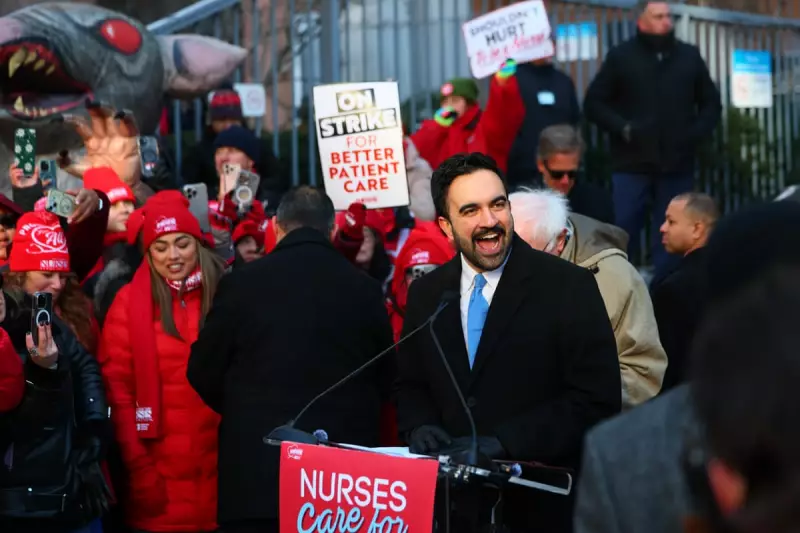
New York City is witnessing its largest nurses strike in history, with almost 15,000 healthcare professionals braving sub-zero temperatures to demand improved working conditions and fair contracts. The industrial action, which began on 12 January 2026, involves staff from three major hospital systems: Mount Sinai, Montefiore, and NewYork-Presbyterian.
Political Leaders Rally Behind Striking Nurses
Mayor Zohran Mamdani and Senator Bernie Sanders joined striking nurses outside Mount Sinai West on Tuesday 20 January, offering their vocal support during the strike's second week. Both politicians emphasised the critical nature of the nurses' demands, framing the strike as a last resort rather than a preferred course of action.
"When we see a strike, people forget that that is not where workers want to be," Mayor Mamdani told the assembled crowd. "The strike is an act of last resort. What workers want is to be back at work. This is about safe working conditions. This is about a fair contract. This is about dignity."

Safety Concerns and Staffing Shortages
The New York State Nurses Association (NYSNA) has highlighted multiple safety incidents that have contributed to the current crisis. In November, a man allegedly threatened to "shoot up" a Mount Sinai hospital before being killed by police. Another incident in early January saw a man threaten staff with a sharp object before barricading himself in a Brooklyn hospital room, resulting in another police shooting.
Aretha Morgan, a nurse with 34 years of experience at NewYork-Presbyterian, explained the daily reality facing healthcare workers: "I'm one of countless nurses who are struggling, exhausted and increasingly afraid to come to work – the main reason is the safety in our hospitals. It's not an exaggeration, it's a daily reality."
Hospital Responses and Negotiations
Hospital representatives were scheduled to return to negotiations with the NYSNA on Thursday, following urging from both Mayor Mamdani and New York Governor Kathy Hochul. However, the institutions have taken a firm stance against what they describe as unreasonable demands.
Mount Sinai has accused the union of making "extreme economic demands," while Montefiore characterised the requests as "reckless demands." The hospitals claim their registered nurses already earn substantial salaries, with averages ranging from $162,000 to $165,000 annually across the three systems.
Executive Compensation Under Scrutiny
Senator Bernie Sanders directly addressed the compensation disparity between hospital executives and frontline staff during his speech: "The people of this country are sick and tired of the greed of the healthcare industry. Don't tell me you can't provide a good nurse-staff ratio when you're paying your CEO at NewYork-Presbyterian $26m a year, the CEO at Montefiore $16m a year. Mount Sinai $5m a year."
The NYSNA has consistently pointed to these executive compensation packages as evidence that hospitals can afford to meet nurses' demands for safer staffing ratios and improved working conditions.
Nurses' Perspective and Temporary Replacements
Cecilia Barreto, a 28-year-old nurse from Queens who has worked at Mount Sinai for two years, described the emotional impact of seeing political leaders join their cause: "Bernie Sanders is a big union champion. So to have learned about his life's work in school, and then to see him standing 15ft away from me, was an amazing experience."
Barreto expressed disappointment that hospitals have spent millions hiring temporary nurses rather than addressing the strikers' concerns: "It's incredibly disheartening to have the hospitals be stalling on this because at the end of the day, striking is a last resort, and we want to be at the bedside. We want to be taking care of the patients."
Weather Challenges and Continued Resolve
Despite temperatures dipping to 19°F (-7°C) during Tuesday's rally, nurses maintained their picket lines with unwavering determination. The frigid conditions have become symbolic of the broader challenges facing healthcare workers, who continue to advocate for what they describe as basic safety measures and reasonable staffing levels.

Morgan summarised the nurses' position: "The hospitals are attempting to tarnish our reputation as a respected profession, they are trying to portray us as being unreasonable and demanding, when in reality, we are just fighting for safe staffing, safe environments and the basic resources required to protect our patients."
As negotiations continue, nearly 15,000 nurses remain committed to their historic strike, supported by prominent political figures and united in their demand for systemic change within New York's healthcare system.