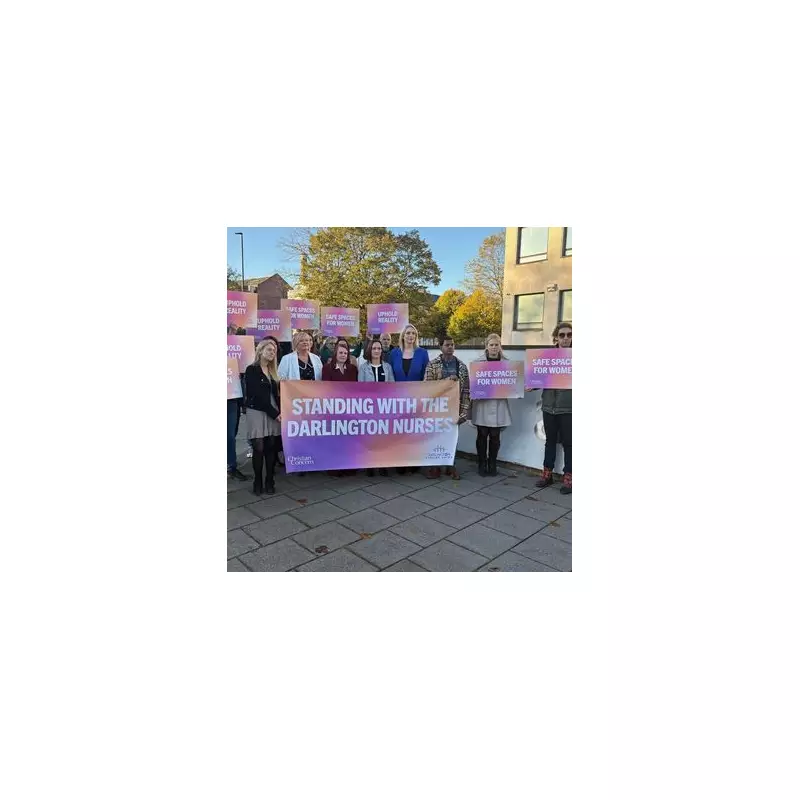
An NHS trust has been found to have violated the dignity of female staff by requiring them to share a hospital changing room with a transgender colleague. Eight nurses from Darlington Memorial Hospital have secured a partial victory in a landmark employment tribunal case that examined the clash between transgender rights and single-sex spaces.
The Core of the Dispute
The case centred on the Day Surgery Unit at Darlington Memorial Hospital, run by the Durham and Darlington NHS Foundation Trust. The nurses, who travelled to work in their own clothes, were required to change into and out of their uniforms on-site. The tribunal heard that from July 2022, they were expected to share the female changing facilities with a colleague, Rose Henderson, a trans woman who was born male.
The claimants—Bethany Hutchison, 36, Karen Danson, 46, Annice Grundy, 56, Lisa Lockey, 52, Carly Hoy, 31, Tracey Hooper, 47, and Jane Peveller, 51—argued this arrangement caused them significant distress. Their case, which was notably supported by author and women's rights campaigner J.K. Rowling, was brought on grounds including sexual harassment, discrimination, and a breach of their right to a private life under Article 8 of the European Convention on Human Rights.

Tribunal's Mixed Verdict
In a ruling released on 16 January 2026, following a hearing that concluded in November, Employment Judge Seamus Sweeney delivered a nuanced judgement. The tribunal cleared Rose Henderson of personal wrongdoing, stating she had not harassed or victimised her colleagues. It also rejected claims that the Trust had victimised the nurses.
However, the tribunal upheld significant parts of the complaint against the Durham and Darlington NHS Foundation Trust. It found the Trust guilty of harassment related to sex and gender reassignment. The ruling stated the Trust created a "hostile, intimidating, humiliating and degrading environment" by both permitting the shared use of the changing room and by failing to take the nurses' concerns seriously.
The judgement was scathing about the Trust's response, which included suggesting staff needed "to be educated on trans rights and to broaden their mindsets." Later provision of alternative facilities was deemed "inadequate and unsuitable."
Broader Implications for Workplace Policy
The tribunal made several critical findings with wider implications. It upheld a complaint of indirect sex discrimination, noting that women are more likely than men to experience fear or humiliation when required to change in front of a member of the opposite sex. It concluded the Trust's policy placed female staff at a particular disadvantage.
Furthermore, the tribunal ruled that by permitting a biological male to use the female changing room, the Trust breached its duties under the Workplace Regulations and infringed the claimants' right to respect for private life.
Representing the nurses, barrister Niazi Fetto KC argued the Trust's handling was a "catalogue of rebuttal, trivialisation, obfuscation and delay." He stated the core issue was the policy that expressly allowed a biological male in a communal female changing room, which "adversely affected" the working environment.
For the Trust, Simon Cheetham KC argued that Rose Henderson had been "demonised" and that the claimants were fighting a broader public campaign. He emphasised that the initial allegation was simply about Rose's presence, not her conduct.
This ruling sets a significant precedent, highlighting the legal necessity for employers, particularly within the NHS, to provide separate and adequate changing facilities that respect the rights and dignity of all staff, balancing protections for transgender employees with those for biological women.