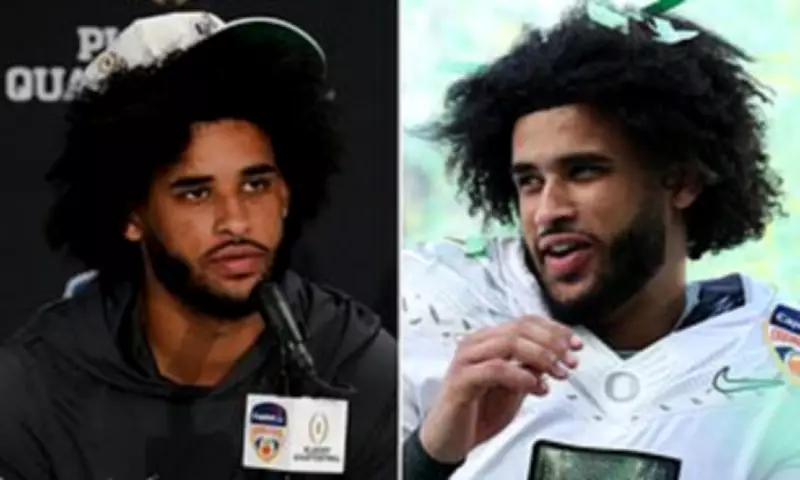
University of Oregon quarterback Dante Moore has courageously opened up about his profound struggles with mental health issues, attributing them to the immense pressure he faces as a college football player. In a deeply personal letter addressed to Oregon Governor Tina Kotek, which was shared with The Oregonian/OregonLive and published on Monday, Moore detailed his battle with depression and called for greater support for mental health services across the state.
A Candid Disclosure of Personal Struggle
In the correspondence dated March 3, Moore wrote, 'Early in my college career, I found myself struggling deeply: I was depressed.' He explained that the pressure and expectations associated with playing quarterback at an elite level felt overwhelming when he was just 18 years old. Compounding this stress, around the same time, his mother was diagnosed with cancer, creating an emotional burden that tested his resilience.
'Watching her endure chemotherapy while I tried to stay focused on school and football challenged me mentally and emotionally,' Moore revealed. 'It was heavy in ways that are difficult to put into words.' His mother, Jera Bohlen-Moore, was diagnosed with breast cancer in 2023 while he was attending UCLA. Fortunately, she was declared cancer-free in the summer of 2024, a relief that has since motivated Moore to continue supporting cancer awareness initiatives.

The Critical Role of Support Systems
Moore emphasized that access to support was pivotal in his recovery journey. 'In my life, what made the difference was support,' he wrote. 'Support from my friends, love from my family, and access to the resources I needed to get better.' He highlighted the particular challenges faced by young Black men and athletes in seeking help, noting that reaching out often feels like an uphill battle requiring vulnerability and trust.
His letter to Governor Kotek specifically aims to protect and expand virtual mental health services in Oregon, which Moore credits with providing crucial assistance during his darkest moments. He advocates for these resources to be more widely available, ensuring others in similar situations can find the help they need without stigma or barriers.
Leadership Beyond the Football Field
Moore connected his personal experiences to his role as a leader, both on and off the field. 'I recently challenged my teammates to lead beyond the field and use our platform to support people who feel voiceless,' he wrote. 'Leadership is not just about what we do on Saturdays -- it is about who we stand up for every day. As a quarterback, I am expected to lead, stay composed, and carry responsibility for my team.'
He reflected on how prioritizing his mental health has transformed him, stating, 'Learning how to care for my own mental health made me a better leader, teammate, and student. I know what it feels like to struggle in silence. I also know what it feels like to be supported and to come back stronger. That support saved me.' This message underscores the broader impact of mental health on athletic performance and personal growth, advocating for a cultural shift in how mental wellness is perceived in sports and society.