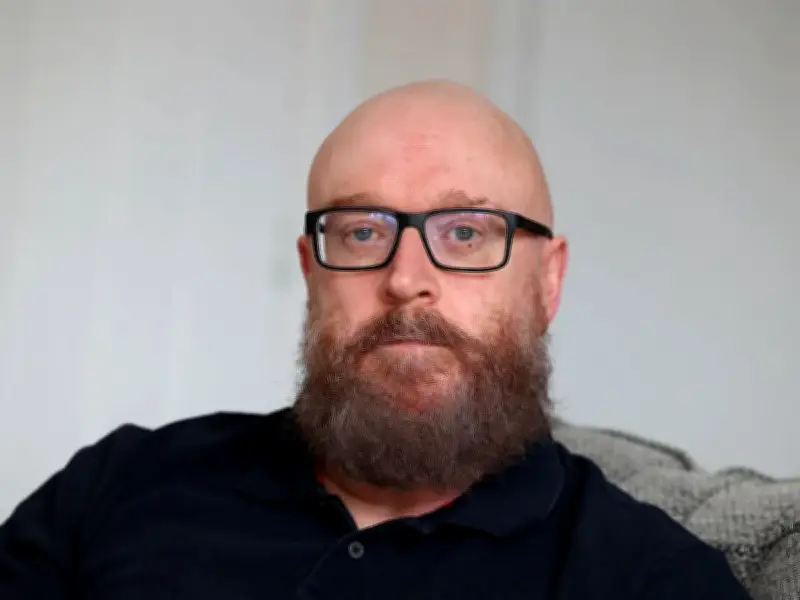
Paul Price, who suffered catastrophic injuries in the Manchester Arena bombing and lost his partner Elaine McIver, has credited a rehabilitation programme funded by public donations with transforming his recovery and helping him find purpose again.
Paul, now 59, spent nine months in hospital after the attack on May 22, 2017, during which he lost his ability to walk independently. He had been waiting with Elaine to collect his daughter from an Ariana Grande concert when the bomb was detonated. Elaine, a detective constable with Cheshire Police, died at the scene.
Paul spent his 50th birthday in a coma and underwent an estimated 30 operations while in hospital. He suffered severe damage to his legs and hands, burns to his head and throat, and loss of hearing in his right ear.
Leaving hospital was a 'massive wake-up call'
After leaving hospital, Paul moved back in with his elderly parents in Liverpool, unable to live on his own. He told the Manchester Evening News: "Nine months is a long time. The world had changed. I had changed. It was frightening coming out."
He added: "To go from that environment to a house that's not designed for someone with disability, district nurses and physios coming once a week, it was a massive wake-up call. All the hard work I had done in hospital to get to that point, I felt like it was a waste."
"I couldn't see a future at that point. I just thought, all this hard work - the pain, the operations - I'm going to watch the world from my window and vegetate from the couch," Paul said.
£21.8m fund supported specialist programme
Nine years on, Paul walks independently and does talks for the Home Office, charities and organisations that support people with life-changing injuries. He attributes his transformation to a two-year programme funded by members of the public after the attack.
An estimated £21.8m was raised for the We Love Manchester Emergency Fund, including £2.5m from the M.E.N.'s We Stand Together campaign. Some of the money, alongside funding from NHS clinical commissioning groups in Greater Manchester, went towards the Enhanced Rehabilitation Programme (ERP).
The programme provided intensive, personalised support for survivors still struggling with physical and psychological consequences more than a year after the attack. It brought together physiotherapists, psychologists, occupational therapists, surgeons, sports scientists and rehabilitation specialists at the Manchester Institute of Health and Performance (MIHP).
'I felt like an athlete'
Paul described his first visit to the MIHP: "I was offered that opportunity. I thought 'wow, this is a second chance'. It was the first time I did not feel like a patient. I felt like I was actually training for some sort of big event. I felt like an athlete."
He attended the MIHP three or four times a week during the project. "It set me on the path of being able to go to my local gym, carry on the work I had done there," Paul said. "I'm trying to be as healthy as I can for whatever life brings next."
Before the attack, Paul worked on the production line at Jaguar Land Rover in Halewood, Merseyside. The thought of returning to work kept him going through the early days of his recovery. "If I didn't have that goal I don't think I would have got through what I went through. I would have thrown the towel in," he said.
Coming to terms with loss
Alongside his physical recovery, Paul had to cope with the loss of Elaine. The couple had been together for three years. "We were just so grateful that we had found one another at a later stage in life," he said. "We used to often say to one another that in this big world with so many people, we could not believe that we had found each other."
Paul found it easier to open up to his physio during the scheme. "It was someone I got really close with and I could talk to them about it," he said. "They knew what had happened, I didn't need to recount my story. It wasn't just the physiological side of going to the MIHP - it was the emotional side as well."
He added: "It's an ongoing journey. You have good days and bad days. Anniversaries can be tough, birthdays, Christmas. But just a normal day too - I miss and love Elaine every day."
Study highlights benefits and challenges
Researchers from the Universities of Manchester and Salford, plus Manchester University and Northern Care Alliance NHS Foundation Trusts, found that ERP participants experienced substantial improvements in physical recovery, confidence, fitness, mental wellbeing and overall quality of life. Survivors described achieving goals they once thought impossible, from walking without aids and reducing pain medication to returning to work and pursuing further education.
The study found that post-trauma recovery should address psychological and social wellbeing, not just physical injuries. It also highlighted concerns about what happens when specialist rehabilitation ends, with patients and clinicians describing a feeling of stepping off a rehabilitation 'cliff edge' once the programme concluded.
Professor Jason Wong, Professor of reconstructive plastic surgery and regenerative medicine at The University of Manchester and consultant trauma surgeon at MFT, said: "This study is ultimately a story about resilience. The survivors we worked with faced life-changing injuries and experiences, yet many went on to achieve things they never thought would be possible."
He added: "Our findings show that structured, multidisciplinary rehabilitation can make a real difference, but they also highlight an important challenge. Recovery doesn't end when someone leaves hospital, and access to rehabilitation does not always provide the specialist input required."