
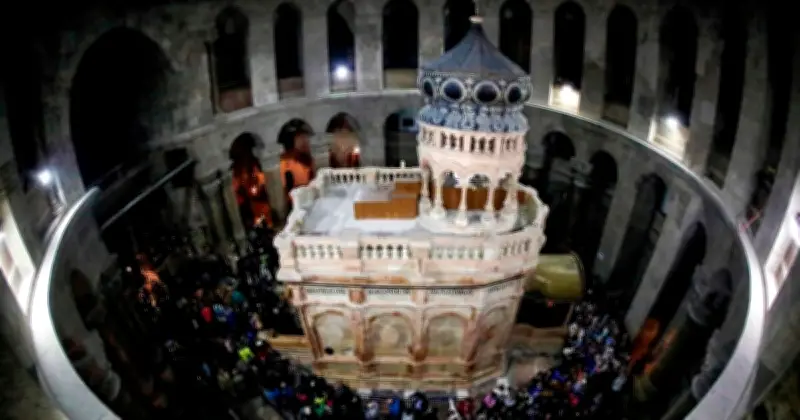
Archaeologists have uncovered the remnants of a 20ft-wide marble monument built around a burial chamber Christians believe once contained Jesus Christ's body. The tomb lies within a shrine at the Church of the Holy Sepulchre in Jerusalem and has been venerated as the site where Jesus was crucified, buried and resurrected.
Discovery of the circular monument
Experts found the remains of a circular, marble monument around the chamber. Its discovery led some to suggest it was possibly built there as early Christians believed it was where Jesus was buried, the Daily Mail reports. Researchers propose that its circular shape could recall an original monument commissioned by Constantine almost 1,700 years ago.
Archaeologist Francesca Romana Stasolla suggested the monumentalisation was "kept to a minimum" to preserve as much of the original "venerated" tomb as possible. Researchers said the discovery was the earliest archaeologically documented monument built around the burial place.
Historical significance and restoration
Ms Stasolla said the link between Jesus and the tomb was transmitted down the generations after it "crystallised" within the early Christian community. The Church of the Holy Sepulchre was built to cover the site of the cross on which Jesus was crucified and the tomb where he was buried.
It has been rebuilt several times since Constantine first built a church on the site. That holy building was dedicated in about 336 CE. Much of the church that stands on the spot now dates back to 1810. The shrine enclosing the tomb was restored in 2016, when the tomb was opened after being sealed for hundreds of years.
Ongoing debate and evidence
Parts of the tomb and a marble slab covering it date back to 345 CE. Elsewhere in the church, the Rock of Calvary, where Jesus is believed to have been crucified, is at the Altar of the Crucifixion. Some experts doubt that the church is where Jesus was buried, suggesting that the Garden Tomb is a better match for the descriptions found in the Bible.
Ms Stasolla suggested that the surviving marble of the monument could have resulted from restoration work following the Persian attack on Jerusalem in 614 CE. Researchers believe the monument's shape matches depictions of the shrine, although only part of the marble base survives.




