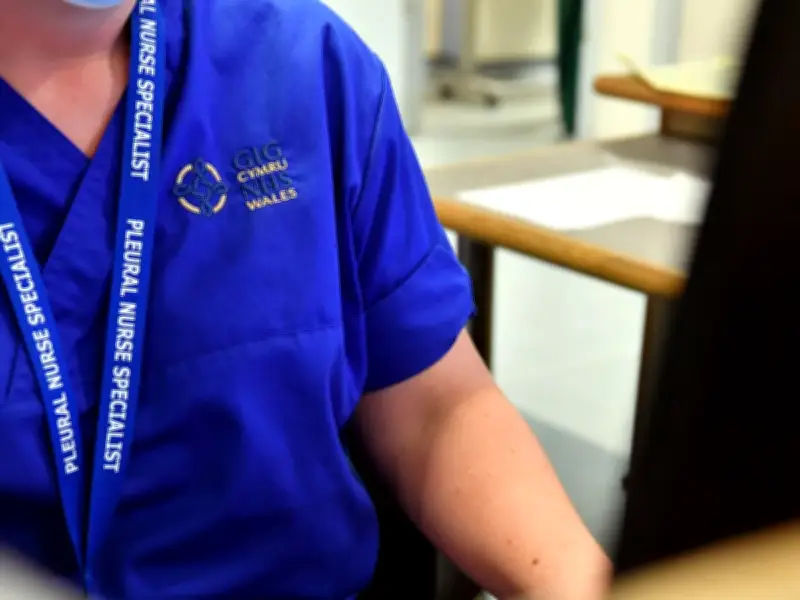
The Welsh Government has confirmed that more than 250 nursing graduates have been placed into roles within NHS Wales since June, following a period of intense uncertainty for newly-qualified nurses.
On Sunday, October 18, the Welsh Government announced that 253 additional graduate nurses had been placed in roles across NHS Wales, ensuring that the remaining unallocated nursing graduates were in employment. A further 28 graduates had either secured employment through other routes or were not currently available for work.
Background to the crisis
In 2025 and 2026, nurses graduating from Welsh universities struggled to find jobs which they had been led to believe were almost guaranteed. Earlier this year, figures from Health Education and Improvement Wales (HEIW) revealed there were no NHS jobs for three in 10 nurses graduating in Wales this summer.
HEIW said just 809 roles would be made available across the NHS for nurses qualifying during the remainder of 2026. This would have been equivalent to 69% of nurses who had trained in the last three years and were due to graduate.
Impact on nursing recruitment
The Royal College of Nursing (RCN) said the creation of the roles marked significant progress but noted that uncertainty had led to a huge reduction in people accepting places onto nursing degrees in Wales. Since 2022, the RCN said there had been a 26% reduction in prospective students accepting places on courses in Wales – the biggest reduction across the UK.
The Welsh Government said lessons learned from the experience of the 2026 cohort would be used to help ensure future workforce planning, education commissioning, and service needs are more closely aligned.
Official response
Minister for health Mabon ap Gwynfor said: "I fully recognise how worrying the situation has been for newly qualified healthcare professionals waiting to start their careers. The progress we've made since the graduate summit shows what can be achieved, but there is still much work to be done, especially for midwifery graduates, and we remain committed to helping graduates into employment and retaining their skills within NHS Wales."
RCN Cymru said a small number of graduates still didn't have jobs but health boards were working to identify suitable vacancies. The nursing body said the challenge was no longer about the overall number of roles but a mismatch between where vacancies are and where graduates are able to work, as well as limited opportunities in certain fields.
In response to the announcement, executive director of RCN Cymru, Nicola Williams, said: "The Royal College of Nursing Cymru (RCN) recognises the work that has been undertaken to ensure that every Welsh nurse graduate who wishes to work in Wales as one of our newly-registered nurses has a job. We are sure this news will come as a huge relief to many newly-registered nurses in Wales who have spent recent months distraught at the prospect of possibly not having a job in their chosen career after three years of training and hardship, facing significant uncertainty at what should be an exciting point in their careers."
Ms Williams continued: "We cannot see a repeat of this situation for student nurses' graduating over the next year and beyond. We need nurses training to work here in Wales. At a time when health and care services are being redesigned to deliver more integrated, person-centred care, nursing must be at the heart of workforce, education, and service planning. It's essential that nursing workforce planning, education commissioning, and recruitment processes are aligned so that students who choose to train to become a nurse in Wales can have confidence that opportunities will be available when they qualify. Getting this right is fundamental to building the future nursing workforce and delivering the transformed services that individuals, families, and communities deserve."