This week's best wildlife photographs from around the world capture a stuck raccoon, a hardy mouse, and a well-camouflaged wildcat, among other fascinating creatures.
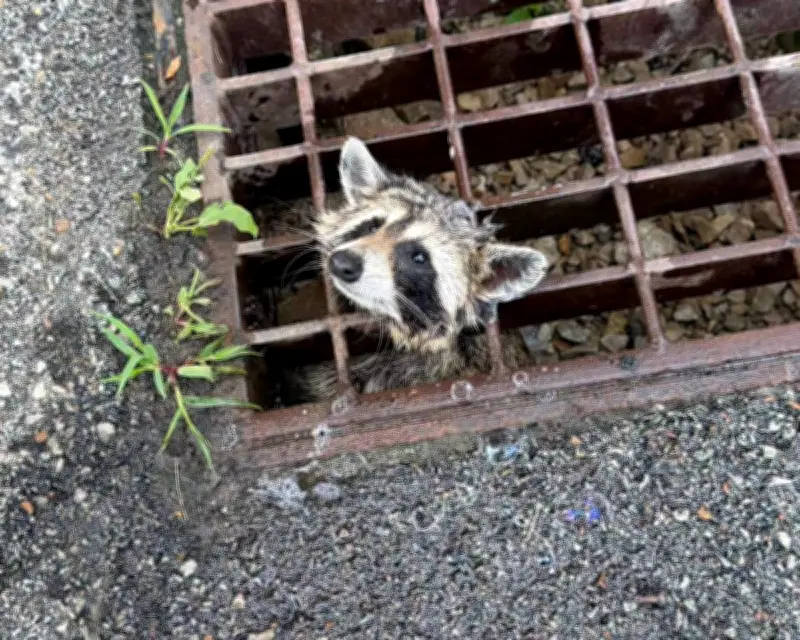
Raccoon Rescued from Storm Drain in Pennsylvania
A little raccoon waited patiently to be rescued in rural Pennsylvania, US, after it became trapped in a storm drain. A local resident first tried to ease it out using washing-up liquid and water. When that failed, firefighters were called in with hydraulic "jaws of life" equipment. They lifted out the entire grate, with the raccoon still stuck in it, and then carefully cut away the metal bars. Once free, the raccoon scampered off into the undergrowth, unharmed.
Hardy Mouse Thrives at 7,000 Metres
Scientists were astonished to find an Andean leaf-eared mouse living at the summit of a remote volcano in the Andes, nearly 7,000 metres above sea level. In a habitat with scarce oxygen, sub-zero temperatures, and toxic plants as the main food source, the mouse appears to be thriving. "Evolution never ceases to surprise us," said one of the researchers.
Camouflaged European Wildcat in Greece
A European wildcat blends into its surroundings in a forest near Grevena, northern Greece. Brown bear numbers in the area have risen steadily due to conservation measures, with a 2025 survey counting about 900 bears – nearly double the total recorded six years earlier. The Arcturos bear sanctuary in Nymfaio, northern Greece, provides a refuge for bears rescued from captivity or found injured in the wild.
Harpy Eagle Chick Born in Bolivia
A harpy eagle chick was documented as part of the National Program for the Conservation of the Harpy Eagle in Santa Rosa del Sara, Bolivia. This birth is the second recorded in Bolivia within a year and represents a significant step forward for the conservation of the species, one of the largest eagles in the Americas.
Loggerhead Sea Turtles Released in Turkey
Two loggerhead sea turtles named Inci and Mercan were released into the sea in Antalya, Turkey, after being fitted with satellite tracking devices. They are being monitored as part of a research project looking at their migration habits and adaptations to the climate crisis.
Northern Bald Ibises Rebound in Turkey
Northern bald ibises, whose population fell below 100 in Turkey during the 1970s, are multiplying again thanks to long-term conservation efforts. One has been placed into a cage at a protection station in Sanliurfa, where it will live until the breeding season begins in February, when it will be released back into nature.
Ringed Seal and Arctic Threats
A photo of a ringed seal won the New Scientist Editors award in the Earth photo awards 2026. The seal is resting on a sand spit on Banks Island in the Arctic. Rapidly melting sea ice has left it stranded on the landward side. Thawing permafrost also releases sediment, which carries mercury, into the ocean. Traces of this toxic metal have been found in seal fat, threatening marine life and disrupting the ocean's chemistry and food chain. The health of humans who rely on marine animals for food is also at risk.
Milu Deer Rebound in China
Milu deer graze and wade through water at Yelu Dang wetland in Yancheng, Jiangsu Province, China. The deer were declared extinct in the wild in China due to hunting and habitat loss, but a small population from zoos in Europe was reintroduced in 1985, and the population has rebounded. Jiangsu Province now serves as the largest wild sanctuary for them in the world.
Other Highlights
Other images include a robber fly in Costa Rica, an egret tending to chicks in India, a white stork in Hungary, a monkey exploring earthquake rubble in Venezuela, a darter dragonfly at Kew Gardens, a caterpillar in Costa Rica, a northern Pacific rattlesnake in Oregon, a pelican in London's St James's Park, flamingos in Germany, butterflies in Turkey, an owlet in Pakistan, a deer in California, a blue-throated bee-eater in China, and more.