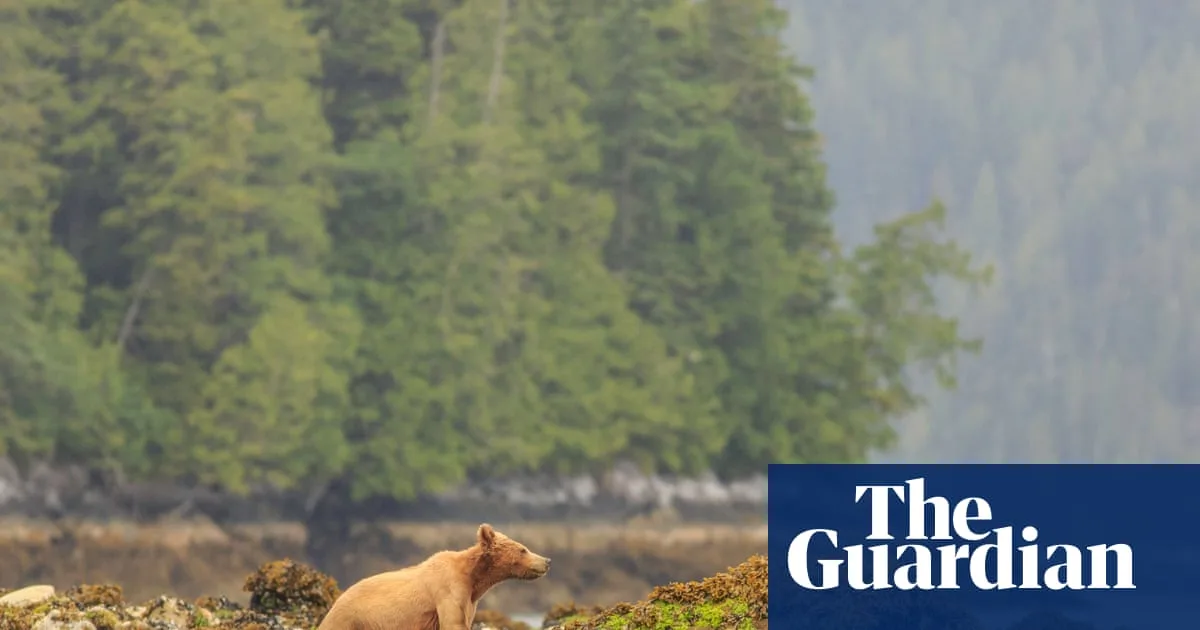
The journey of Tex, a young grizzly bear that gripped public attention in Canada after swimming to a populated island near Vancouver, came to a violent end this week after he was shot and killed without authorisation, despite plans by Indigenous groups to relocate him.
The four-year-old bear’s landfall on 25 May on the 300 sq km Texada Island, in the Strait of Georgia, set off a controversy between differing interpretations of how to treat wild predators. Provincial officials insisted Tex posed a danger to residents, noting he had already 'stalked' two people on the mainland before swimming to the island and had been moved once before.
Local First Nations communities offered weeks ago to rehome the bear to their territories. But some of the island’s 1,200 residents felt Tex should be euthanised instead, said Katrin Glenn, a longtime Texada resident and creator of the 'Save Tex' Facebook group. 'I’ve always said, Texada Island is not safe for him. And it’s not because of the land, it’s not because of anything but the people here,' she said.
The province’s conservation officer service said on Tuesday it was investigating the death of a grizzly bear, which they confirmed had been shot. Bear behaviour specialists said Tex was simply a young male bear gaining independence by exploring. In June, several First Nations communities offered a strategy to relocate the bear, and a coordinated effort between the shíshálh, Tla’amin and Homalco First Nations to relocate the bear to Homalco territory was under way when Tex was killed.
'We are deeply saddened by this outcome. Tex’s life mattered, and our Nations had come together in a good way to find a peaceful solution,' said Tla’amin Nation in a statement. Mamalilikulla First Nation Chief John Powell said he was devastated the bear was killed and angry the government was slow to listen to Indigenous communities. 'I knew the writing was on the wall when there was resistance with the government,' Powell said, adding that 'it really has to examine its approach to this situation, because this is not the last time this will happen.'
Randene Neill, the province’s minister of water, land and resource stewardship, said on Tuesday that authorities had been working in partnership with the First Nations to move Tex, calling the timing 'especially unfortunate'. But Nicholas Scapillati, head of the Grizzly Bear Foundation, said the tragedy of Tex’s death contained an important lesson for the province. Powell noted that British Columbia passed legislation in 2019 to align with the UN Declaration on the Rights of Indigenous Peoples, and said the Tex incident showed the government still had a long way to go when it comes to consulting with First Nations. 'I hope they examine this result objectively,' he said. 'Their inaction was responsible for killing this bear.'