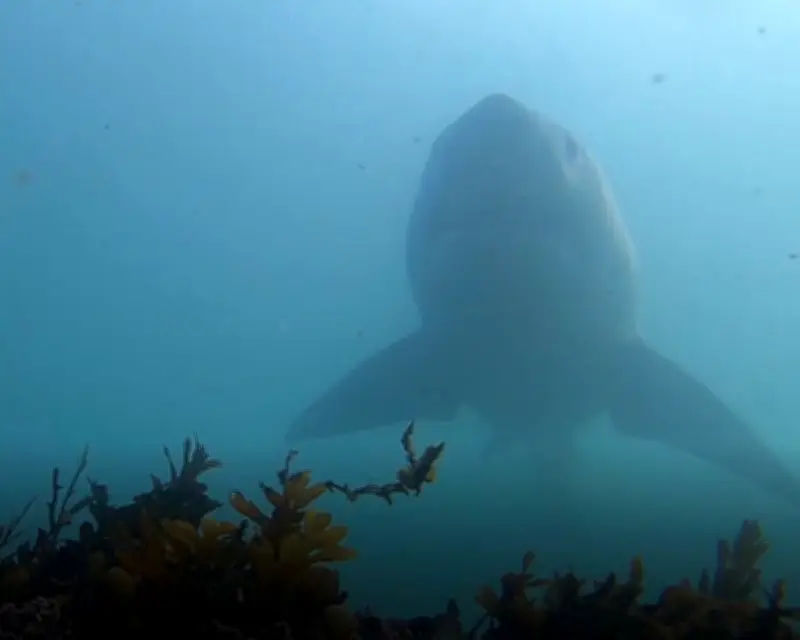
Record Numbers of Juvenile Great Whites Expected Off California Coast
California is bracing for one of its sharkiest summers in a decade as large numbers of juvenile great white sharks migrate north from the warm waters of Mexico. Scientists have already observed unprecedented early arrivals, with baby white sharks appearing off the coast in February—two months earlier than usual.
Dr. Chris Lowe, director of the Shark Lab at California State University Long Beach, reported that his team has been tracking the phenomenon. “We’re already seeing a high number of white sharks,” he said. “We started seeing baby white sharks in February, which we’ve never seen before. Usually that happens in April.”
El Niño Drives Sharks North
The primary driver behind the surge is the El Niño climate phenomenon, which was confirmed by the National Oceanic and Atmospheric Administration (NOAA) in early June. El Niño warms Pacific waters, pushing cold-water species—including great whites—northward or into deeper waters.
Lowe noted that similar conditions occurred in 2015, another El Niño year coinciding with a marine heatwave known as the “Blob.” During that period, his lab observed twice as many white sharks along the California coast. “When we have these El Niño conditions, it gets too warm, and the white sharks don’t like it,” Lowe explained. “And it pushes them into California.”
The warming waters also alter prey availability. In 2015, subtropical species like mahi mahi replaced usual populations of squid, anchovies, and sardines, creating a buffet for great whites. Lowe expects similar shifts this year, including the arrival of smooth hammerhead sharks, bull sharks, and tiger sharks.
Juvenile Sharks Close to Shore
Most of the sharks off California are juveniles, ranging from 6 to 9 feet in length. Born live at about 5 feet, they spend much of their time in shallow coastal waters where prey like stingrays, fish, and squid are abundant. This brings them into close proximity with swimmers and surfers.
Despite the increased shark presence, incidents with humans remain rare. Since 1950, California has recorded fewer than 250 shark incidents across all species, with only 17 fatalities. Over 85% of those incidents involved white sharks. However, conservation measures have led to growing white shark populations, yet bites have not increased proportionally.
“We always assumed that the more sharks and the more people you put together, the higher the likelihood of bites,” Lowe said. “But what we’re seeing in California is actually the opposite.” He attributes this to sharks learning that humans are not prey. “These sharks are around so many people, and they recognize that we’re not prey.”
Emergency Regulations to Protect Sharks and People
In response to the anticipated shark influx, the California Department of Fish and Wildlife passed emergency regulations last month prohibiting certain fishing gear on beaches and piers to prevent accidental hooking of white sharks, which are fully protected in the state.
John Ugoretz, a pelagic fisheries and ecosystems program manager at the department, expressed concern about interactions between sharks and fishing gear. “What we’ve seen already this year is a pretty significant increase in people interacting with those white sharks in southern California in particular,” he said. “That includes people fishing for white sharks.”
Ugoretz warned that a hooked shark trailing fishing line could pose a danger to swimmers. “We’re just very concerned with the potential, not only for additional sharks being caught and killed, but also the potential for a hooked shark to wrap the line around a swimmer, or even in a worse case, biting someone while it’s fighting on that line.”
Shark Sightings Remain Rare, Officials Advise Caution
Both Lowe and Ugoretz stressed that shark bites are extremely uncommon. Ugoretz compared a white shark sighting to seeing a mountain lion or bear on a hike—a rare encounter that should be met with caution but also appreciation. “If you do, you’re probably lucky because you’re seeing them at all,” he said. “It’s part of the diversity of the marine environment.”
Lowe, who swims daily with white sharks, said his research has given him confidence. “Flash forward 20 years later, based on all our drone data, I swim with these white sharks every day, and I have no qualms doing it,” he said. He noted that sharks have learned humans are not food, though occasional bites do occur, possibly due to mistaken identity.
As summer progresses, Lowe expects even more sharks to appear. “As I’m speaking to you, a white shark is swimming by a surfer or swimmer who doesn’t know the shark is there.”