
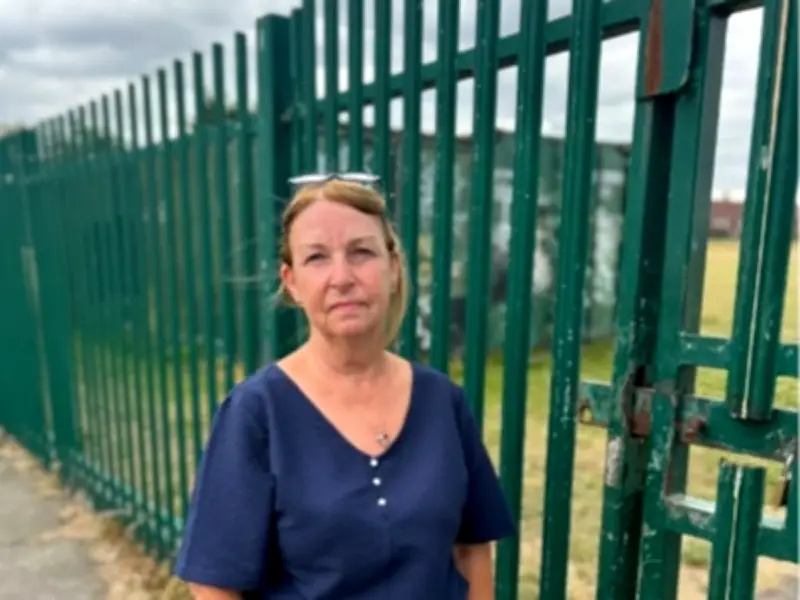
Dawn Millea has lived in Speke for most of her 63 years. She raised four daughters there and is now a grandmother to 16 grandchildren, many of them living locally. But she says the place they call home is unrecognisable from what went before it and in danger of being forgotten about altogether.
A village swallowed by the city
Speke, around seven miles south-east of Liverpool city centre, began as a village of farmland and cottages. It was incorporated into Liverpool Corporation and merged with the city in 1932. The small population of 400 exploded to 25,000 by the end of the 1950s. Speke Airport, now John Lennon Airport, began operating in 1930, and its continued expansion, plus the arrival of factories and industrial sites, went on to define the area for generations.
'Completely hemmed in'
For residents, that definition has come at a cost. Dawn said: "If you don't live or work here, there’s rarely a reason to visit, so people don’t always realize that Speke is like a little self-contained place all on its own."
"Geographically, our housing estate is completely hemmed in on all sides. We have the John Lennon Airport runways on one side, the Oglet shoreline on the other. We are blocked in by the massive Jaguar Land Rover and Ford industrial plants and are cut off from the rest of Liverpool by the busy A561 Speke boulevard."
"Because we are boxed in by the airport, factories, and dual carriageways, our children cannot safely travel out of the neighbourhood on foot to find a playground or a sports pitch. We are entirely dependent on what is inside our own boundaries."
Lack of parks and schools
The lack of facilities for children has turned Dawn into a community campaigner. She and others are incensed by the lack of a proper park with playing facilities for the 4,000 children in Speke, an area with some of the worst poverty levels of council wards in the country.
As well as no substantial parks, there are no secondary schools serving the community. Parklands High School closed in 2014, although the £100m Private Finance Initiative deal it had been built under meant the council continued to pay millions for years afterwards. The school was later partially reopened as a Pupil Referral Unit.
The approximately 1,400 secondary school-age youngsters in Speke currently have to travel to high schools in Halewood, Widnes or Garston. Similar journeys are required for families wanting to take children to a park. Dawn said: "Recently, my grandkids wanted to go to the park, it took us three car loads to get to Hale Park and three car loads back. That's what we have to do every time. There is nowhere to play."
Lost central park
In the 1980s, Speke had a central park with play equipment and green space. During the 1990s, the space was altered, eventually sold off, and replaced by a Morrisons supermarket and car park.
Many of the remaining green spaces are fenced off and locked up, and appear overgrown. On West Mains, there is a sizeable piece of land. "It's all hills with no flat spaces," Dawn said. "Kids can't do much there, it is not a park, there is nowhere for them to play."
A short drive away on Central Way, Little Heath playing fields are fenced off and locked, but youngsters have removed a section of fencing to get in. "That's council-owned," Dawn said. "We had a football team in Speke but they haven't got anywhere to play now. The field is locked up and no one is using it. As you can see the kids have found a way to get into there because they haven't got anywhere else to go."
Housing development and 'prison fencing'
On South Parade, work is ongoing for a large housing development by South Liverpool Homes. When completed, there will be 92 new homes. Dawn said: "When will the focus shift from pouring concrete foundations to investing in the actual community infrastructure like a park? We just get more houses, more people and not enough facilities."
Directly over the road is another unkempt space with prison-style fencing. "These fields have just been left to rot. They are not fit for anything and they have been like this for years," Dawn said. "A lot of the kids are saying that if they do get a park, they don't want this prison fencing around it. They say everywhere they look in Speke, it looks like a prison."
The Venny
There is one place the children of Speke can still go: The Venny, an adventure playground on Conleach Road, which has been a lifeline for generations over its 50-year existence. It is now the only full-time provider of children's services in Speke.
"It's all we have got left," Dawn said, who campaigned to keep The Venny open in the 1980s. "My kids used to go there when they were little, it was like their second home. It is only open at certain times now but it is an absolute lifeline for people in Speke. Without that we would have literally nothing."
Liverpool City Council says it is investing in Speke and will spend cash on improving The Venny. The local authority also pointed to the recent replacement of a play area in Blackrod Avenue.
'Very, very last piece of land'
On Stapleton Avenue, the former site of Stapleton Avenue School now has a concrete 5-a-side football court and some green space. Both the former Pope John Paul School on Alderwood Road and the former Speke Comprehensive School in Central Avenue were demolished for hundreds of new homes. Dawn said promises about a new park never materialised.
"So this space," she said, gesturing at the basic park, "is the very, very last piece of land that is big enough for a communal park for the kids of this area."
"As you can see a lot of Speke just looks like wasteland. But the kids are coming up with great ideas for how to make this area better. They just want things that normal kids want, a place to play and have fun. It isn't a lot to ask for. These are the dreams of young children around here."
Oglet Shore closure
Dawn also referenced the nearby beauty spot famously loved by a young Paul McCartney. In 2019, Dungeon Lane - the inspiration for Sir Paul's latest album - was partly closed as part of works to extend the airport's perimeter fence, cutting off local access to Oglet Shore.
"Why are they allowing our remaining green spaces to be bought up by private companies while ignoring local residents? Over 10,000 people signed the petition to save Oglet Shore and it was completely bypassed," Dawn added.
Unspent developer contributions
Dawn and fellow campaigners believe existing money is owed to Speke. Findings from a recent Freedom of Information request suggest that over a ten-year period the council received more than half a million pounds in developer contributions for Speke - with less than 10% actually spent on the area.
The cash comes from Section 106 payments, financial contributions made by developers to help mitigate the impacts of building. The money is intended for local amenities like affordable housing, road infrastructure and parks. "Why is that being hoarded in a bank account when our kids are playing on concrete street corners?" Dawn asked.
Government funding and community boards
Speke East is one of four areas of the city named as part of the government's Pride in Place communities, which aims to improve disadvantaged neighbourhoods with around £2m per year across a decade, with decisions made by resident-led neighbourhood boards. Earlier this year, the Rector of Speke, Reverend Philip Saltmarsh, was named as chair, promising to make sure that "every voice is heard to deliver meaningful impact" for the area.
"We just feel forgotten about," Dawn said. "It has been slow and they have taken a little bit from us here and there and people don't notice it when they are busy. But people are really noticing it now. They remember what we used to have and can see we have nothing now. These kids are our future and there is nothing for them."
"This place is crumbling around us. It has been systematically pulled apart and now it is just a forgotten area. I feel like I have to do something for the kids, because they are our future."
"I think the lack of a park is actually part of a much bigger picture here. It feels like Speke is systematically being stripped of almost every community resource that makes a neighbourhood liveable."
Council response
Deputy council leader, Cllr Ruth Bennett, insisted Speke had benefited from investment in recent years. She said: "The council has begun a programme of replacing play parks across the city and Speke has benefitted from this, a brand-new play area plus exercise equipment has been installed in Blackrod Avenue, and similar improvements will be brought to Speke Venny from September."
"We are exploring further support for grassroots football at Little Heath Playing Field with plans for a new changing room and during August we will be looking into how we can improve the infrastructure across Speke green space, including where new benches and bins are needed across the whole area."
"In the 2025/26 budget the Council significantly increased its provision, investing an additional £7.5m to improve street cleaning and the maintenance, management and operation of its green spaces across the city. This investment is in recognition that good quality usable greenspace benefits the health and wellbeing of the residents of Liverpool."
"The funding has seen the introduction of two new barrow walkers in Speke and a new parks maintenance teams to deliver a more consistent maintenance schedule, improving safety, usability and the overall presentation of our parks. In addition, the new funding will be used for the refurbishment of park infrastructure such as benches, bins, signs, and railings."
"Speke East is one of four areas of the city that will receive a share of £20 million through the Government's Pride in Place Programme. How this funding will be spent will be decided by the local community and residents and through dedicated neighbourhood board."
"Similarly, Speke is one of 34 areas that has been identified as part of the Council's Community Renewal Fund. The fund is targeted at areas in the city with high levels of deprivation, Speke will receive a share of £1.8 million investment each year, which has been designed to be community-led, allowing it to be spend on the priorities that matter most to local residents."




