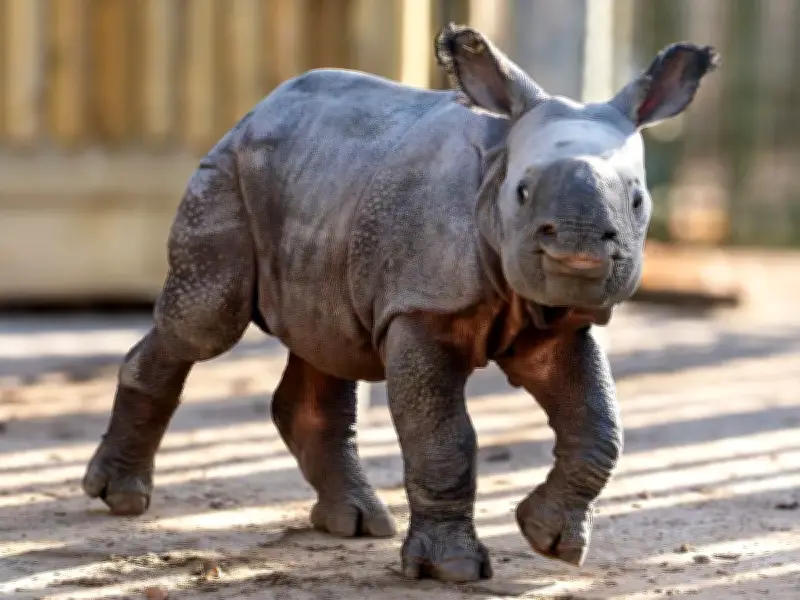
A rare greater one-horned rhino calf has been born at Chester Zoo, offering a boost for a species once pushed to the brink of extinction. The birth occurred on November 11, after a 15-month pregnancy for mum Asha, and was captured on CCTV.
Birth captured on camera
Footage shows Asha carefully manoeuvring herself into the corner of her enclosure before the newborn arrived. Moments later, the exhausted mum turned around to lick and tend to her youngster before lying down to rest. The tiny calf, who shares her parents' "slightly wrinkled armoured plating", got to its feet for the first time less than an hour after being born and took its first shaky steps.
Keepers at the zoo say both mum and baby, whose gender has not been revealed, are doing well and have already ventured outside together. Images show Asha confidently leading the way out of her pen, while the nervous calf, who is yet to be named, hesitates at the entrance before following its mother around the outdoor enclosure.
Important arrival for species
The newborn tipped the scales at around 45kg (7st) at birth, about the size of a large adult dog. One day it could weigh more than two tonnes, the same as a family car. The calf is the fourth youngster born to 19-year-old Asha and father Beni, 22, who died earlier this year following a short and sudden illness.
Tom Garland, assistant manager of the zoo's rhino team, said: "It's always exciting to welcome a new calf and Asha has been a brilliant mum to all her youngsters. Every birth is important for the future of this species and it's wonderful to see another healthy arrival."
Legacy of Beni
Garland added: "Beni was a lovely rhino. He was calm and approachable, helped train animal care specialists and even took part in animal behaviour studies. It's lovely to know that his legacy lives on through this calf."
Emma Evison, team manager for rhinos, said: "We had our fingers crossed when she showed signs of labour and we knew we were likely to welcome the calf very soon. It was a big moment for us - and for the conservation breeding programme - when the calf arrived. Any birth can be risky, even for an experienced mum, but fortunately everything went smoothly. The calf was up and about within an hour and feeding shortly afterwards. Asha knows exactly what she's doing."
Conservation efforts
There are thought to be around 4,000 greater one-horned rhinos left in the wetlands, forests and grasslands of India and Nepal. While conservation efforts have helped the species recover, it remains vulnerable because many animals live in a relatively small number of protected areas.
The calf forms part of a Europe-wide conservation breeding programme designed to maintain a healthy and genetically diverse population of rhinos in human care. Conservation scientist John O'Hanlan said: "Supporting Asha's pregnancy has been really exciting. She's one of relatively few greater one-horned rhinos in Europe actively breeding, so every successful birth is important in maintaining a healthy and genetically diverse population."
Zoo experts spent months preparing for the arrival, carefully monitoring Asha's behaviour and collecting dung samples analysed in the zoo's science laboratory. By tracking hormone levels, scientists monitored her reproductive cycle, identified when she was most receptive to Beni, and later confirmed the pregnancy.