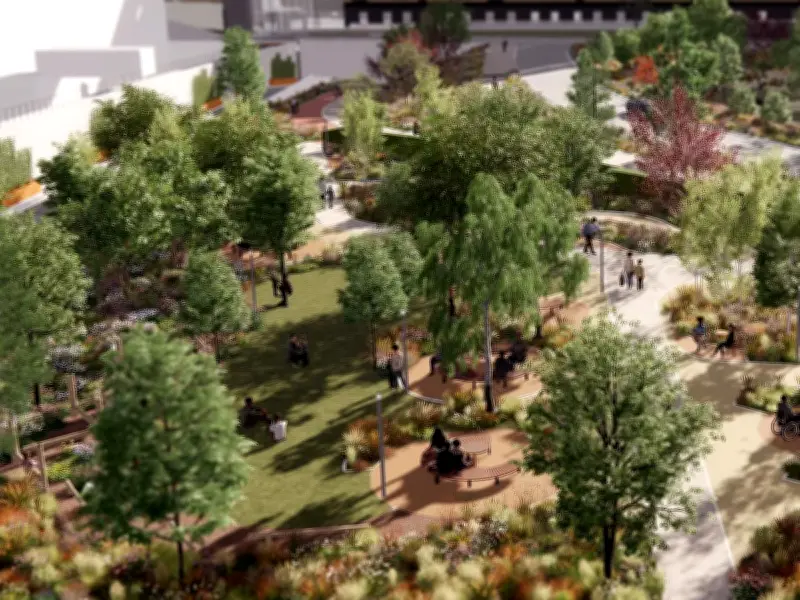
A new nature park is set for Liverpool city centre, featuring 163 new trees, native wildflower meadows, natural play areas and outdoor spaces designed to support community wellbeing. The former Royal Liverpool Hospital site on Prescot Street is to be transformed into a 'mini-Eden' through a garden and landscaping scheme delivered by one of the country's most outstanding environmental regeneration projects.
Approval and partnership
Liverpool City Council approved the initiative on April 17. The Eden Project (TEP) and contractor BAM UK & Ireland will work together with NHS University Hospitals of Liverpool to create the new public green space, as well as walking and cycling routes.
According to developers, which organised the first tree planting yesterday (September 29), the scheme has been designed to 'enhance healing' and provide a quiet space for relaxation for patients and staff at the new Royal hospital, as well as the wider community. The landscaping design will also use native species, aimed at encouraging pollinators and supporting 'long-term ecological viability'.
Design and ecological benefits
TEP plans on creating a 'mini-Eden' in the city centre, 'restoring nature' at the former Royal Liverpool hospital site, including the creation of a 'nature-rich' public garden. The nature garden is expected to set a new benchmark for the integration of natural environments in major public infrastructure, according to planning documents, demonstrating how design can create places that are both 'beautiful and beneficial for generations to come'.
In addition to the expected ecological benefits, 'mini-Eden' project planners said it will also create opportunities for community involvement, education and volunteering.
Early biodiversity measures
In July, BAM installed a 33-metre living 'vertical meadow' around the construction site, which uses native wildflowers and grasses to provide habitat and food for pollinators while the permanent park is being built. The idea is that biodiversity benefits do not have to wait until construction finishes.
“Just as importantly, it will create opportunities for people to connect with nature in the heart of the city”, said BAM UK & Ireland director, Zebrina Hanly. "This is exactly the kind of integrated approach we need if we are serious about delivering healthier places for both people and the environment."
Completion and community impact
The main nature park is expected to be completed in October 2027, with a ceremony conducted on site on Tuesday with stakeholders overseeing the planting of the first tree.
Development director at the Eden Project, Dan James said: “We’ve designed nature-rich spaces where patients can recover, families can find moments of calm, children can explore and play, and staff can step outside and decompress during a busy day. Healthy people need healthy places, and healthy places need healthy nature.”
Those sentiments were shared by group chief development officer at University Hospitals of Liverpool Group, Jenny Hannon who said: “Access to high-quality green space can often be limited in city-centre environments, and this project will transform the former hospital grounds into a welcoming park for patients, visitors, staff and local communities.”