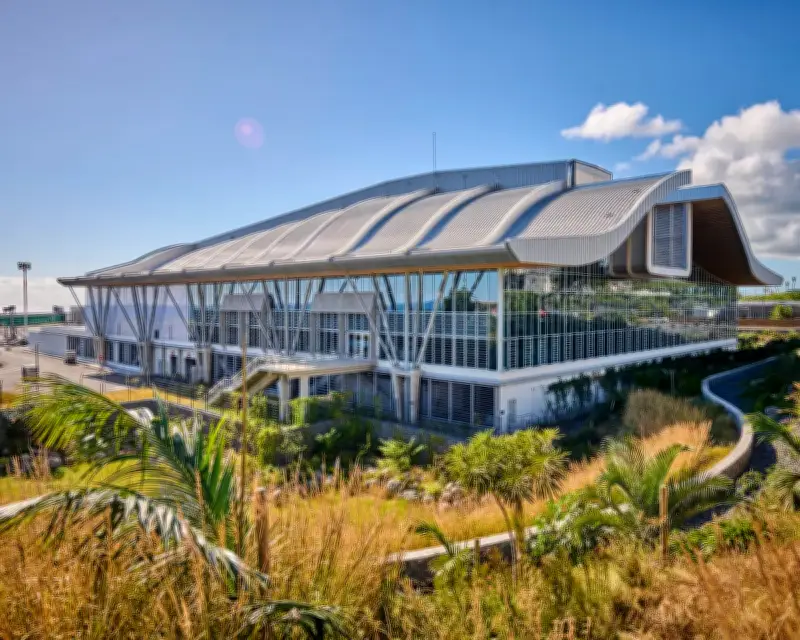
The arrivals terminal at Roland Garros airport on Réunion island is cooled by a light tropical breeze, the result of natural ventilation built into its unique design, rather than air conditioning. Since opening two years ago, the airport has saved €150,000 a year in energy bills.
Design and construction
The project began in 2016 as part of a wider effort by airport management to reduce its carbon dioxide emissions. Marc Delanoë, who was then leading the airport's environmental and energy team, was determined that the new arrivals terminal, built completely from scratch, would not use air conditioning.
“I took on the responsibility to prove to my management that not using air conditioning was feasible,” said Delanoë, now the airport's sustainable development director. “So, from the start, we never thought of this building having air conditioning being an option. It was a risky bet, but the further we went with our studies, the more we realised that we were right.”
How natural ventilation works
The roof of the terminal, which opened in 2024, curves upwards from each of the rectangular building's long sides in gentle waves. Instead of meeting in the middle, the roofs end abruptly to form a “canyon”. The creation of an area of low pressure funnels wind into the building through vents on each side that are adjusted depending on the weather conditions.
Ceiling fans with a 7.5-metre diameter help to circulate the air. In the 30C humid heat of Réunion's wet summers, which last from around November to April, the resulting breeze reduces the perceived temperature by four to five degrees. Less air is allowed to flow in during the island's dry winters, when the coastal daytime temperature falls to 25C and below. During a cyclone, the entire building is closed up.
Architectural philosophy and savings
The building's lead architect, AIA Life Designers, said it wanted to challenge the assumption that adjusting temperature was the only way for humans to cope with heat. “It is precisely this pitfall – understanding summer comfort solely through the lens of indoor temperature – that we want to dismantle, a pitfall that traps us in the logic of air conditioning as the only answer to comfort requirements,” said Éric Bussolino, the firm's engineering and environment director.
“Our objective is to maintain an indoor air temperature identical to the outdoor temperature while generating an airflow of 1 metre per second to reduce the perceived temperature for passengers.”
AIA partnered with a local architect, Olivier Brabant, who had expertise in designing buildings for the island's tropical maritime climate, Delanoë said. Building the arrivals terminal cost €75m, of which €15m went on a new baggage sorting system and €60m on the building. AIA said this amounted to savings of about 60% compared with an air-conditioned building, while carbon emissions were lower by a factor of eight.
Reception and limitations
Delphine Robert, who leads the local tourism board's welcome team, works in the terminal once a week and said she preferred it to other offices. “It's very airy. It's comfortable – a lot of light, the ventilation is optimal,” she said. “I find it better working in this building, because I am often sick. And that's the result of air conditioning, which is very strong in offices. So that's why it's more pleasant to work in a building where the air circulates, but it is natural.”
The lessons from the terminal's natural ventilation will be harder to apply in large, polluted cities in mainland Europe, said Delanoë. “You will concentrate the pollutants inside – it doesn't work,” he said. “We are lucky, we are on an island, there is no pollution around.” Continental Europe, struggling to adapt to heatwaves made more severe by the climate crisis, would also have to eschew air conditioning to make use of natural ventilation, Delanoë said.