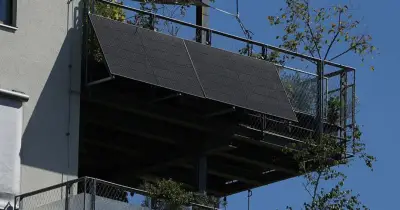
Households can buy plug-in solar panels which could knock £110 a year off their electricity bills without the cost of a conventional rooftop installation. Major names including Amazon, Argos, Currys and Wickes have committed to stocking the new systems, while the Government says B&Q and Screwfix have also worked with officials on the rollout.
The move opens the door to a new generation of cheaper, easy-to-use solar panels that can be positioned in a garden, outdoor space or, where permitted, on a balcony and connected to a household socket. An 800W kit could provide as much as 20% of an average home's electricity use, according to the Department for Energy Security and Net Zero. Crucially, the systems do not require the expensive professional installation associated with conventional rooftop solar.
How much do they cost?
The Government has previously indicated that a typical two-panel system could cost around £350 to £400, although prices will vary considerably between manufacturers and retailers. At the Government's maximum claimed saving of £110 a year, a £350 system could theoretically recover its purchase price in a little over three years. A £400 system would take around three years and eight months, while a £500 system would need about four-and-a-half years.

However, these figures assume households achieve the full £110 saving every year. The actual amount will depend on how much electricity the panels generate and, crucially, whether that electricity can be used in the home when it is being produced. Factors such as the direction the panels face, shading and the amount of sunshine they receive will all affect their performance.
What can £110 of solar power get you?
Each compliant plug-in solar kit can produce up to 800W of power. The Government says this is sufficient, when the sun is shining, to run a typical fridge, television, Wi-Fi router, laptop, phone charger and Xbox S at the same time. Over a year, it estimates the panels could provide up to 20% of the electricity used by an average household.
Electricity produced by the panels is fed directly into the home's electrical system, reducing the amount that needs to be bought from the grid. However, households without battery storage will get the greatest benefit by using appliances during daylight hours when the panels are generating electricity.
Warning for Britain's older homes
For many people, the attraction will be the apparent simplicity: buy the panels, position them outside and plug them in. But it may not be quite that straightforward for everyone. Britain has some of the oldest housing stock in Europe and household electrical systems vary enormously in age and condition.
People living in an older property - or anyone who does not know the condition of their wiring, consumer unit or protective devices - may need to get the electrical system checked by a qualified electrician first. The Government's safety specification says consumers should seek an inspection where a consumer unit does not have modern protective devices, is not clearly labelled or its condition is unknown. Electrical Safety First has similarly recommended that electrical installations are assessed before plug-in solar is used, particularly in older properties.
The concern is that electricity generated by the panels is being fed into the home's electrical wiring, which older systems may not have been designed to accommodate. There are also strict rules around how the panels are connected. Consumers should not use an extension lead or adaptor to plug them in.
The Government insists compliant systems are safe. It says the legal change follows rigorous independent safety testing of the key electrical components and that Britain's safety specification is tougher than that used in Germany.
Germany shows how big plug-in solar could become
Britain is relatively late to a technology that has already become a familiar sight elsewhere in Europe. Plug-in solar has been particularly successful in Germany, where the systems are widely known as Balkonkraftwerke – or 'balcony power plants'. Hundreds of thousands of households have installed them on balconies, terraces and in gardens.

The German Government said around 800,000 plug-in solar installations were already generating electricity from balconies and patios by early 2025. The country's energy regulator subsequently recorded around 430,000 new balcony solar installations during 2025 alone. And the British Government says around half a million new devices were plugged in in Germany last year. That experience is one reason ministers believe there could be a sizeable market in Britain, particularly among renters and people living in flats who have effectively been shut out of conventional rooftop solar.
Do you need permission?
Although the panels do not require a conventional solar installation, that does not necessarily mean householders can put them wherever they like. People living in rented accommodation may need permission from their landlord. Flat owners could require approval from the building owner or freeholder, while planning permission or listed building consent may also be necessary in some cases. The Government is encouraging landlords, freeholders and councils to consider applications on their individual merits.
Solar demand hits a record
The launch comes amid a boom in households turning to solar to escape high electricity prices. Almost 150,000 certified solar panel installations were completed in the first six months of 2026, according to MCS figures. That was 17% above the previous record start to a year in 2025 and is equivalent to one solar installation every 74 seconds. Battery installations have also surged, with some 36,000 certified installations in the first half of the year – almost double the figure for the same period last year.
Traditional rooftop solar can save homeowners up to £480 a year, according to the Government. However, it requires a much bigger upfront investment and is simply not an option for many renters and flat dwellers. Energy Secretary Miatta Fahnbulleh said: “Plug-in solar is a simple, affordable way for households to take control of their energy bills and start saving straight away.” Joanna O'Loan, Knowledge Manager at the Energy Saving Trust, cautioned that the savings will vary from home to home. She said: “While the savings will vary from home to home, plug-in solar panels will give more people greater control over their energy use and costs.”