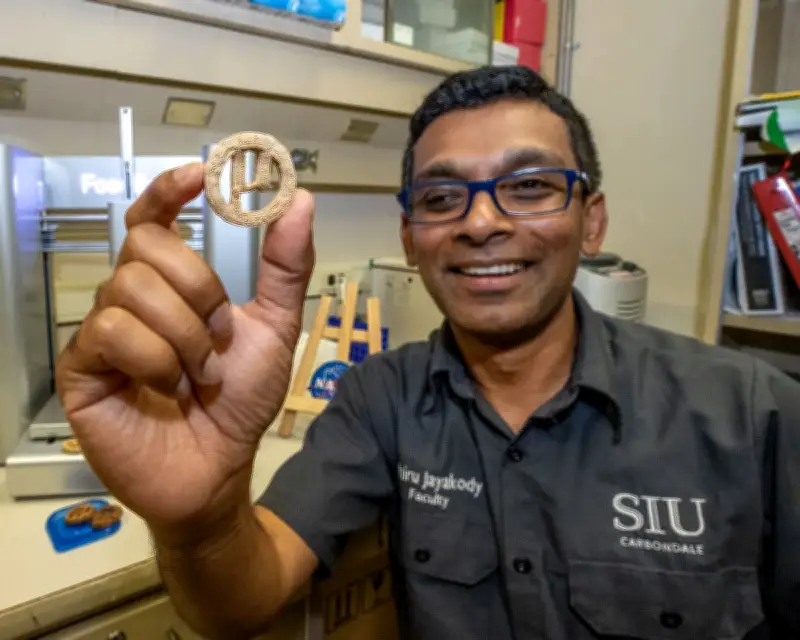
Cookies produced from upcycled plastic may sound like something straight out of a dystopian sci-fi plot. But researchers say that they have succeeded in creating such a product as part of a Nasa-funded project aimed at feeding astronauts on future space missions.
The technology uses specially designed yeasts to transform plastics and agricultural waste into edible proteins, fats and flavourings. The resulting slurry is passed through a 3D printer to create a disc-shaped “cookie”.
From plastic to food
“My lab works on developing technologies for plastic upcycling,” said Dr Lahiru Jayakody, a microbiologist at the Southern Illinois University Carbondale, who led the project. “We thought, why not look into food? Plastic is carbon and food is carbon.”

The team are yet to receive institutional sign-off to taste the plastic-derived cookies but report that they “receive high marks on aroma”.
Awaiting human testing approval
“We haven’t eaten them yet because we’re awaiting approval for testing in humans,” said Jayakody, before a presentation of the work on Monday at the meeting of the American Chemical Society in Chicago.
The method to transform waste plastic into nutrition was funded as part of Nasa’s Deep Space Food Challenge, which invited scientists to develop new food technologies to solve the problems of feeding astronauts on long voyages.
How the process works
“When an astronaut goes to Mars, they have to survive in extreme conditions,” said Jayakody. “The round-trip is three years. You have to use everything you have.”
In this case, the researchers took one of the most common forms of plastic, polyethylene terephthalate (PET), which is often the sole ingredient in single-use water bottles. First the PET is “digested” using a process involving water and oxygen at high temperature and pressure to break down tough material into smaller carbon-rich molecules. These are then fed to yeast, which have been genetically reprogrammed to use the plastic-derived molecules as food.
The yeast converts the carbon from plastic into new biological molecules, including proteins, fats and other nutrients, which can be mixed with starch and shaped into edible products. A different strain was used to produce vanilla flavouring from plant biomass.
Cost and future applications
Currently the cookies cost $60 a kilogram to produce but improving the yeast’s efficiency and scaling up production are expected to reduce the cost in future.
The team suggest that, besides long-distance space travel, the concept might be useful in extreme environments on Earth, such as on submarines or in disaster zones – or even as a mainstream ecological solution to the dual challenges of plastic waste and food production. “Global food demand is expected to rise 35% to 56% by the year 2050, and about 30% of the world population will be at risk of hunger in the future,” said Jayakody. “The way to address that, I believe, is by using microbes.”
However, the team acknowledge that before the cookies gain widespread acceptance the public may need to get used to the concept of eating plastic-derived food.