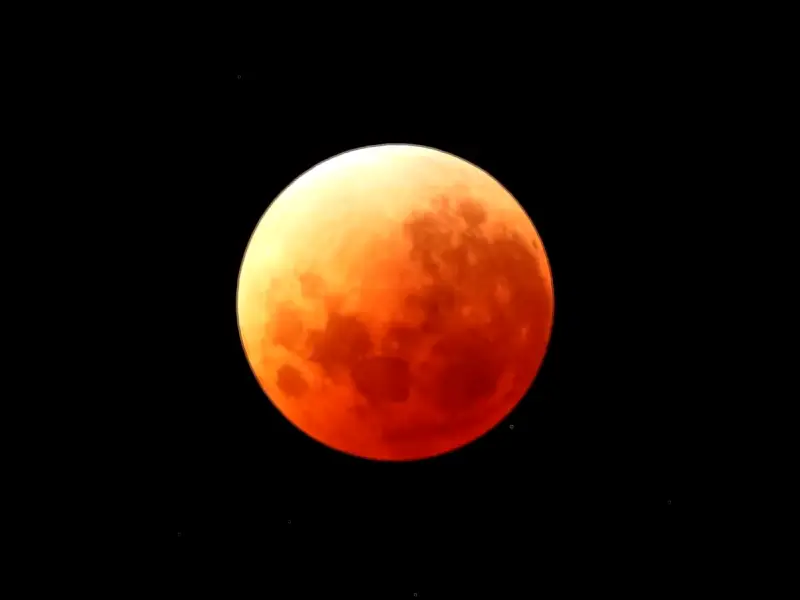
A deep partial lunar eclipse will be visible from the UK and Ireland in the early hours of Friday, August 28, with around 93% of the Moon in the darkest part of Earth's shadow at its maximum, according to Royal Museums Greenwich.
During a lunar eclipse, the Earth moves directly between the Sun and the Moon, causing the Moon to take on a deep red colour. This event follows the solar eclipse witnessed by many earlier this month.
Why the Moon Turns Red
Royal Museums Greenwich explained: "During a partial lunar eclipse, the portion of the Moon within Earth's umbra (deep shadow) may appear reddish or copper-coloured. This is because sunlight passing through Earth's atmosphere is scattered and refracted towards the Moon."

The eclipse will also be visible from North and South America, Africa, and other parts of Europe. For some time zones, the eclipse will occur in the late hours of August 27.
No Special Glasses Needed
Unlike the solar eclipse earlier this month, when special solar eclipse glasses sold out at major retailers, no special glasses are needed to view this lunar eclipse. Royal Museums Greenwich said looking at a lunar eclipse is as safe as looking at the full Moon.
Timings and Viewing Tips
The spectacle will begin at 2.23am when the Moon moves into the lighter part of Earth's shadow, the penumbra. The darkening will be subtle initially, becoming more prominent as the Moon moves deeper.
The partial phase begins at 3.33am, when the Moon starts moving into Earth's umbra. The maximum eclipse occurs at 5.12am, with roughly 93% of the Moon's visible surface in the darkest part of the shadow. The partial eclipse will end at around 6.51am, but the Moon will have set below the horizon before then, at approximately 6.15am in London. Timings will vary across the country.
For the best chance of seeing the full spectacle clearly, Royal Museums Greenwich said you'll need to find a high point with a clear view to the southwest.