
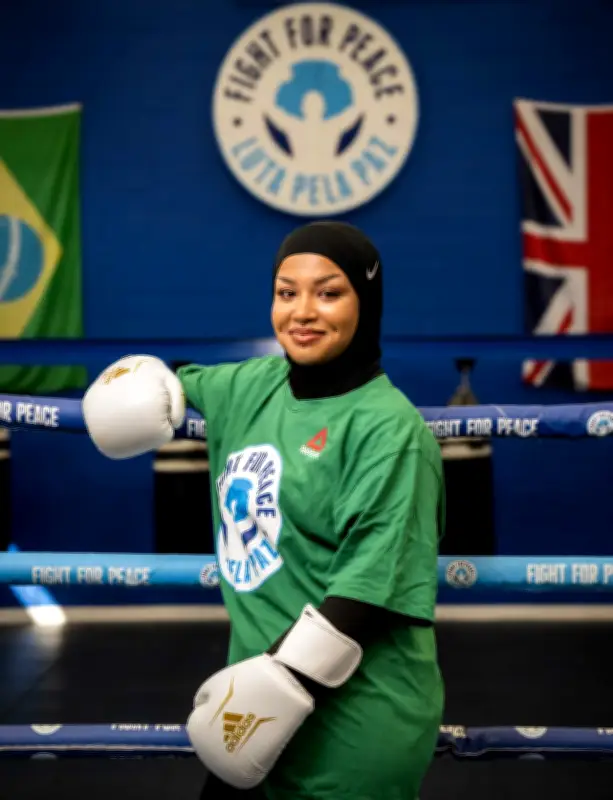
Fight for Peace, one of five charities backed by the Evening Standard's £500,000 Sporting Chance campaign, uses boxing and mentoring to transform the lives of marginalised young Londoners. The charity, based in North Woolwich, supports more than 1,300 young people aged 7 to 25 each year.
From TikTok to the ring
Luna, 25, signed up for a boxing class with a Fight for Peace coach after seeing a video of the session on TikTok. She had no interest in sports and was extremely unfit, unable to do a single burpee and breathless after running for the bus. She had no intention of attending more than one session.
But to her surprise, she went back. As a Muslim, she liked that the class was for women only, found it social, and was drawn to the structure of the sessions. She had never laced up a glove or picked up a weight before, but fell in love with the fitness classes and weightlifting.
That TikTok video two years ago profoundly affected her life. At the time, she was anxious, lacked self-belief, avoided stretch challenges, had few friends and barely a social life. At Fight for Peace, she met people she connected with and began to take risks. She also gained coaching qualifications that changed the direction of her working life.
Champions in the ring and in life
Fight for Peace was founded in Rio de Janeiro in 2000 and brought to London in 2007. It offers combat sports — including boxing, mixed martial arts, Muay Thai and Capoeira — alongside trauma-informed mentoring, employment and education support, and leadership training. The charity is situated in North Woolwich, one of London's poorest and most isolated neighbourhoods, hemmed in by London City Airport, the River Thames and post-war council estates.
CEO Lee Hemmings says the area is under-served: there is no mainstream school, no supermarket, no post office, only a very limited parade of shops and not a single cashpoint machine. “We have an open-door policy and increasing demand for our services,” he says. “Our aim is to create champions in the ring and champions in life.”
More than a third of participants are female, above average for combat sports. Fight for Peace has been commissioned by Sport England to look at women's engagement in male-dominated sports because of its success in attracting and retaining women. The charity also co-founded the Newham Youth Partnership, a 63-strong consortium of borough-based organisations, and has trained 450 coaches as mentors.
From asylum seeker to coach
Percy, 25, arrived in the UK aged 16 as an unaccompanied minor asylum seeker from Angola, knowing nobody and with little English. After winning a place at Queen Mary University in east London to study biomedical engineering, he spotted the Fight for Peace Academy while walking through North Woolwich. Boxing had been his refuge in West Sussex, and he decided to go in and look.
He was surprised that the facilities were free and that the coach also started mentoring him. They ran a weekly session called Man Talk, and he attended five or six days a week. “Boxing became part of my daily routine and how I built my confidence and resilience. The people at Fight for Peace became my family,” he says.
Today, Percy is a qualified university graduate, a boxing coach and a Level 3 personal trainer. He recently applied for government funding to start his own social enterprise, pt² Fitness, which he secured. He now runs boxing and running sessions for young refugees and migrants at premises in Canary Wharf.
Luna, who used to work in a fast-food outlet, is now a qualified personal trainer and boxing coach. She went from being unable to run for the bus to completing the Hackney Half Marathon. Fight for Peace is one of five charities backed by the campaign, which champions sports coaching and mentoring to transform the lives of marginalised young Londoners. The charity received a £62,500 grant from the Standard's Dispossessed Fund, administered by The London Community Foundation, and a further £250,000 has been pledged to fund school sports programmes delivered by campaign partner Greenhouse Sports.




