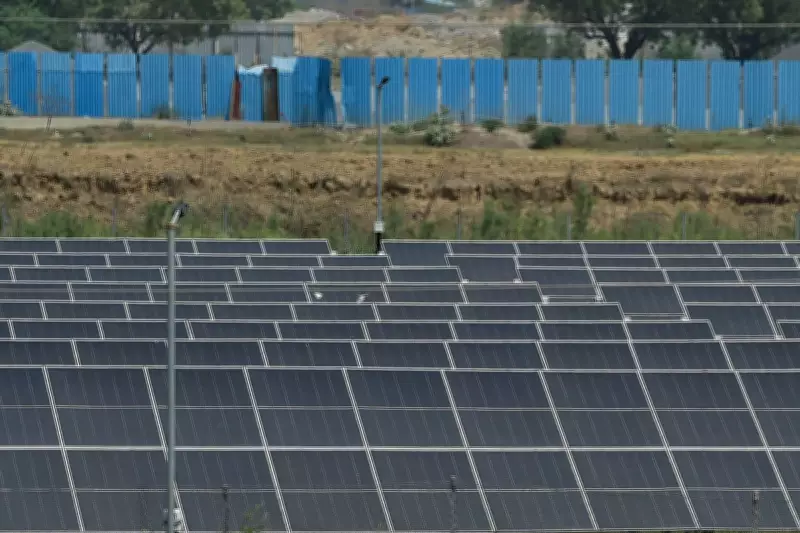
The United Kingdom has unveiled a $300 million (£224 million) renewable energy platform in India, as the world's third-largest clean energy market strives to bridge a $160 billion annual funding gap to meet its 2030 clean energy targets.
Investment Details
British International Investment (BII), the UK's development finance institution, is committing $150 million to the platform, named North Star. Danish fund manager Copenhagen Infrastructure Partners (CIP) is providing the remaining $150 million. The platform will invest across solar, wind, hybrid, and storage projects, and is expected to generate over 4 million megawatt-hours of clean energy annually, avoiding approximately 4 million tonnes of carbon emissions each year.
This marks the first investment under British Climate Partners, a £1.1 billion climate finance initiative launched by BII last month.

Strategic Importance
Leslie Maasdorp, chief executive of British International Investment, stated: "North Star is the first embodiment of that commitment. By partnering with CIP, we are crowding in private capital from day one of this new platform, and I expect further private investment in North Star over the following years."
India has been rapidly expanding its clean energy portfolio, reaching 50% of total installed electricity capacity from non-fossil sources in June 2025—five years ahead of its Paris Agreement target. In March 2026, India surpassed 150 gigawatts of installed solar capacity and added a record 44.61 gigawatts in the last financial year, nearly double the previous year. India now ranks as the world's third-largest renewable energy market by installed capacity.
Funding Challenges
However, the pace of expansion is creating financing hurdles. India requires $160 billion annually to achieve its goal of 500 gigawatts of non-fossil fuel capacity by 2030. Many developers lack sufficient capital to advance projects from planning to construction.
Progress has also been uneven, with a handful of states—including Rajasthan, Gujarat, and Maharashtra—driving most of the growth. States such as Bihar, Odisha, and Uttar Pradesh have lagged in building clean energy infrastructure.
Peter Jannik Sjøntoft, partner in CIP's Growth Markets Funds, said the platform would deploy "long-term capital into scalable, high-impact renewable investments that contribute meaningfully to India's decarbonisation and energy security goals."
Broader Impact
The broader British Climate Partners programme is expected to mobilise £3.5 billion of private capital over five years, with total commitments reaching £4.6 billion across India and fast-growing economies in South and Southeast Asia, including the Philippines, Indonesia, and Vietnam.
The announcement comes amid wider funding cuts by the UK government, including for climate finance, which have drawn criticism from rights groups. UK development minister Baroness Jenny Chapman defended the launch, saying it reflects what partner countries have requested. "We have heard what our partners have been calling for. They want to work in partnership with the UK. Countries want to have more control, move beyond aid, attract investment, strengthen their own health and education systems, and take charge of their own futures," Baroness Chapman said. "Traditional development finance alone cannot meet that call, indeed it never could. Nor can it respond to the scale of today's challenges. We need to bring new ideas and a broader coalition of partners to the table."
This article has been produced as part of The Independent’s Rethinking Global Aid project.