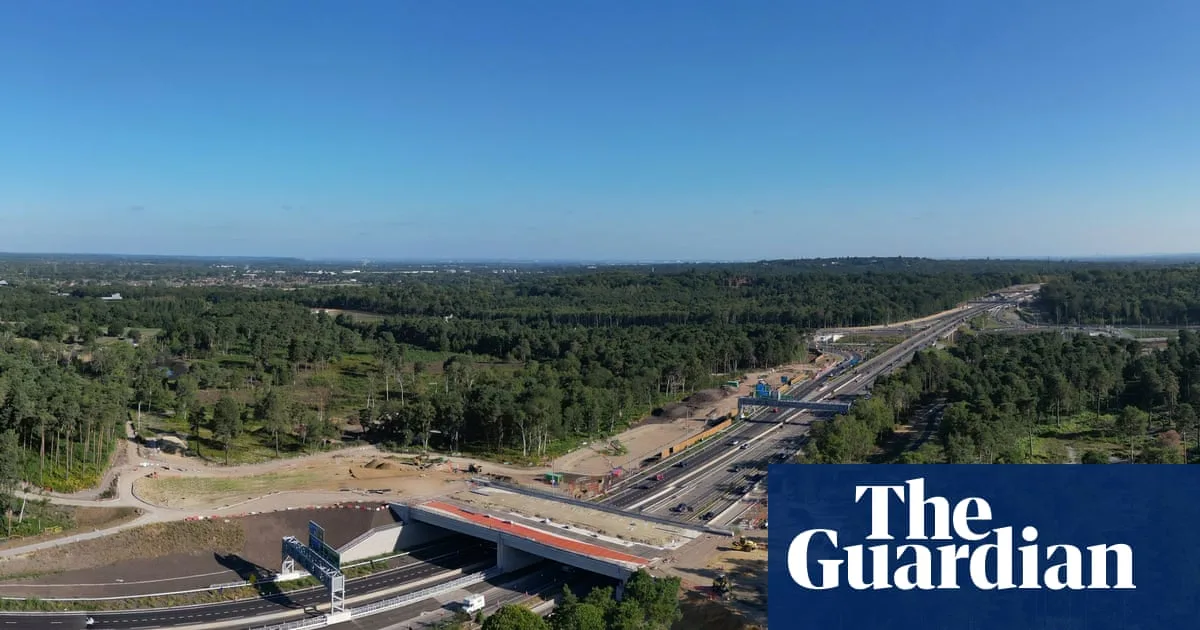
A new 'green bridge' in Surrey is set to open in the coming weeks, providing a safe crossing for wildlife over the busy A3 motorway. The Cockrow Bridge, built by National Highways as part of the £317m M25 improvement scheme, connects the fragmented habitats of Wisley and Ockham commons, rare lowland heathland that is home to species such as the sand lizard, Britain's rarest lizard.
James Herd, director of reserves management at Surrey Wildlife Trust, has witnessed a decline in wildlife over the past decade, which he attributes to the A3 cutting through the protected area. 'It has fragmented the habitat, disconnected the ecological permeability of the site,' he said. 'Species on this side of the common can't get to that side of the common because there's six lanes of tarmac and vehicles doing 70mph in the way.'
The green bridge is designed to mitigate the impact of the road widening project by allowing animals and insects to move between habitats. The bridge itself is a floating patch of nature reserve, with heather and other plants transplanted from the surrounding heathland. Piles of sand provide breeding habitat for sand lizards, while logs offer cooler areas for reptiles to escape heat and predators.
Wildlife has already begun using the bridge, with foxes, roe deer, and adders spotted on the crossing. Insects, which are crucial for pollination and decomposition, are also expected to benefit. 'This isn't just about big, charismatic species – it's about reconnecting entire communities of insects that underpin the heathland,' said Herd.
According to the UK's State of Nature report, average abundance of terrestrial and freshwater species has fallen by about 19% since 1970, with nearly 1,500 species threatened with extinction. Experts say roads contribute to genetic isolation and weakened gene pools. Ben Hewlett, senior biodiversity adviser at National Highways, noted that the UK lags behind continental Europe and North America, which have over 1,000 green bridges.