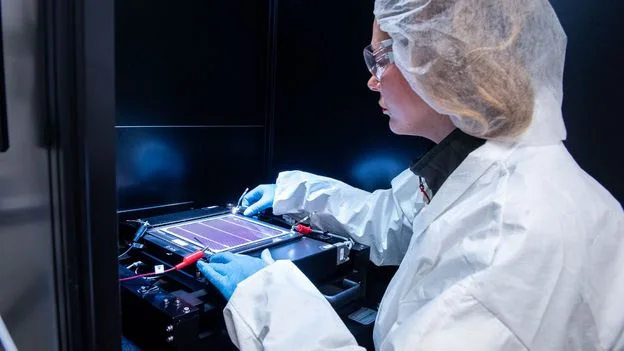
Researchers at Oxford PV, a spin-off from Oxford University, are developing tandem perovskite solar cells that could dramatically increase the efficiency of solar panels. The technology combines traditional silicon with perovskite materials, which are synthetic versions of a mineral first discovered in the Ural Mountains in 1839.
Perovskite cells can be manufactured using readily available materials such as bromine, chlorine, lead and tin. Proponents argue that these panels could cheaply boost energy generation from solar farms and rooftops, and perform better than silicon in applications such as satellites and electric cars. The theoretical maximum efficiency for perovskite-silicon tandem cells exceeds 47%, compared with around 33% for silicon alone.
However, concerns remain about the technology's durability. Perovskite is more susceptible to moisture and heat than silicon, which could lead to faster degradation. Additionally, many perovskite formulations contain lead, a toxic substance with potential health and environmental risks. A study also found that perovskite panels have up to 7% higher environmental impact per panel due to the extra manufacturing processes required.
Despite these challenges, solar power is growing rapidly. It accounted for almost 7% of global electricity generation in 2024, a 29% increase year-on-year, and has become the second-cheapest new source of electricity worldwide. David Ward, chief executive of Oxford PV, noted that tandem panels were initially met with scepticism because earlier multi-layer approaches, such as gallium arsenide, were significantly more expensive than silicon.
Oxford PV's internal analysis suggests that tandem panels could reduce the cost of electricity by around 10% compared with standard silicon panels. The key question is whether they will hold up in real-world conditions, as lab efficiency records are yet to be matched by proven long-term performance.