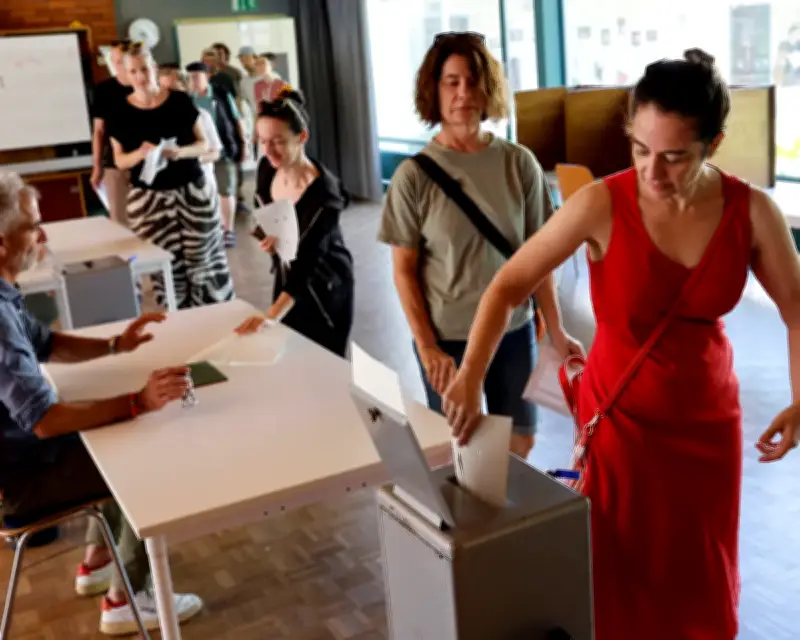
Switzerland's tradition of direct democracy helps keep the far right at bay, according to Joseph de Weck, an associate fellow with the German Council on Foreign Relations. He argues that far-right policies rarely pass the referendum test, citing several recent votes.
Recent referendum outcomes
In March, 62% of Swiss voters rejected a far-right initiative to halve funding for the country's public broadcaster. In 2017, 59% struck down corporate tax cuts proposed by the Swiss government. Another 59% rejected a far-right proposal to automatically deport foreign nationals convicted of crimes without judicial review. This week, a resounding 70% voted "No" on a far-right proposal to tighten Switzerland's neutrality, which would have forced Bern to drop sanctions on Russia over Ukraine.
In June, Swiss voters narrowly rejected (55%) a far-right proposal to cap the population at 10 million and terminate EU-Swiss economic agreements. Unlike the Brexit referendum in the UK, a vote is never a final decision for the Swiss. Since 2000, the Swiss have voted on relations with Brussels more than a dozen times.
Direct democracy and power
De Weck, who grew up in Switzerland, says direct democracy also frustrates the authoritarian power grab. He notes that from Donald Trump to Giorgia Meloni, the right seeks to centralise power, while direct democracy disperses it. He references Hannah Arendt, who fled Nazi Germany in 1933 and argued that citizens' participation maintains the link between people and power.
A 2017 poll found that 74% of Germans, French and Spanish people think public referendums would be a good way to govern their country. De Weck points to the gilets jaunes movement in France in 2018, whose demands included a plea to be seen and heard, embodied in the call for citizens' referendums.
Responsibility and community
De Weck acknowledges risks but notes that responsibility breeds responsibility: two-thirds of Swiss voters rejected a proposal to extend annual holidays by two weeks. He argues that democracy's most powerful idea is the promise of self-government, recognising humans as authors of our common future.
To put a lock on the far right, he suggests a transfer of power from the nation state to its citizens, accompanied by a transfer of power from the nation state to Europe. In Switzerland, with its four linguistic communities, referendums create a joint public sphere and a sense of national community. He imagines Europeans debating and voting together on migration policy, the 2035 ban on new petrol and diesel cars, or taxing big digital corporations, calling it a potentially exciting new chapter in the continent's coming together.