
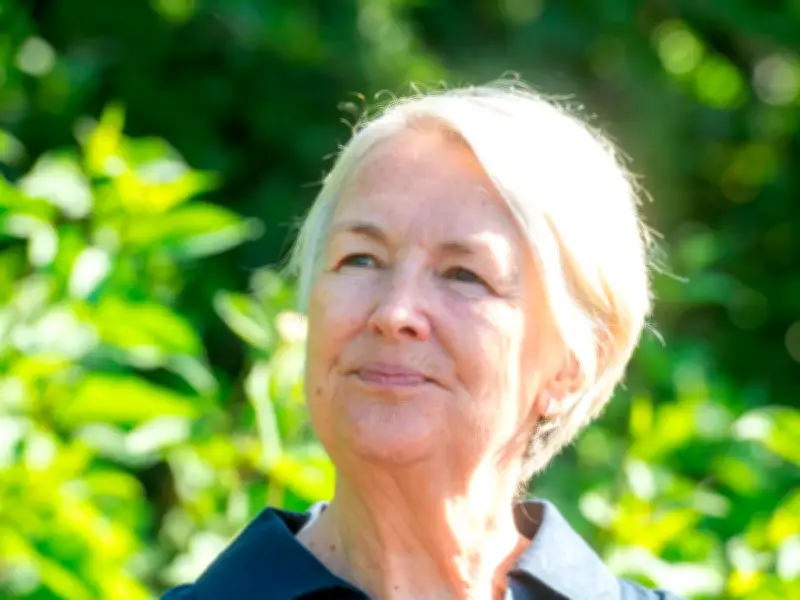
Days after Plaid Cymru's election victory, Rhun ap Iorwerth called Siân Gwenllian into his office and asked her to become his housing minister - a role she had suspected, and hoped, she would be offered. Now, as minister for housing, local government and planning, she is responsible for delivering the party's manifesto commitments, including 20,000 new social homes and a new national development agency called Unnos.
From Felinheli to the Senedd
Originally from Felinheli, Gwenllian's involvement in politics began at school. She was part of the National Union of Students and eventually became its president while studying at Aberystwyth University, before moving to Cardiff to study journalism and working for the BBC and the-then HTV. When she moved back to north Wales in her early 30s, she met her husband Dafydd, and the couple had their first child.
In 1999, when their youngest son was just three, Dafydd Huws died from cancer, and she brought the children up as a single parent. Balancing a part-time job and her role as a mum, she worked in communications for Gwynedd council and for Golwg, while also serving as a school governor and joining the community council. It was a conscious decision after her husband's death. She never wanted pity, or for her kids to go without. There were holidays, trips and experiences for them - and her determination saw her named chair of the community council, then elected to Gwynedd council before she was given the finance portfolio.
A decade in the Senedd
At the 2012 election, when the council introduced the leader-cabinet model, she was deputy leader and the sole woman in the cabinet. Two years later, she was selected as Plaid Cymru candidate, replacing the retiring Alun Ffred Jones, and was successfully elected to the Senedd in 2016 with a majority of more than 4,000. Until then, travelling to and from Cardiff, and being away from her kids, made it impossible. When she was 60, it was her time. She was re-elected in 2021 and most recently in 2026.
As is often the case, particularly for women, when childhood caring responsibilities ended, parental ones started. Until her mother's death last November, she was balancing a caring role with her career. She has just turned 70, and looking back she admits those early life experiences, particularly the loss of her husband, shaped her.
"It was a very difficult time for me but it taught me so much about myself. It taught me to have empathy, that really grew during that time. I can empathise with lots of people in vulnerable situations but it also it also taught me, 'gosh, well, if I can do that, I can do anything'," she said. "It doesn't frighten me when people say, 'Oh, it's too difficult, it's too complicated.' No, it's not! If you really want something to happen, you get it to happen."
Housing in her blood
Her grandfather was one of the Welsh builders who went to Liverpool to build the Welsh streets in Toxteth. Her father was born in Liverpool before returning to Llŷn, and he became an architect. "Houses and housing has always been kind of in my family, because my dad was an architect, but at the end of his career looking after all the council homes in Llŷn," she said. "I used to go with him to see the houses that needed maintenance work so it's kind of in my background. And then, of course, when I became a Gwynedd councillor, you suddenly become aware through individual stories. You become aware very quickly how tangible improvements to somebody's home can make such a difference to everything else that's happening around them."
Labour had pledged to build 20,000 homes by the end of the 2026 Senedd term, a target expected to be met by this autumn. She spelt out the problem to the Senedd simply: "The core of the housing crisis in Wales is that we don't have enough social homes." Plaid now promises 20,000 new social homes, but the party has a year less in its term to deliver what Labour, narrowly, failed to do. The party has already learned that the opposition is not letting the minority administration have much of a honeymoon period.
Unnos: A new development agency
The other plans are to strengthen renters' rights and set up a new national development agency designed to accelerate the delivery of affordable housing and social homes across Wales, called Unnos. The party put £20m of its supplementary budget - yet to pass - to one side for housing, signifying it is a priority.
Asked what a Plaid-led government can do that others haven't, her answer is immediate: "Because of the urgency that I bring to the situation and the pace that I want to see happening. We're also going to be setting up an arm's length body called Unnos to really accelerate that delivery. Up to now, that infrastructure hasn't been there, and I'm convinced that we need that infrastructure, and it's not just me saying this, the sector's saying this as well."
The housing sector points to spiralling building costs, labour shortages and an overly complex planning system as barriers. "There are a lot of barriers, lots of challenges, and that is what Unnos would be concentrating on unpicking," she said. "Finance is a barrier, we need to find innovative, new ways of financing, leveraging in more private sector finance. Skills, that is a barrier as well, we haven't got the skilled workforce for construction, so I'm working with the minister for the economy. Planning is always cited as a problem. There's problems in terms of capacity within the planning system, but there are also opportunities to be streamlining much more and to do more around community development rights and that kind of work as well. Land assembly, derisking sites so that registered landlords and local authorities can actually go into sites much quicker."
"There are a lot of barriers, but there are a lot of opportunities, and I think Unnos will be that vehicle to get rid of some of these barriers and to actually look at individual sites as well and look at how do we move this on quicker. It's a mission for me now," she says.
Defending the approach
Another criticism levelled at the new government is that it is setting up too many commissions and advisory groups. With housing, it is Unnos. "We do not need any more taxpayer-funded bodies to wade through a broken system," said Reform UK's Francesca O'Brien in a Senedd exchange where Gwenllian set out her priorities.
But she says planning reform will run in parallel. "We are also looking at planning reform, looking at the blockages that need unblocking. That's working in parallel with setting up the arm's length. The arm's length will give us a long leading time. It takes years to get from having land allocated in the local development plan to when you actually have the housing built, we all know that. We can speed that up, yes, but in parallel to that work there's a pipeline of social homes already coming through. They're both happening in parallel. But to have that sort of long look beyond electoral cycles, we need to have that infrastructure which we haven't got."
When does she envisage Unnos being up and running? "Well, elements of it will be up and running as soon as possible. We will in the next announcements that we'll be making around the 100-day plan be saying what the remit is, what the purpose is, and some idea of the timetable of where we're going with that," she said. "But in the meantime the pipeline is strong, and we're working with local authorities because we're hoping that we will have an extra £20 million in the social housing grant capital stream," she says, referencing Plaid's supplementary budget which failed to pass before the summer recess and remains on hold. "There are projects coming through because people are looking forward to having that extra money."
Renters' rights and data
Other areas she plans to tackle include rental rights. "We've got to improve protections and the enforcement, and we've got to collect data as well around rent levels in Wales," she said, "in terms of prices in particular." She argues that the situation is getting worse: "It's getting worse, and the situation in Wales is worse than in other parts of the UK. I am really looking forward to having discussions with the new UK administration in London around the local housing allowance, because it's been frozen. If you unfreeze that, it would raise the amount of money that people on benefits have towards paying for their accommodation."
She references a report by Crisis that had come out just before we met stating only 0.7% of private rental homes on the market in Wales during 2025/2026 were affordable to households relying on housing benefit. "While there are significant issues with a severe shortage of affordable rental homes across Great Britain, there are even fewer affordable private rental homes for Welsh house hunters on low incomes than in any other British nation," it read.
The minister continues: "It is contributing towards homelessness, the fact that the rents in the social housing in the rented housing are so high, it is actually contributing to to the homelessness problem. I'm determined to do something about that. So, the first phase is to actually look and collect data, we haven't got the correct data yet."
Rent controls and a right to a home
An early theme in questions to her has been criticism of that desire for data, something she does not back down from. "We have to have the data. I mean, it's a historic fact, it's not my fault that we don't have the data," she says. "We've got to rectify that as soon as we can. I want to move us on into rent controls. It is part of our commitments because then you can start to make rents more affordable and people won't find themselves facing huge increases overnight. It'll teach us how to progress and what kind of legislation is needed. We'll have to look at other countries, we look at Scotland, we look at Catalonia, there are examples where it's actually worked."
"Rent controls isn't a new concept in the UK. There used to be controls, but it's just disappeared and it's causing huge problems. Looking at that, all of that, is really important, and making sure that we have the evidence, that there aren't any unintended consequences, that is a piece of work which I'm progressing. Then the other piece of legislation is around people's rights to have a safe, affordable, warm, or cool, home. I think that we need to be enshrining that right into Welsh law, because that will shift the dial around housing. It'll make housing be seen less as an asset, and more as a home."
Asked how that might be enforced, she said: "I'm not sure how exactly it's going to look yet, but it could involve duties on local authorities so that we're strengthening the whole housing infrastructure around protections and affordability. Because at the end of the day, it's also part of the preventative agenda, of course, because at the end of the day, what is more preventative from people falling homeless, becoming ill because of damp and mould, than having a proper place to live and a safe place and a roof above your head? To me, it's just one of those basic, basic, elements of society that we're not getting right at the moment."
Energy efficiency and carbon emissions
She acknowledged that enshrining a right to a home will take time: "It's going to take time, obviously, and we're talking about progressive realisation of that right so there's work happening on increasing the supply of social housing, there's work happening around renters' rights at the same time as looking at that kind of end goal of enshrining it into Welsh law as well."
The third aspect is making homes more energy efficient. Social sector housing has seen substantial retrofit work, but "there's a huge amount of work to be done in owner-occupied and rental accommodation. The Warm Homes Programme that we have, we're reviewing that and we also need clarity now as soon as we can from the UK Government around what they are going to be replacing, because they pulled the plug on ECO4, which has meant we're in danger of losing a lot of skills that are needed for retrofitting, for installations, etc."
"Housing and buildings in Wales do contribute 11% towards carbon emissions so, there's a big piece of work that needs to be done around housing to lower the carbon emissions, but also to make them energy efficient, which will lead to lower bills, of course, and that is a really important selling point for people to understand that having your house energy efficient and putting measures in isn't just helping us with climate change, but it's also bringing bills down substantially in some cases," she says.
Message to those waiting
To people waiting for a better home, or a home at all, her message is: "There are immediate steps that we can take with renters' protections. If renters have more protections, obviously, they have more ability then to challenge poor conditions, with social housing ramping that up at speed. There is a pipeline, it will come through, and that will help move people from temporary accommodation and lower down the list."
"But, you know, I acknowledge, some of it is going to take time, because housing has been neglected and hasn't had the investment that's needed for a long time. Moving quickly into another phase where we actually want to see housing being seen as an important part of our infrastructure in terms of providing safe, affordable housing, but also the low-carbon element and the carbon emissions. I'm determined that this cabinet will see housing as such a crucial part of everything we do," she said.




