
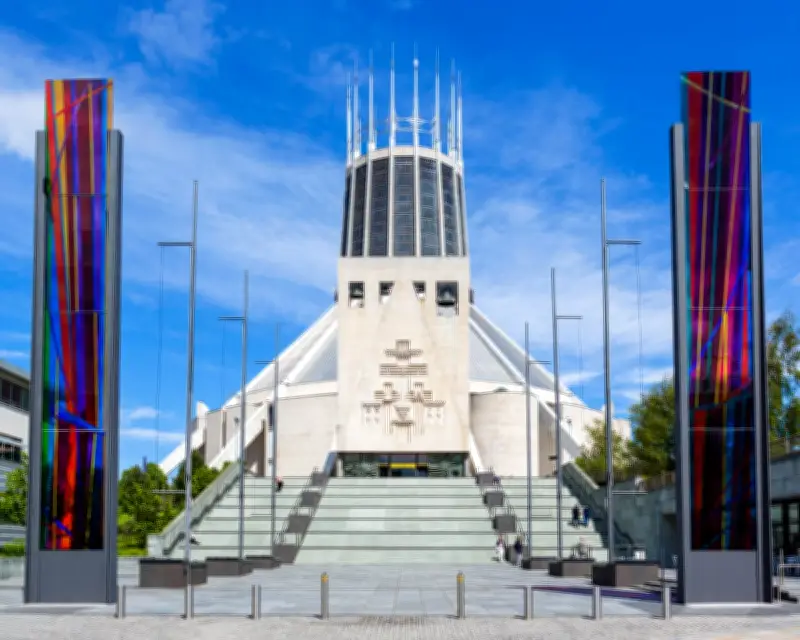
Andy Burnham is the first British prime minister to have grown up in the small-town northern Catholicism that also shaped the author's own childhood. Two weeks into his premiership, the influence of that formation is becoming evident in his policy choices. He has named his chief influences as "Everton FC, the Labour party and the Catholic church", and has been explicit about the connection between his faith and his politics. It meshes with his critique of "40 years of neoliberalism".
The author, like Burnham, was an enthusiastic altar boy, although without the same competitive instinct for the communion plate. Much of his motivation was less than pious: tips from weddings were generous, and he got on well with Father Jerome, an engagingly worldly monk from Ampleforth who shared his passion for Manchester United. The author is five years older than Burnham, but the atmosphere of the northern Catholicism they grew up with was much the same.
The Second Vatican Council's reforms, a response to the social changes of the 1960s, were "democratising" the tone and style of worship, and traditionalists mourned the sidelining of the old Latin mass. Pope John Paul II's ground-breaking 1982 visit to Britain - the first by a reigning pontiff - made the faith seem more mainstream and less rarefied. Politically, most Catholics voted Labour, and the large number of Celtic surnames in parish registers testified to a demographic significantly different from Anglican congregations, which were both more English and more Tory.
From altar boy to prime minister
Burnham is the first prime minister raised in that environment, and he has been explicit about its influence. Secular well-wishers may respond with polite indifference; Catholicism gets a better press among progressives as Rome takes a stand against the cruelties and excesses of Maga-style xenophobia and nationalism. But most liberals would be wary of any Catholic proselytising beyond migration and human rights. They should look deeper, the article argues.
The author lapsed at university, looking for different kinds of truths in western Marxism and leftwing social theory, but unlike Burnham he later went back to the church in his 30s. He has watched with fascination as the significance of Burnham's cradle Catholicism is pondered beyond the confines of the religious press. Burnham talks of a "direct read-across" between what he learned in church and Labour values, which might sound broad and obvious, in a "be kind" type of way. In fact, it is anything but, and it matters that the church was Catholic.
Resisting the Thatcherite creed
Burnham has pledged to "roll back" the 1980s, the decade in which Margaret Thatcher did not attempt to disguise the theological roots of a political vision that emphasised self-reliance and the Protestant work ethic. The Methodist worldview she inherited from her lay-preacher father translated into a strident individualism, and a contempt for the collectivist institutions and ethos of the postwar welfare society. "Economics are the method; the object is to change the soul," she asserted in the first phase of her premiership.
As she evangelised, the surplice-clad Burnham was immersed in the Catholic resistance to this harsh social doctrine, digesting and disseminating the sermons of the archbishop of Liverpool, Derek Worlock. Worlock's politics, and those of his Anglican counterpart, David Sheppard, emphasised fraternity, solidarity and mutual obligation. "I am my brother's keeper," he observed in 1990. "And he's sleeping pretty rough these days."
That message appears to have left a mark. Burnham's first big policy announcement was a vow to end rough sleeping across the country, and on his first morning in office he went to talk to homeless people on the streets of central London. Commentary has focused on the practical difficulties he encountered with a similar pledge as mayor of Greater Manchester, but the message about priorities was clear. The Catholic church would call this the "preferential option for the poor", a way of systematising the gospel idea that the last should be first.
Catholic social teaching in government
Other pillars of Catholic social teaching are also central to Burnham's agenda. Subsidiarity, the idea that power should not be hoarded at the top but devolved downwards, is clearly at the heart of what might be called Burnhamism, protecting people from an overmighty technocratic state. The dignity of work, elaborated in papal encyclicals such as John Paul II's Laborem Exercens, speaks to debates about the legacy of deindustrialisation and the future of AI, and guards against the moral indifference of the market.
The clue, the author suggests, is in the word "social". Thatcher's assertion that "there is no such thing" as society channelled a Protestant emphasis on individual responsibility, with a lineage going back to post-Reformation distrust of a Catholicism that, with its smells, bells and rituals, inserted its clerics between the believer and the Bible. Burnham's sensibility is quite different: it finds meaning and truth in relationships and social institutions, and is at heart convivial. His determination to present the crisis in social care as an issue to be collectively faced and resolved comes from the same source.
Beyond meritocracy
Burnham's love of Philip Larkin, a self-described agnostic poet who captured the pathos, sadness and beauty of ordinary lives, fits a worldview not obsessed with individual achievement and material wealth. Labour's error in the 1990s and 2000s, the article argues, was to succumb to the meritocratic, aspirational creed, alienating vast swathes of traditional support that looked to the party for different, associational values.
Burnham's Catholic upbringing appears to have provided him with convictions that allowed him to emerge relatively intact from that heretical turn. The intriguing possibility is that the country finally has a prime minister able to understand the deeper origins of the anomie gripping a country in which former sources of social solidarity are under threat, or have already disappeared.
A moral challenge for a secular nation
The discontents are eminently practical, with the cost of living and the degradation of public services at the top. But they can also be attributed to a sense that the common good - another concept of Catholic social teaching - has been chronically neglected in an unbalanced, unequal society. That is a moral issue about the way we live now, as much as a technical policy challenge.
If Burnham's stint as an ambitious altar boy can help him resolve it, it will be good news for a largely secular nation.




