
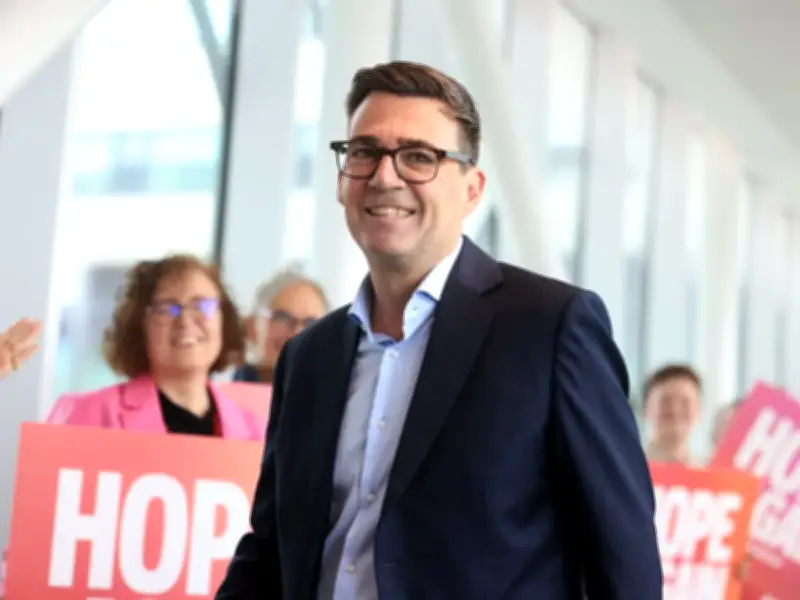
Andy Burnham announced a number of key money changes in his first Labour leader conference speech, including major changes to pensions and energy bills. The Prime Minister made his first speech as Labour leader at the party's conference in Liverpool on Tuesday afternoon (September 29).
During the speech, he promised to put the country on a new path and pledged to tackle the issues politicians "usually avoid". He vowed to give the country greater control over housing, energy and water and reform the social care system.
State Pension triple lock adjustment from 2030
One of the most controversial money changes announced include plans to break the State Pension triple lock after the next general election in order to fund a new National Care Service in England. The Labour Party leader announced a major change to the State Pension triple lock system - a mechanism used to ensure payment rates rise each year in line with whichever is higher out of inflation, earnings or 2.5%. This is to prevent the value of pensions being reduced by cost of living pressures.
He announced during his speech that he will "adjust" the triple lock from 2030, removing the link to average earnings to pay for social care reform. This means the State Pension will continue to rise each year by whichever is highest out of CPI inflation, or a minimum of 2.5%, which will generate "significant savings" and remove the link to average earnings.
Mr Burnham said this will ensure pensions will hold their value relative to earnings over time while generating savings that will be used to pay for a new National Care Service that will be "free at the point of use" and impose no charges on the basic State Pension.
Income tax promise and National Care Service
Addressing the Labour Party conference in Liverpool he also said low-income pensioners would not have to pay income tax during this Parliament. The current UK personal allowance for income tax is set at £12,570 for the 2026/27 tax year, whilst the current highest standard amount for the State Pension is £12,548 per year.
There has been speculation in recent years on what will happen when the State Pension surpasses the personal allowance and whether pensioners solely reliant on the State Pension will be forced to pay income tax. Mr Burnham promised today that low-income pensioners will not be "dragged into paying income tax in this Parliament".
Mr Burnham said that he was making his proposed changes to the State Pension triple lock in order to generate savings that will be used to pay for a new National Care Service that will be "free at the point of use" and impose no charges on the basic State Pension. The changes will come as part of the Prime Minister's "long held ambitions to reform social care" and ensure that people who care for other people's parents aren't on "poverty pay" whilst also creating a "person centred, high quality care service that starts in the home."
Energy bills and public ownership of water
Mr Burnham announced a new publicly-owned "Great British Grid" that will "challenge the private sector operators" to "increase competition, drive down costs and speed up delivery." The new body being set up under the Great British Energy umbrella should make it easier to get connections to the energy grid in a bid to address one of the issues which has been blamed for slowing the pace of economic growth and pushing up costs.
It will be the first publicly-owned player in electricity networks since privatisation under former prime minister Margaret Thatcher. The new publicly owned body will "challenge the private sector operators" and help give consumers "breathing space." The UK will have a national energy plan for the first time and give stronger powers to mayors and local leaders, he added.
He said: "Energy, water, housing. Back under stronger public control. We rely on them, we pay for them and once again we will have power over them." Mr Burnham added that he would be "pragmatic" in relation to North Sea oil and gas amid looming decisions on Jackdaw and Rosebank "as we build a bridge to a clean energy future as we confront the climate crisis."
The Government will pave the way for public ownership of water companies through a new water Bill, which Environment Secretary Angela Eagle will unveil, the Prime Minister has said. He said: "Water is a symbol of what has gone wrong with Britain – a service where the shareholders never lose and the public never win, from which some have syphoned out easy money while the public picked up the bill for the sewage in our seas. It stinks."
Mr Burnham said Ms Eagle "will present a strengthened Water Bill to Parliament." He added: "The centrepiece of that Bill will be this: the repeal of Margaret Thatcher’s ideological ban on public ownership of water companies." It will start a 10-year journey to a very different water system, it will strengthen public control, mayors will have new powers to hold water companies to account, with tougher consequences for those which repeatedly fail. It will close the loopholes used to pay excessive bonuses.
"Where private companies serve the public interest, we will support them but the consequences will be clear for those who do not, including taking back control or ownership."
Housing and welfare changes
Mr Burnham confirmed plans to open up home ownership "to those not backed by the bank of mum and dad" by reducing the size of the deposit needed for a mortgage. He also pledged to introduce a Bill before Christmas for "long overdue" leasehold reform, telling leaseholders that "the days of you being squeezed for every penny are coming to an end."
Councils will be given the power to take over poor quality homes if landlords refuse to improve them, he said, adding: "We don’t let people sell food which damages health, so why allow it with homes? From now on, we won’t."
Pledging to show "the same boldness for our young people," Mr Burnham said he wanted to "invest" in them rather than "pay for failure through the benefits system." Too many young people are "drifting" towards the benefits system, he said. He pointed to Alan Milburn’s review into the rising number of young people not in education, employment or training which is due this autumn.
He reiterated Labour’s plans to change the education system with academic and technical pathways from 14 and offer work placements and apprenticeships, as well as reducing waiting times for young people needing mental health support. He said: "We will need a fundamental rethink of the welfare system to find the money for these opportunities upfront, and we will require young people to take up the help presented to them, guaranteeing in-work support and not leaving those out of work losing confidence and connection."




