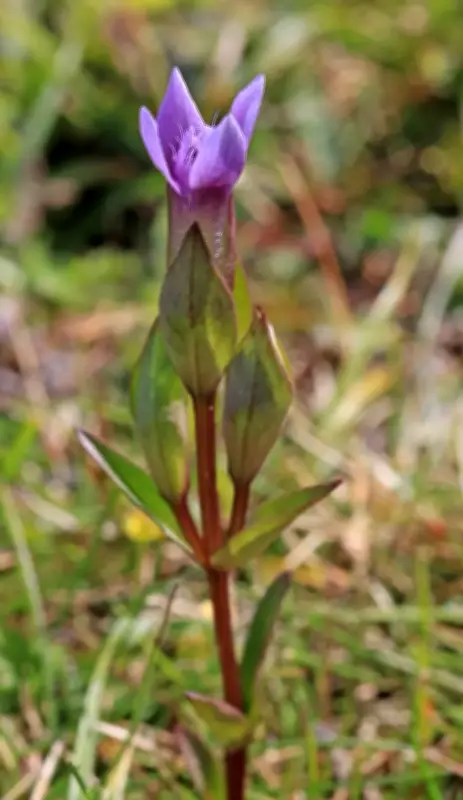
A rare wildflower may have been wiped out in southern England after a summer of record heat and drought, conservationists have warned.
The field gentian, once widespread across Britain, was until recently so abundant in the New Forest in Hampshire that conservationists said counting the flowers was a challenge.
But after 2026 brought record warmth, successive heatwaves and severe drought — the third extreme summer in just five years — the plant may have disappeared from southern England altogether.
Conservationists raise alarm
Experts described its possible disappearance as a “canary in the mine” for climate-driven species loss.
The Species Recovery Trust, a charity working to save some of Britain’s most endangered species, said the potential loss was “deeply worrying” because the field gentian had previously been abundant wherever it grew.
Dominic Price, director of the Species Recovery Trust, said the plant’s habitat — dry, “skeletal” grassland — was on the “absolute front line” of climate change.
“These habitats are becoming parched and dead in hot, dry weather,” he said.
Decline and recovery attempts
The field gentian’s disappearance would be a striking example of how increasingly frequent heat and drought can push even locally abundant species towards extinction.
In 2022, when temperatures in the UK soared to 40C for the first time on record amid an extremely hot, dry summer, field gentian populations crashed for the first time across all known sites in the south of England, and went extinct at a county-level in Devon.
Populations recovered slightly the following year, and it was thought the New Forest populations could survive, due to their sheer size – often more than 5,000 plants at each site – and their ability for seeds to move with livestock into more sheltered areas.
But then populations were hit by successive record hot summers and droughts, in 2025 and again this year.
No plants found for second year
The Species Recovery Trust has confirmed it has been unable to locate a single field gentian plant in the New Forest for the second year in a row.
Mr Price said “there’s potential for a miracle” with a wet summer next year helping the plant stage a comeback.
But he warned previous evidence tended to show the plant did not return once it was lost, and suggested field gentians had been seen for the last time in southern England.
He said: “This loss of what was such an abundant plant is deeply worrying, and in many ways, it feels like a canary in the mine for how climate change is likely to accelerate species loss, especially in the south of England.
“We expected to be gradually losing species as the planet warmed up, but the scale and speed of what we are already witnessing is pretty breathtaking.”
He said there were still sites in the north of England and Scotland where field gentians were thriving, but added “even these may not be safe forever”.
Leanne Sargeant, nature recovery manager with Forestry England, which manages much of the New Forest, said: “We were alarmed to hear of these drastic crashes in populations of the field gentian.
“Management of the sites hasn’t changed, so this has to be down to these hot, dry summers.
“We all need to learn more about how climate change will affect species so we can help as many as possible to survive.”