
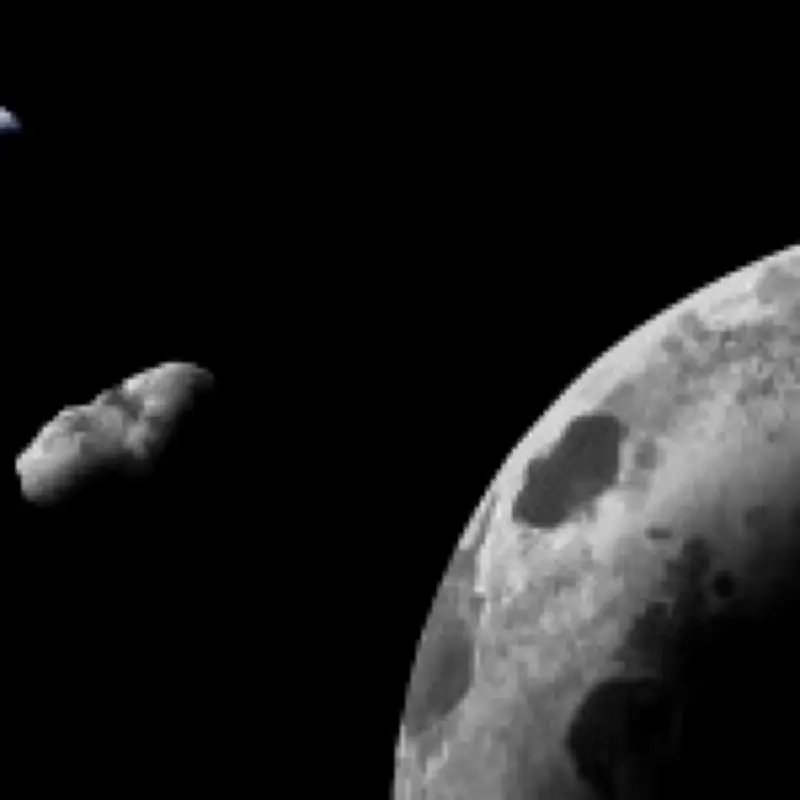
China's space agency has released the first-ever photograph of 469219 Kamo'oalewa, an asteroid known as Earth's 'second moon.' The image was captured by the robotic Tianwen-2 spacecraft from a distance of just 20 kilometers, the Chinese National Space Administration (CNSA) announced on July 6, 2026.
Historic image from 600 billion miles
The Tianwen-2 spacecraft traveled approximately 600 billion miles over 400 days to reach the asteroid, which is estimated to be about 100 meters in diameter. If confirmed, this would make Kamo'oalewa the smallest asteroid ever visited by a spacecraft. The image was taken using optical navigation data to precisely locate the object, which is difficult to track due to its small size and tendency to hide in Earth's shadow.
What is Kamo'oalewa?
Kamo'oalewa, meaning 'wobbling celestial object' in Hawaiian, is a near-Earth asteroid designated 2016HO3. It is one of only seven known 'quasi-moons' of Earth—objects that orbit the Sun but remain close to Earth. Unlike a true moon, it is not gravitationally bound to Earth; instead, it follows a path that keeps it near our planet. Its orbital dance with Earth began about a century ago and is expected to continue for a few more centuries.
Possible lunar origin
Scientists suspect that Kamo'oalewa may be a piece of the Moon that was torn off by a meteor impact. In 2021, researchers discovered that its composition matches frozen minerals found on the lunar surface. Three other quasi-moons share a similar composition, suggesting they may all originate from the same cataclysmic lunar strike. Alternatively, the asteroid could be a fragment of a larger rock broken apart by the Earth-Moon system or a captured asteroid.
Determining the asteroid's origin is a key goal of China's Tianwen-2 mission. The spacecraft launched aboard a Long March 3B rocket from the Xichang Satellite Launch Center in Sichuan province in May 2025, according to state media.
Next steps: sample collection and return
The CNSA stated: 'Going forward, the probe will gradually conduct more detailed scientific explorations to obtain information on the asteroid's shape, material composition and internal structure, providing support for preparations for sampling.' The spacecraft is expected to collect samples of the asteroid's surface material and return them to Earth in a capsule late next year. If successful, China will become the third country to retrieve material from an asteroid, after Japan and the United States.
Scientific significance
Asteroids like Kamo'oalewa are remnants from the early solar system, offering clues about its formation. Understanding the composition and structure of this quasi-moon could provide insights into the history of the Earth-Moon system and the processes that shaped the inner solar system.




