
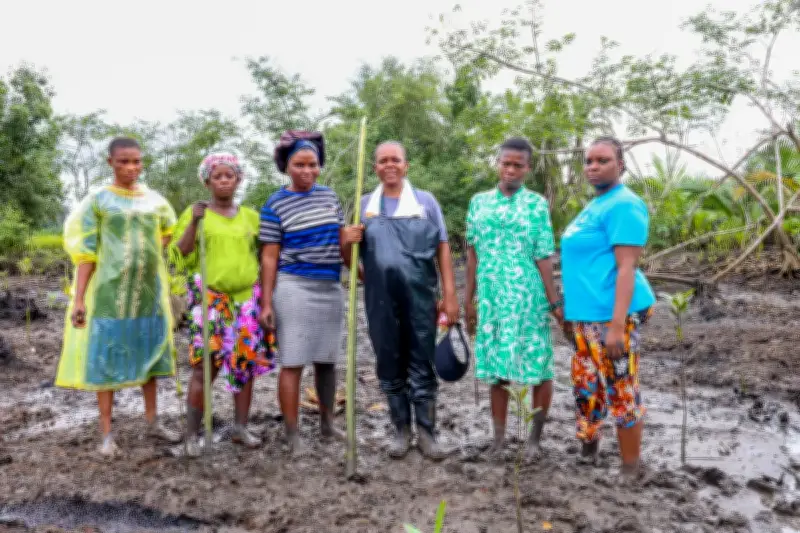
In Ogoniland, in Nigeria's oil-exploited Niger delta, Martha Agbani is training women to plant mangrove trees back into a landscape ravaged by decades of oil pollution. Her aim is not just to put trees in the ground but to heal the wetlands, restore livelihoods and peace, and rebuild the sense of ownership Ogoni communities lost along with their mangroves.
Growing up, Agbani was familiar with the toxic landscape – the smell of crude oil in the air, rivers running black and trees dying on the banks. She saw spills rot away the mangrove forests and destroy the livelihoods of communities around her.
From activism to restoration
Agbani's mother, Theresa Terabiewaa Agbani, was an activist. When Agbani was in college, they were devastated by the state's execution of Ogoni activist and playwright Ken Saro-Wiwa, who, along with eight other environmental campaigners, was hanged in 1995. "The execution of Ken Saro-Wiwa and the other Ogoni land defenders decades ago opened my eyes to what really lay behind the destruction of my home town," she says.
In 2003, soon after the death of her mother, Agbani established the Lokiaka Community Development Centre to support female Ogoni farmers in caring for the environment and helping to restore the mangroves, devastated by more than five decades of oil pollution.
Planting in the swamp flats
In the swamp flats at Teenama, Joy Lebewi is ankle-deep in mud, holding a sapling in one hand. Trained at Agbani's centre, Lebewi works alongside a dozen other women, all planting while keeping an eye out for crabs and periwinkles worth collecting. In the wetland of Teenama, they have planted more than 150,000 mangrove saplings.
"We want to space the mangroves right," says Lebewi. "This is our forest." When the women started restoring mangroves in 2018, they planted them too close together, and the trees' canopies crowded each other out. Now, they use a stick – 2 metres long, with one end pressed into the swampy ground to mark where the next seedling will be planted.
Ecological damage and cleanup efforts
Teenama sits between the Kwawa and Kpean oil settlements in the Yorla oilfields of Ogoniland, a region ravaged by decades of oil production and spills. The ecological damage has been felt across the region – people who relied on mangrove-lined creeks to fish and gather shellfish have lost a valuable food source and income.
In Bodo, where Shell was ordered to pay £55m in compensation to local people after two big oil spills in 2008 and 2009, Dr Ferdinand Giadom is deputy project director of the Bodo Mediation Initiative, a stakeholder group overseeing oil cleanups around the region. About 1,000 hectares (2,500 acres) of mangroves were directly destroyed in the 2008 Ogoniland spill, and Giadom estimates that more than 500,000 barrels of crude oil have been spilt into the environment in under 20 years. "Two decades have been lost," Giadom says. "Livelihoods over that span of time have been lost."
Invasive species and restoration efforts
The wetlands are also being encroached on by the nipa palm, also called mangrove palm, an invasive species from south-east Asia that has spread through disturbed areas of the Niger delta. Thick clusters of nipa crowd out native species and make it difficult for local people to access the wetlands. Clearing nipa is demanding work. In Teenama, men from surrounding communities are clearing the land to prepare it for the women who will plant the native mangrove saplings.
The mangrove ecosystem in the Niger delta region is the largest in Africa and the third-largest globally, covering about 1m hectares. These forests provide habitat for fish, shrimps and molluscs and act as nurseries for other aquatic life. They help protect coastlines, store carbon and support communities whose food and incomes depend on the wetlands. "Millions of people's livelihoods depend on healthy mangroves," says Oluwakemi Odufuye, a coastal ecologist at the Nigerian Institute of Oceanography and Marine Research.
Empowering women and measuring success
For Agbani, the connection between environmental destruction and human lives is deeply personal. Inspired by her mother's activism and the risks faced by Ogoni activists such as Saro-Wiwa, she chose her path in restoration. Her Lokiaka Community Development Centre merges environmental justice, gender inclusion and biodiversity. Instead of classrooms, women are taken into swamp forests, supervised by experienced restorers.
Her goal is to empower women in the Niger delta to restore their wetlands independently. She has trained more than 400 women from various communities, many of whom have replicated the training locally. Since 2018, Lokiaka's teams have restored 3m mangroves and reclaimed 190 hectares of swamp forest in Ogoniland. For Agbani, the return of fish and crabs demonstrates progress. "Life is returning," she says.
Erabanabari Kobah, an environmental scientist and campaigner from Ogoniland, says one measure of success is what happens to a forest over time, not just how many trees are planted. "Planting in unsuitable areas won't ensure long-term success," he says. For the planters, that means understanding how the forest behaves – where the water moves, where the mangroves can survive, how the forest can eventually support marine life again.
Collins Lebeteh, an environmentalist who works in community-led conservation, says a different way of measuring success is needed. "What is really important is who is doing the planting. Many women who rely on and are affected by the degraded environment are often left out of decisions around the restoration of ecosystems," he says.
Agbani wants to change that. Her organisation also works with local fishers, training them in species identification and managing mangrove buds. Her hope is for restoration to become a process communities own and control, rather than another "top down" intervention. Back in Teenama, Lebewi pushes her spacing stick into the mud again. It is a mark almost invisible in the vastness of the wetland but here another sapling will be planted – and spread its roots.




