
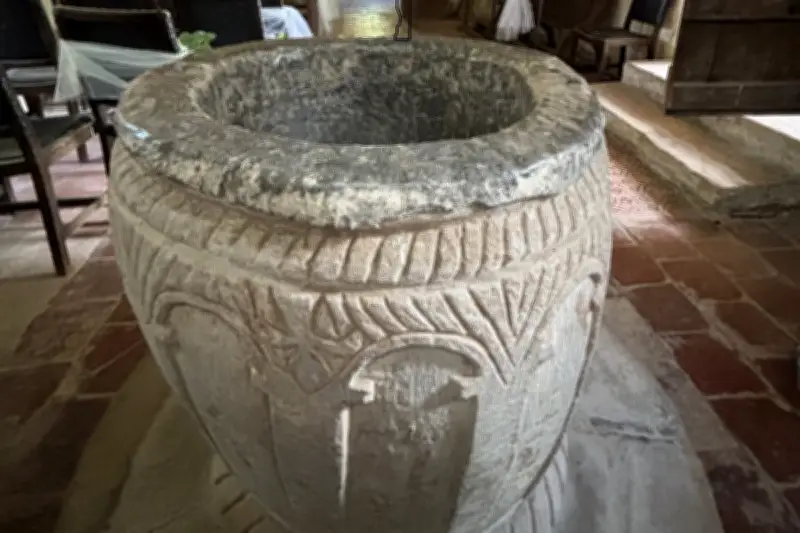
A Norman font that travelled from Shropshire to Scotland while the King was at school there in the 1960s has been described as “like something out of an Arthurian legend”.
Prince Philip arranged for the 12th-century font to be shipped to Gordonstoun school in Moray when Charles started there in 1962, so he would be “surrounded by ancient objects of English beauty”. It stood in the school’s chapel for a number of years before being returned to its original home of St Michael’s Church in the hamlet of Upton Cressett, Shropshire, where it remains to this day.
Prince Philip’s discovery
The Duke of Edinburgh had spotted the font while visiting St Michael’s in the 1960s with former MP Ivor Bulmer-Thomas, who had been working with him on a scheme to protect unused historic church buildings. St Michael’s had fallen out of use in 1958 and was in a “terrible state”, and had been selected as an example to show Philip of a dilapidated country church in need of rescue.
Bulmer-Thomas went on to set up the Redundant Churches Fund, which later became the Churches Conservation Trust, of which Charles is now the patron. William Cash, one of the font’s current custodians, told the Press Association that when Philip visited St Michael’s the building was locked and its contents, including the font, were due to be put into storage. Cash’s parents moved to Upton Cressett estate, where the grade one listed church is located, in the 1970s.
He said: “They went to see it, and Prince Philip apparently said (of the font), ‘I think that would be really good if it was moved to Gordonstoun, because I want my son to be surrounded by ancient objects of English beauty’.”
He added: “I think Philip thought, ‘What a waste to have it just sitting in a storage unit’. It’s quite large – how they got it up to Gordonstoun I really do not know. This is a strange story that to this day most people don’t know about.”
An ancient stone barrel
Shaped like a large stone barrel, the so-called “Gordonstoun font” is an example of a Norman tub font, with ornate carvings around its outside and a lead-lined interior. The font stood in the modern school chapel during Charles’s time there before being returned to Upton Cressett in the 1970s.
Although St Michael’s no longer holds regular services, the font is still occasionally used, with Mr Cash saying he and other members of his family were baptised with it. He said visitors to the church today are “flabbergasted” when they learn of the font’s royal connections, due to it being tucked away “in the middle of nowhere in Shropshire”.
‘Fit for a king’
Mr Cash said: “Frankly they find it almost impossible to believe that this font has moved so many hundreds of miles for the King’s aesthetic benefit.” He added: “It always feels like something out of an Arthurian legend, like this was a font that was fit for a king, a Norman font with roots going back pretty much to the age of William the Conqueror.”
Steve Tarling, a community officer at the Churches Conservation Trust, which now looks after St Michael’s, described the church as “a really lovely, picturesque, almost ‘fairy tale’ chapel”. He continued: “You could imagine someone out of the Brothers Grimm having a wedding in there – it’s an understated little chapel, but a nice little oasis of calm in what is quite beautiful countryside.”
He said he had the impression it had been an “honour” for the local community that Philip had chosen their font to accompany his son, but that they were “grateful” it had been returned. “I think it would just miss something there without it. I think it completes the picture. It’s like the cherry on top of the cake.”




