For seven years, the seaside town of Hoylake has been embroiled in a 'nasty' row over its beach. Arguments have raged in pubs, spats have played out on social media, and slogans have appeared on Shrek-themed banners around the town.
The argument simmered beneath the surface for decades. Locals worried their broad beach would go the way of Parkgate's silted coast when salt marsh plants began to appear as early as the 1960s. But when Wirral Council stopped raking and spraying weedkiller on the beach in 2019, the row erupted, with national figures wading in.
Both sides, those for and against clearing the plants, claim a 'vocal minority' is behind the division. But both agree the last seven years have been 'troubled times' for Hoylake.
Residents divided over the beach's future
John Rogers, 72, was enjoying a day at the beach with his family, sitting on a strip of sand cleared for the RNLI lifeboat. He said: "These last few years have been awful. We used to be able to walk to a sandy beach; now it's a quagmire. We're limited to this little strip. People call it a swamp. It smells, it's muddy, and you can't get to the sand beyond. We're campaigning every day of the year because we hate it."
Looking over the thick strip of grasses, spartina and sea aster, John Irwin, 80, said: "It really bugs me. It gets up my nose. I'm really against it. It should be raked and sprayed. They keep saying it's natural, but there's nothing natural about it at all: the channel was moved. During covid, my grandkids played to their hearts' content on this beach. Now it's gone to rack and ruin. I'm worried it'll be like Parkgate. There's a real strength of feeling among certain people about the beach."
John's assertion that the beach is 'man-made' is held by many in Hoylake who want the sandy beach restored. The Dee was canalised along the Welsh coast in the 18th century, which led to the Wirral coast becoming a salt marsh.
A banner on a nearby home features Shrek and Donkey, from the hit film series. It reads "Don't be an ass, just get rid of the grass". Shrek has made an appearance on several banners in Hoylake down the years, a reference to the 'swamp' that proponents of clearing the beach say has been created.
Hoylake Beach is a designated Site of Special Scientific Interest (SSSI). This means it is protected under law from anything that could damage the special interest of the site, including actions that could cause harm or disruption to the range of rare or nationally important species and habitats.
Families and friends falling out
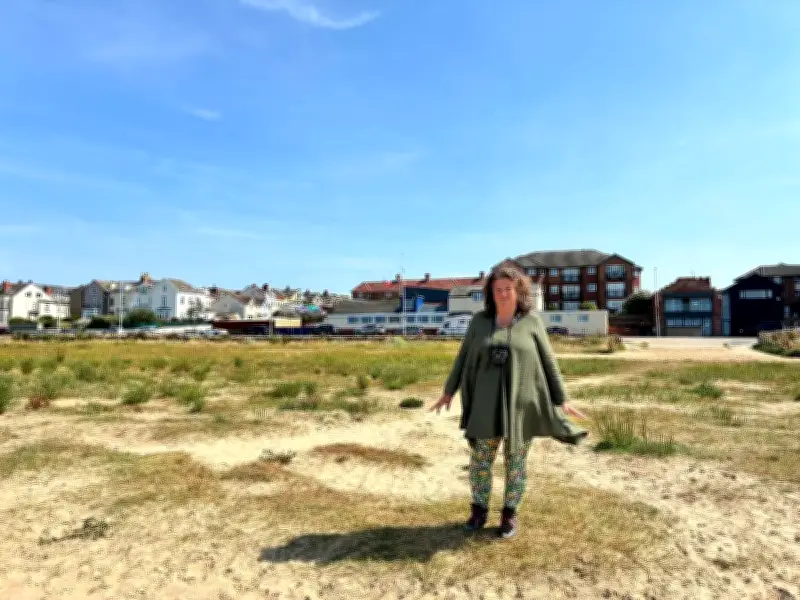
Dr Jane Turner is a biophysicist and has lived in Hoylake her whole life. Her home looks out onto the beach. She stands on the old lifeboat slipway and watches for rare sea aster bees that have dug burrows in the sand and will soon emerge. She said: "Spartina started growing on the beach in the 60s, and that was the first time there was a mass campaign to try to stop it. But in recent years, it has gotten out of hand. Around 2010, it really started to get out of hand. It became the campaigning point for local Tory councillors. Then, in the summer of 2019, the inevitable happened. The grass started to grow faster than the council could remove it. Most tides don't reach Hoylake anymore, and once it's above sea level, it wants to be a field. The grassy area was expanding, and there were increasingly loud calls to spray glyphosate."
The council spent three days in August 2019 spraying glyphosate on the beach. Signs warned beachgoers not to pick vegetation on the beach. Social media outrage followed, and a simmering local debate ignited into an all-out row. Political writer George Monbiot called the spraying "madness". Dragons' Den star Deborah Meaden waded into the debate, asking the council "what was your thinking?" The council responded by agreeing to phase out glyphosate spraying.
Jane said: "Once it got to social media there was a bit of an inquest. It got nasty. It has been deeply damaging to relationships in the community. Families and friends are falling out over it. People have been made to feel very bitter about an issue driven by emotion rather than facts and logic."
Jane argues that, rather than turning to saltmarsh, the area has already started to form dunes, and in generations' time, Hoylake beach will resemble the Sefton coast, with large dunes and a steeper beach. Wirral Council confirmed in April the area had started to form an "embryonic dune habitat".
Constant abuse and emotional campaign
Botanist Josh Styles said he found himself on the receiving end of vitriol after advocating for his side of the debate. In 2022, the Local Democracy Reporting Service (LDRS) told how Josh received homophobic abuse after appearing on Countryfile to talk about the beach. Josh, who advocated against raking and spraying the beach, said he had faced "constant" abuse: "I've had lots of abuse. I've been called a 'swamp monkey' and told I'm not credible because I'm autistic. I've also had people giving me minor homophobic abuse. They've also called me things like 'pillock' and said I need a smack."
Even as someone who has lived her whole life in Hoylake, Jane said: "There's all sorts of interesting politics that I don't fully understand."
Returning Hoylake beach to an amenity beach was one of the key issues local Conservative councillor Max Booth ran on when he was first elected in 2023. He said: "I don't think it's a divisive issue when it comes up on the doorstep. You obviously still get the spats on Facebook from time to time. I think losing that space has been huge. For a lot of people, it's been emotional rather than divisive, because that is their amenity space. People, multi-generational families, or even just new families moving to the area, see it as a coastal destination. As a coastal destination like New Brighton, West Kirby, or Sefton, we should be looking after visual amenities; not just for the people who live there, whether it's for dog walking or taking children out for free. It doesn't cost people anything. For the sake of a packet of sandwiches and a couple of buckets and spades, it's a full day out in the weather we've had in recent weeks. For a few people it has been emotional, and for other people it has been a campaign to get it back through determined dedication since 2019."
The issue prompted lively debate when the ECHO asked about the beach at The Plasterers Arms pub, a 300-year-old Hoylake institution tucked away on a back street. Luke Hopper, 36, says the issue of the beach is "wearing thin". He said: "These have been troubled times. There needs to be more balance and compromise. I think it should be maintained as a beach between the King's Gap and the RNLI station, and the rest left wild. People who want to keep the beach don't necessarily agree with spraying. I'm not massively opposed to sand dunes, but they can form somewhere else. I don't think many people hold a balanced view, and now the issue is wearing thin. It has become more of an issue because of the inaction. It's Victorian and it's manmade because the channel was moved."
Joanne Moreland, 58: "It brings income into the town in summer. Since they cleared some of it, it looks like a proper beach. It's heart-warming to see people raising their families there, and it's good to see that people with disabilities can access it."
Village green bid and painstaking process
The row still rages as campaigners launch fresh efforts to return the beach to its former state. In a meeting on Friday, August 7, locals advanced a bid to get special "village green" status for Hoylake Beach, which they believe would force the council to maintain the beach for leisure. Campaigners made their case to a council-appointed inspector as they argued for the beach to be designated a Town or Village Green. Beverley Aspinall argued people use the beach for various activities such as sports and dog walking each day, without needing to secure permission to do so. The speakers each said they have never known anyone having been prevented from accessing the beach. One speaker said that for many people in the town, the beach is their "back garden", as many of the homes are terraced houses with little open space.
Conservative councillor Max Booth conceded the status was "confusing", adding: "Green does not mean grass. It's about getting the space maintained."
In December, an agreement was reached to clear some of the vegetation on the beach to allow the RNLI lifeboats to operate. In March, a 7.5m strip was cleared following along the promenade, with a space cleared around the lifeboat station. At the time, Cllr Liz Grey, Chair of the Environment, Climate Emergency and Transport Committee for Wirral Council, said: "This has been a complicated and painstaking process, involving a number of partners and a range of individual and collective viewpoints. It was never going to be easy to find a position that could be assented by Natural England and would please all sides in this long running debate. With the clarity provided by this decision, we can move forward, managing the beach in everyone's interests and carefully monitoring the results of any actions taken. We will carry out the work to prepare the beach, starting in early March 2026, with the utmost caution and following Natural England's instructions. My hope is that all interested parties will see the value of what has been achieved through this process and come to love this beautiful beach."
The ECHO approached Wirral Council. A spokesperson said there was nothing the council could add following the Town and Village Green status meeting, and that the process needs to take its course before the council can comment.