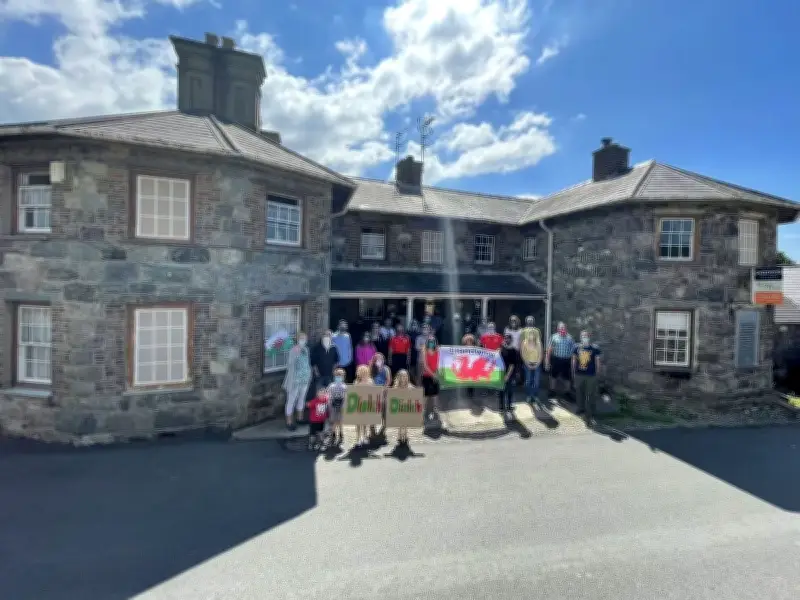
Five Welsh buildings have been included in a UK list of 25 projects compiled by the Architectural Heritage Fund (AHF) to mark its 50th anniversary. The selection spans five decades of AHF activity and illustrates heritage-led regeneration across the UK, with the Welsh projects including an art deco pier and Britain's finest surviving New Poor Law workhouse.
The AHF, a registered charity working since 1976, promotes the conservation and sustainable re-use of historic buildings for communities across the UK, particularly in economically disadvantaged areas. Through advice, grants, communications and loans, the charity supports heritage at the heart of local economies.
Llanfyllin Workhouse, Powys
Established in 1838, Llanfyllin Workhouse once sheltered some of the most vulnerable members of nineteenth-century Welsh society. The Grade II* listed building, known locally as Y Dolydd, is thought to be the finest surviving example of a workhouse constructed under the New Poor Law. After serving as a care home and briefly as an outdoor pursuits centre, it had fallen into abandonment before being acquired by the Llanfyllin Dolydd Building Preservation Trust with AHF support in 2004.
Today, while gradual restoration continues, the building offers Wales' only Workhouse Museum, a bunkhouse, café, venue and gallery, 20 workshops and studios, and an escape room, alongside guided tours, events, exhibitions and educational programmes.
Ty'n Llan, Llandwrog, Gwynedd
In 2017, the Ty'n Llan pub shut its doors, and the building stood vacant for more than three years before the community took action. Within months of the pub being listed for sale in 2021, residents of Llandwrog near Caernarvon had raised thousands of pounds, with celebrity backing and global support helping the shareholder scheme generate tens of thousands of pounds – sufficient to purchase the Grade II listed property.
The venture extended beyond saving the pub, with the site needing to include a restaurant with catering kitchen, five ensuite bedrooms, and a community space. In 2021, the AHF supported the building with a grant towards viability and development planning for community-focused reuse.
Penarth Pier Pavilion and Lower Treginnis Farm
Penarth Pier Pavilion, once rundown and unused for many years, underwent a major refurbishment from 2011 to 2013. It is now an art gallery and café and a gateway to the town's pier stretching into the Bristol Channel. The AHF says it has supported efforts to 'restore and sustain this landmark seafront building, helping to secure its future as a community cultural venue on the south Wales coast'.
Lower Treginnis Farm, at the most westerly point of the Welsh coastline with views of St David's Head, Ramsey Island, and St Bride's Bay, was heading for dereliction. In 1986, Farms for City Children, a charity founded by children's author Michael Morpurgo and his wife Clare in 1976, began a project to restore the farm and its early 19th-century outbuildings, including a focus on accessibility. The farm now welcomes six adults and up to 39 children and young people aged 8-19, particularly from underserved communities, who can enjoy the landscape and beaches and experience farm tasks, cooking and craft sessions.
Former St Luke's Church, Swansea
When Grade II listed St Luke's closed in 2014 and was damaged by water ingress, its future was uncertain until Circus Eruption, a free integrated youth charity in Swansea, found it as a potential new home. After buying the church in 2019, Circus Eruption reopened it in 2021 as a large, safe, and supportive space for young people to learn circus skills. The AHF supported the redundant church through grants enabling feasibility and development work.
Matthew Mckeague, chief executive of the Architectural Heritage Fund, said: "For fifty years, the AHF has worked alongside communities to give new life to historic buildings and to ensure that heritage remains at the heart of regeneration. These 25 projects are a snapshot of what that looks like across the UK. They are hugely different in scale, age and what they've become, while all sharing a similar spirit. They are united by the fact that local communities saw potential in a building that others had given up on, and found a way to bring it back."