
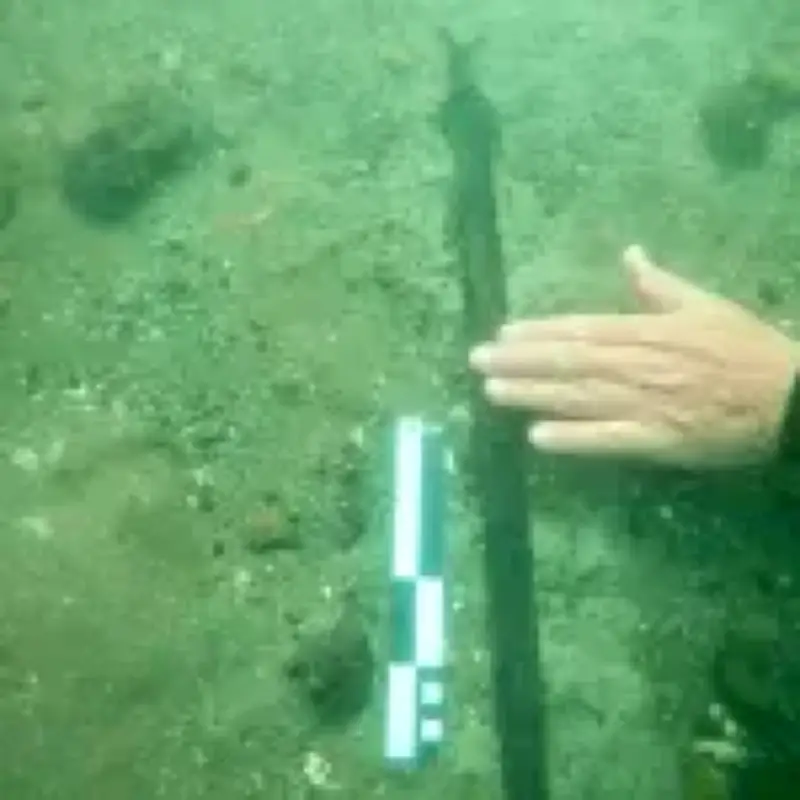
A perfectly preserved Bronze Age sword has been discovered in Lake Mezzano in Italy, the third such weapon found at the site, and archaeologists believe it may have been a deliberate cult offering.
The tang-tongue sword, known as a 'spada a lingua da presa', was found on 28 September in a relatively unexplored area along the lake's southern shore. The blade is the third sword recovered from Lake Mezzano since archaeological investigations began in the 1970s. Archaeologists working nearby also found intact pottery vessels and further bronze objects, including a razor and an axe.
Rare find in unexplored sector
According to Italy's Superintendency for Archaeology, Fine Arts and Landscape for Viterbo and Southern Etruria, the metal objects are being found at broadly consistent archaeological levels, potentially providing clues about how the deposits formed.
'Today's day has yielded an extraordinary find: a Late Bronze Age dagger, perfectly preserved, was identified this morning in a sector of the southern shore of the lake that has not yet been fully explored,' staff from the Superintendency for Archaeology said in a statement. 'The third dagger found since the beginning of the search in the 1970s makes us rethink the function of the numerous weapons found in the last two campaigns.'
Settlement beneath the waters
Lake Mezzano lies in the volcanic landscape of northern Lazio, west of Lake Bolsena. Beneath its waters are the remains of a large pile-dwelling settlement occupied during the Bronze Age, between about 1700 and 1150 BC. The site was first identified in the early 1970s and investigated intermittently until the 1990s. Systematic underwater research resumed in 2025 after a lengthy break.
Archaeologists mapped more than 600 wooden piles emerging from the clay lakebed, although the survey covered only about one-third of the known settlement. The renewed investigations have revealed an unusually large collection of metalwork, raising the question of whether weapons and other offerings were placed in the lake deliberately.
Metalwork and possible cult function
More than 25 bronze objects were recovered during the first campaign, including winged axes, spearheads, fibulae, rings, a pin and a well-preserved sickle. Fragments of bronze ingots have also raised the possibility that metalworking took place at the settlement. The discovery of a third sword adds another dimension to the finds, particularly given the number of other objects associated with weapons and metalworking.
One possible explanation is that the objects simply ended up in the water as the settlement deteriorated. Mezzano was a substantial lakeside settlement built partly on wooden structures. Archaeological evidence suggests objects could have fallen or rolled from platforms into the lake over many centuries. Objects could have fallen from wooden structures, moved down slopes or been redeposited as the shoreline changed.
However, the growing concentration of weapons is prompting researchers to investigate whether some objects may have been placed in the water deliberately. The two swords discovered at Mezzano before the latest find provide some context. The Museo della Preistoria della Tuscia e della Rocca Farnese in Valentano, which houses material from the site, describes the earlier swords as being in excellent condition. One had not been sufficiently hardened for practical use. Museum staff have interpreted it as a possible sacrificial offering rather than a weapon intended for combat.
The museum also associates later phases of the settlement with a possible cult function, during which bronze objects including swords, a spearhead and other valuable metalwork may have been deposited in or around the lake. There is currently no indication that the newly discovered sword was itself an offering.
Preservation and future research
Archaeological investigations at Lake Mezzano have recovered pottery, wooden artefacts, animal remains, grinding stones and structural timbers, providing an unusually detailed insight into Bronze Age life in central Italy. The oxygen-poor clay surrounding some of the finds has also contributed to their exceptional preservation. During the 2025 campaign, archaeologists reported bronze objects with remarkably well-preserved surfaces. The submerged settlement itself also appears to cover a considerably larger area than early investigations indicated.
Researchers are now examining how artefacts are distributed at different depths around the lake. Earlier material appears to have been found in deeper areas, while later remains are closer to the modern shoreline. This could provide evidence of how the settlement changed as water levels fluctuated. The latest sword was found in a part of the southern shore that had received comparatively little archaeological attention. Its discovery, together with intact pottery, an axe and a razor, suggests further artefacts could remain beneath the lakebed.
The question of how the weapons reached the water remains unresolved. Some may have belonged to a community whose buildings eventually collapsed or burned. Others may have been deposited deliberately for reasons that remain unclear. With three swords now known from Lake Mezzano, determining how and why they ended up beneath the lake is likely to be an important focus of future research.




