
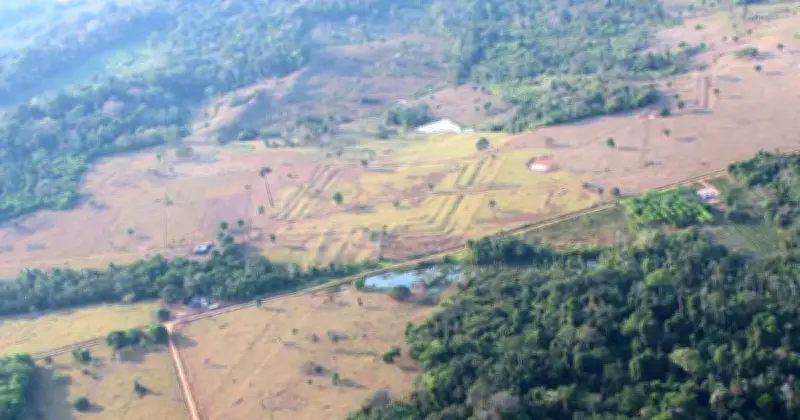
Archaeologists have uncovered a forgotten civilization beneath the Amazon rainforest that may have been mistaken for the legendary City of Gold, El Dorado. Using laser scanning technology, they identified hundreds of ancient earthworks built by a society known as the Aquiry, which may have numbered up to 3 million people.
Discovery of the Aquiry
The Aquiry emerged in what is now Brazil around 2,500 years ago and constructed vast geometric structures called geoglyphs across the rainforest. A study published in the journal Nature on July 29 revealed the results of a survey covering nearly 1,740 square miles (4,500 square kilometers), uncovering 396 previously unknown geoglyphs.
Researchers believe the scale of these monumental earthworks suggests the Aquiry was one of the most complex pre-Columbian societies in the Amazon, challenging long-held assumptions about ancient populations in the region.
Common worldview and ceremonial centers
“The cultures and societies that composed the Aquiry shared a common worldview and constructed ceremonial centers in a variety of monumental geometric forms, characterized by deep ditches and high outer embankments, commonly known as Amazonian geoglyphs,” Martti Pärssinen, an archaeologist at the University of Helsinki, told Live Science.
Pärssinen has studied geometric earthworks in Brazil’s Acre state for more than 20 years. In 2021, he formally introduced the name Aquiry for the ancient multicultural society, taking the name from the Acre River. The word Aquiry means “river of caimans” in the language of the Indigenous Arawakan people.
El Dorado legend
The legend of El Dorado—meaning “the gilded one” in Spanish—originated from a ritual where a native Muisca chieftain covered himself in gold dust and dove into a sacred lake. Spanish conquistadors misunderstood this ceremony, falsely believing El Dorado was a literal empire built entirely out of solid gold and hidden deep within South America.
This obsession triggered centuries of dangerous and destructive European expeditions into the Amazon, forever altering history in the pursuit of wealth that never actually existed.
Lidar technology reveals hidden structures
Because thick rainforest vegetation hides much of the archaeological record, modern-day researchers have relied heavily on lidar and airborne laser scanning technology to identify the remains of the civilization. The geoglyphs were built between 600 B.C. and A.D. 850, according to the study. The people who created them lived in large family longhouses near the earthworks and cultivated crops including maize and squash.
“According to native oral traditions, the Aquiry centers were built to foster relations among communities” and with important otherworldly beings, Pärssinen said. He added that the sites also acted as places for gatherings, political decision-making and displays of generosity by local leaders.
Population estimates and comparisons
Archaeologists have so far identified around 1,700 geoglyphs in the region, but researchers believe the true number could be far greater. They estimate more than 20,000 Aquiry earthworks may still be waiting to be discovered in unexplored areas. Based on an estimate that around 300 people were needed to construct and maintain each geoglyph, the researchers calculated that the civilization may have reached a peak population of between 1.25 million and 3 million people between A.D. 100 and 300.
The discoveries have drawn comparisons with the famous Nazca Lines of Peru, another collection of ancient geoglyphs created between 200 B.C. and A.D. 500. However, Pärssinen said the two cultures were likely separate. “The Nazca geoglyphs represent a different phenomenon and were probably unrelated to the Aquiry civilization,” he said. “Nevertheless, in both cases, the straight roads and lines, as well as the geometric forms and motifs, are best appreciated from the air.”
Mystery of collapse
The growing evidence of extensive ancient settlement in the southwest Amazon is forcing archaeologists to reconsider ideas about pre-Columbian societies and urban development. But one major mystery remains: what caused the Aquiry civilization to disappear? “We do not know why the geoglyphs were suddenly abandoned between A.D. 850 and 950,” Pärssinen said. “The available evidence points to a relatively rapid collapse” that may have coincided with the decline of other major pre-Columbian societies, he added, including “the Classic Maya in Central America and the Tiwanaku and Wari civilizations in the Andes.”




