
The National Trust for Scotland (NTS) has warned that a planned wind farm could have a “significant” impact on some island communities. The charity has set out its opposition to the proposed MachairWind development, which would see 91 to 144 turbines sited in waters to the north-west of Islay and to the west of Colonsay on Scotland’s west coast.
Developer ScottishPower Renewables has said the project could generate around two gigawatts (GW) of electricity – enough to power the equivalent of up to two million homes. If it gets the go ahead from the Scottish Government, the energy firm said the wind farm could be up and running by 2033.
NTS raises concerns over location and scale
The NTS has raised concerns about the impact the development could have on some of the island communities it cares for. A statement from the charity made clear it “supports the transition from fossil fuels to renewable energy, including the development of offshore wind”, but it added that such projects “must be at the right scale and in the right location to minimise negative impacts on communities, heritage, and nature”.
It added: “The trust does not agree that the MachairWind offshore wind farm is in the right location. The scale and magnitude of impact will be significant on island communities, landscape, marine mammals and environment, the tourist economy, habitability, and the cultural heritage of Iona, Staffa, and the Treshnish Isles, locations that are in the care of the trust.”
Bird populations and tourism at risk
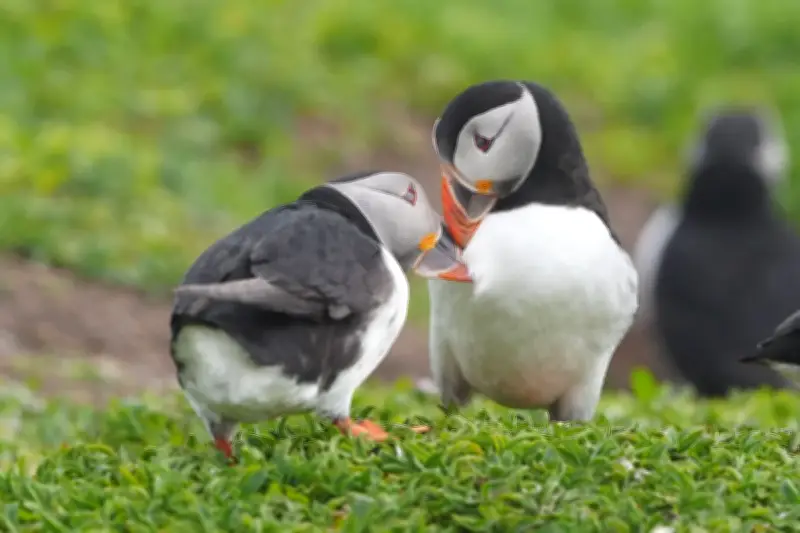
The NTS owns much of Iona, which is famous for sacred sites such as Iona Abbey, while Staffa, a national nature reserve also owned by the conservation charity, is famed for its puffin population and Fingal’s Cave. The Treshnish Isles, which are owned by the NTS, have been designated as a site of special scientific interest (SSI) and are said to be an important nesting site for puffins, guillemots, and razorbills.
The NTS said it is “concerned about the ornithological impact of the MachairWind development”, suggesting this should be “closely examined” when considering if the project goes ahead. It also raised concerns about the development’s socio-economic impact, warning tourism could be impacted if the turbines change the “character” of the landscape.
The NTS said: “The application suggests that tourism will not be affected, yet it omits key viewpoints from Iona, Staffa and the Treshnish Isles and therefore the impact it will have on landscape character.”
Developer responds to objections
ScottishPower Renewables says a “key aim” for the project is for the design to reduce “any impact on seascapes and views”. MachairWind project lead Kiera Wilson also insisted it could provide “long and lasting economic and social benefits across the islands”.
The wind farm could provide a boost for local ports, and local businesses, as well as supporting skills, training and employment in the area, she added. Ms Wilson said: “MachairWind is a vital green energy project that will deliver more clean power to the grid, strengthen the UK’s energy security and help drive economic growth. We believe it will deliver long and lasting economic and social benefits across the islands, west coast of Scotland and beyond, and have carried out extensive work to measure this as part of our consent submission.”
She continued: “There’s still a lot of detail to be finalised in consultation with various stakeholders – including local communities – but that could mean using a local port for marine operations, supporting local businesses to serve the offshore wind industry, and wider skills, training and employment opportunities that will develop as the project takes shape. We’ll also be setting up a community benefit fund if the projected is consented, shaped by local people for local people.”
But a spokesperson for local campaign group Hebridean Horizon hit back at the energy giant, saying: “ScottishPower Renewables’ claim that a ‘key aim’ for the project is for the design to reduce ‘any impact on seascapes and views’ would be laughable if this project was not going to industrialise what should be regarded as some of the most sacred and beautiful seascapes and landscapes in Scotland. How do you hide 91 Eiffel Towers? They had the chance to reduce the visual impact by building smaller turbines further from shore but they have declined to do so to maximise the eye-watering profits to be extracted from the Hebrides.”
The spokesperson continued: “We have invited the chairman of Iberdrola to visit Iona, to see where Saint Columba landed 15 centuries ago in the hope that he can see what we all see – that this is the wrong project in the wrong place and vague talk of community benefit is because ScottishPower Renewables are firmly on the back foot, in the face of overwhelming public rejection of the project, with objections from more and more surrounding island and now the National Trust for Scotland.”




