
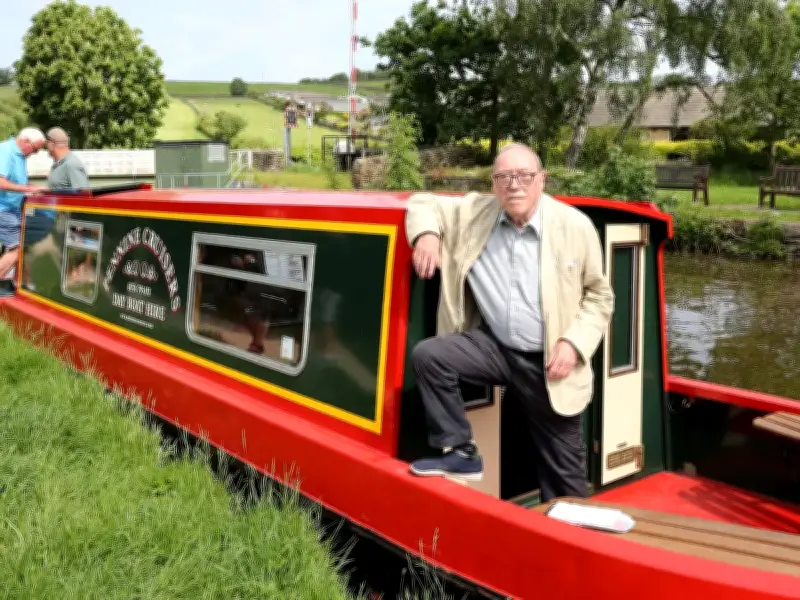
Severe summer droughts and canal bursts have left narrowboats stranded and sections of the 2,000-mile network closed to conserve water, according to journalist Paul Routledge in his new book For The Love of Canals.
More than fifteen million litres burst from the Llangollen Canal in Whitchurch, Shropshire, inundating fields and stranding narrowboats in the mud. Eight months on from that Christmas catastrophe, engineers are still working to reopen the waterway, which plays a key role in moving fresh water for public supply.
This year of unprecedented heatwave and drought has forced operators Canal & River Trust to close two dozen sections and impose low-water restrictions on many parts of the 2,000-mile system to conserve water and protect navigation. In another emergency move, until the end of August cruising boaters have been released from the legal obligation to cast off and move every fourteen days.
A 'perfect storm' of dry conditions
Campbell Robb, chief executive of the Canal & River Trust, warns of a “perfect storm” created by dry and hot conditions, with no rain for weeks on end, meaning that even where water is available, it can't be moved to where it's most needed.
It was never supposed to be like this, even in Britain's notoriously fickle weather. But the network of man-made waterways was built 250 years ago, when no one imagined we might one day have a Mediterranean climate. Routledge is not a boater, but he has been walking canal towpaths for decades, enjoying the peace and quiet – even in big cities – and the abundance of wildlife by the water's edge.
He is also fascinated by the extraordinary history and architecture of this feature of the landscape that powered the Industrial Revolution and now serves as a home and a playground for many thousands of fellow-enthusiasts.
From childhood memories to a new book
His towpath treks in all weathers, alongside waterways as diverse as the magnificent, 125-mile Leeds & Liverpool, the dried-up Somerset Coal Canal, and the idyllic Kennet and Avon, have now borne fruit in a book, For The Love of Canals, published 27 August by Mirror Books.
This love-affair began in childhood, when he would see tugboats on the Aire & Calder Navigation pulling long strings of “tom pudding” barges filled with coal from nearby collieries to power stations and export docks at Goole. In the 1950s, the canal was a word almost as dirty as the rubbish thrown into them. They were grubby highways of industry. Nobody wanted to live next to “the Cut”, as it was known to generations of working boatmen.
As commercial trade dried up in the sixties, so did the waterways. Of the 6,000 miles of navigable water, more than two-thirds were lost in a few years: filled in, paved over for car parks and built on. The nation was in danger of losing a priceless heritage, the product of great Georgian and Victorian architects, builders and pioneering scientists who imagined their work would endure as long as the Pyramids.
Pioneers and preservation
Men like James Brindley, regarded as the father of the narrow boat system – unique to the UK – who built the Bridgewater Canal, the nation's first modern waterway, to bring coal to Manchester, and the 1.65-mile Harecastle Tunnel on the Trent & Mersey, the longest man-made tunnel on Earth when built and still in use after two hundred years.
And Thomas Telford – the only pioneer to have a new town named after him, in Shropshire – who built the incomparable Pontcysyllte Aqueduct, soaring high above the valley of the river Dee, and now a UNESCO World Heritage Site: a frightening experience for boaters and towpath walkers alike. Too scary for Routledge!
And Scots engineer John Rennie, star of the “Canal Mania” years of the late 18th century, who not only constructed canals but created Staffordshire's tranquil Rudyard Lake to feed one of them.
That so much of their ground-breaking work remains fully operational today is not only a testimonial to their remarkable skill, but a tribute to a preservation movement that has saved so many canals from closure, and restored many more to navigation.
Their campaign, combined with an ambitious programme of work by the Canal & River Trust, continues apace. Thousands of volunteers toil away at weekends digging back where navvies once toiled. They have saved a national treasure, that keeps on giving – not least to television, with celebrity canal boat diaries aired at prime time.
The canal is a Mecca for creative people, bringing together artists, photographers and writers like the poet Ian Macmillan who has contributed a foreword and a poem to the book. For some years Routledge was fortunate to live in one of the most attractive places on the mighty Grand Union Canal.
Therein lay a mystery, solved when he retraced his steps to the towpath of his former home, Dudswell Wharf, close to the inland Port of Berkhamsted, barely thirty miles north of London.
He moved there in the early 1980s, to get away from the traffic on the busy A41 through the town (it's now by-passed), to a strange, half-timbered building that looks more like a farm building than a house. That's because it was, once. The home was originally part of a hay and coal merchant's business alongside a deep lock in the canal. Local gossip said it was also part of a pub, The Swan. Indeed, the bedroom had been a drinking den, not just a place for a newspaper man to lay his head after a hard day's toil in the pubs of Fleet Street, where he worked at the time.
For several years, he walked the towpath every morning from this idyllic setting to Berkhamsted station to catch a train to Euston, and the office of The Times. It was a two-mile slog in all weathers, dodging puddles to save his suit from the mud.
He was determined to relive that experience, and discover whether the old home was as he remembered it forty years before. It was. And not only was the wooden shelf above his bed where pints were once crossed to thirsty boatmen still there, but Ms Diana Holliday, the cellist lady to whom they sold the house in 1986, still lived there!
Little had changed, apart from a small conservatory with a view to the back garden where his hens once strutted, until the fox got them. The summer house built by his brickie brother John was now a music room. And his one-time neighbour Ned Hunt, just a school boy in those days, still lived in Lockside, the former pub, and is a rival canal historian. They should rename it the Grand Coincidence Canal!
As pledged, he did the towpath to “Berko” station. It took him more than twice as long as the old days, but then, he was twice as old and not rushing for a commuter train. The Grand Union is clearly in business, with many boats moored and others passing through the many locks. There's a new park, with a bench dedicated to Suzan, the late wife of his towpath comrade of the day, David Felton, another ex-Times journalist who took the pictures.
Future challenges and a call for action
It was all very nostalgic, and great for the book. But it set him thinking: what of the future? This is a serious issue. Canal owner-operator Canal & River Trust, a charity set up when the Tories wanted to privatise state-owned British Waterways in 1989, is strapped for cash and faces a downward spiral of government subsidy.
Robb seeks greater long-term investment for the network: not just for leisure and stay-aboard boaters but for water transfer, drought and flooding resilience and environmental protection. The canal, he argues, should be “a core part of the nation's climate change resilience plan.”
He's right. And not just climate change, but defence. The network was once a water-style Maginot Line against Nazi invasion in WW2, complete with concrete pill boxes that still survive.
A land invasion is unlikely, but the War on Iran shows that water, not just a useful transport link but vital for life as we know it, has been weaponised by both sides. That's why Routledge suggests in the book that the canal network should be declared a National Strategic Asset, funded in part by the Ministry of Defence.
Our canals are not just iconic heritage. They are the biggest and most ubiquitous reservoir of water imaginable. Island Britain needs them. Meanwhile, best foot forward on the towpath. There's no better way to see this wonderful country. A million footfalls every year – official – can't be wrong.
For The Love Of Canals (Mirror Books, £12.99) is on sale August 27th.




