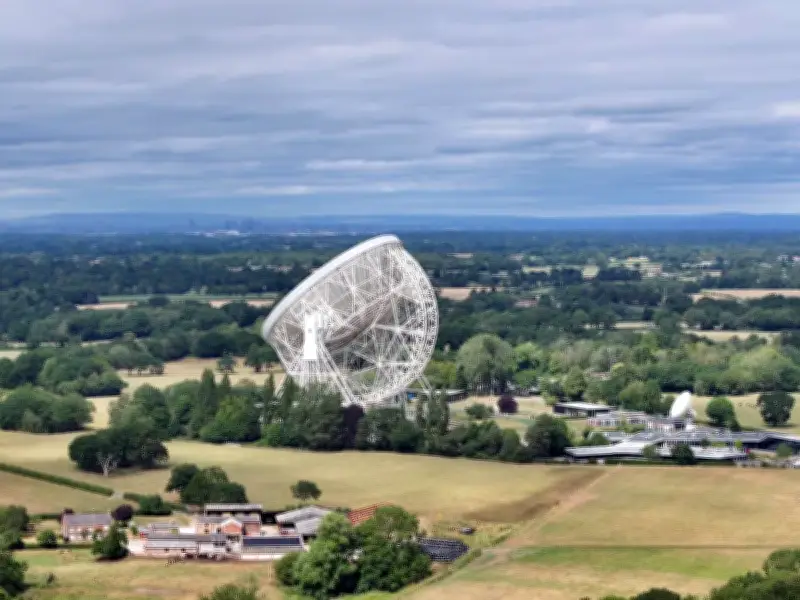
UNESCO has thrown its support behind Jodrell Bank Observatory, as funding cuts threaten the working future of its iconic Grade I-listed Lovell Telescope.
In a statement issued exclusively to the Manchester Evening News, the body said it was 'premature to speculate' on whether the Government's cuts could ultimately affect the observatory's coveted World Heritage status, bestowed on Jodrell Bank in 2019 due to its significance to astronomy globally.
UNESCO said it hasn't 'officially been notified of any development' in terms of the site's future funding, but confirmed it was attempting to liaise with 'UK authorities to gather information related to the conservation, management and future use of the property'.

World Heritage status and funding
The awarding of World Heritage status isn't decided by a site's funding model alone. But, crucially in the case of Jodrell Bank, it depends on whether a site continues to be able to operate in the manner that led to the status being awarded in the first place.
The University of Manchester, which manages the observatory, said the funding cut - worth around £2.8m a year - would mean the end of the Lovell Telescope as an 'active scientific instrument for radio astronomy' by March 2028, and the loss of 28 jobs.
In a detailed statement, UNESCO described Jodrell Bank as being 'recognised as an outstanding scientific and technological ensemble that bears exceptional witness to the development of radio astronomy' - and said it would be monitoring further developments closely.
Campaign to save the telescope
The news comes as a Manchester Evening News campaign to help save the Lovell Telescope, a much-loved landmark which dates back almost 70 years, climbs past 9,000 signatories.
UNESCO stands for the United Nations Educational Scientific and Cultural Organisation. Based in Paris, it's part of the UN and works to promote and preserve the natural environment and cultural heritage sites around the globe, alongside its educational and science-based programmes.
UNESCO names landmarks it considers to have 'outstanding value to humanity' as World Heritage sites, bringing enhanced protection and status for them. The body is said to be able to intervene when sites are in danger of destruction or damage.
UNESCO statement and future implications
A UNESCO spokesperson said: "UNESCO is aware of recent media reports concerning the future of scientific activities at Jodrell Bank Observatory, but the organisation has not officially been notified of any development. It would therefore be premature to speculate on any potential implications for the property’s World Heritage status."
The spokesperson added: "UNESCO will continue to engage with the UK authorities to gather information related to the conservation, management and future use of the property. Should circumstances evolve, the Organisation would follow the procedures established by the Operational Guidelines of the World Heritage Convention in consultation with the UK."
The Science and Technology Facilities Council announced the multi-million pound funding cuts in July, prompting outcry from politicians, astronomers and scientists across the world, music stars and celebrities who have performed at Jodrell Bank - and the family of the late Sir Bernard Lovell, who created the space observatory and designed the telescope.
The Lovell Telescope opened in 1957 and remains the largest in the UK. It's part of the e-Merlin array, a network of telescopes up and down the country which is operated by the university from the site on the Cheshire plains.
UK Research and Innovation (UKRI) said e-Merlin would not be prioritised for further funding by the Science and Technology Facilities Council after its current agreement ends in March 2028. The decision puts the functioning of the Lovell Telescope and the e-Merlin array of telescopes - and the science being worked on within them, at risk. The grant funds the 28 jobs, which would be lost unless alternative funding can be found.

The Manchester Evening News reported earlier this month that the Government was refusing to intervene to protect the observatory from the cuts, saying Jodrell Bank was 'not closing'. As Prime Minister Andy Burnham faced calls to step in, the Department for Business, Innovation, Science and Trade (DBIST) said Jodrell Bank would continue to host scientific research and remain the headquarters for the Square Kilometre Array Observatory – a global partnership building the world's largest and most powerful radio telescope. The Jodrell Bank Centre for Engagement, the visitor centre, is a separate entity and is not at risk as a result of the cuts.