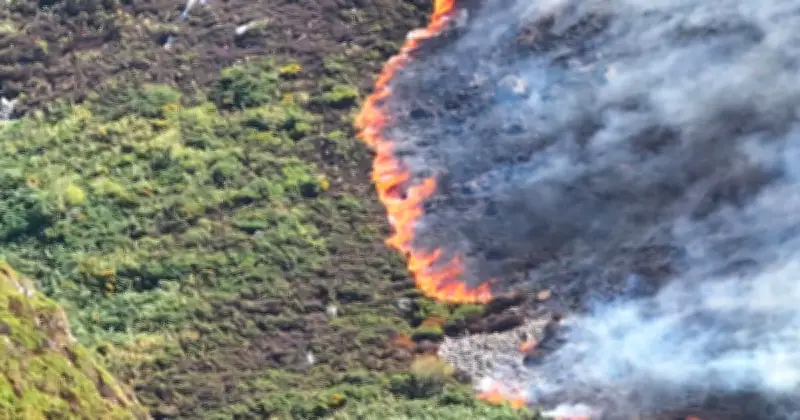
Major incidents have been declared in England and Wales as heatwave conditions create an “exceptional” wildfire risk, leading to home evacuations and ongoing firefighting efforts across the country.
Evacuations in North Wales
People were evacuated from their homes in Conwy, north Wales, after a wildfire spread across a mountainside, turning the sky black with smoke. A major incident was declared in the early hours of Sunday, with residents near Conwy Mountain urged to flee and others told to “keep windows and doors closed”.
North Wales Fire and Rescue Service reported working in “challenging conditions” to contain the blaze, with the effort “expected to continue for some time”. Officials stated it was too soon to say when residents could return to their homes.
Three-Week Blaze in Derbyshire
Fire chiefs also declared a major incident in Glossop, Derbyshire, three weeks after a large-scale wildfire broke out. Derbyshire Fire and Rescue Service said the blaze was caused by “tinder dry” ground and has affected around 260 hectares of moorland and woodland.
The response has involved dropping water from helicopters as the fire escalates amid hot conditions and high winds. Ellie Gillat, area manager for the fire and rescue service, said firefighters were still “working to tackle the wildfire and protect the surrounding infrastructure and environment”. “This remains a significant and complex incident, requiring a protracted, multi-agency response,” she added.
Exceptional Wildfire Risk Across England
Natural England’s Fire Severity Index has put much of England at “very high” risk of wildfires, with some areas in the south and the Midlands at “exceptional” risk. Fires have also broken out in London, Greater Manchester, County Durham, Sussex and Somerset.
The National Fire Chiefs Council (NFCC) said emergency services were tackling 19 active wildfire incidents at the start of the week. The body also noted that Staffordshire Fire and Rescue Service and West Midlands Fire Service were taking precautions to manage exceptionally high demand.
Dave Swallow, NFCC wildfire deputy lead, said dry, hot and sunny conditions “significantly increase risk”. He warned that “most wildfires start because something provides the spark”. “Whether it is a disposable barbecue left behind, a discarded cigarette or even a glass bottle left in the sunshine, we all have a role to play in preventing them,” he said.
Heatwave Conditions Continue
The UK is entering its second consecutive week of heatwave conditions, with north west, south west, south east, East Midlands, West Midlands, east of England and London all given yellow heat-health alerts by the UK Health Security Agency (UKHSA). This means significant impacts are likely across health and social care services because of the heat, including a rise in deaths, particularly among those aged over 65 or with health conditions.
The Met Office has confirmed that 2026 is the first year to record over 35°C on six separate days, breaking the previous record set in 1976 and 2020, when temperatures exceeded the threshold for five days. This year is also the first to see temperatures of 35°C or higher in three calendar months, and broke the record for the most temperatures of 34°C or higher, with nine so far this summer.